On eBird ↗
White-winged Swallow
Live sightings near you, the range map, bar charts of when it is seen, and Macaulay Library photos and recordings.
White-winged Swallow
Tachycineta albiventer
The white-winged swallow (Tachycineta albiventer) is a resident breeding swallow in tropical South America from Colombia, Venezuela, and Trinidad south to northern Argentina. It is not found west of the Andes. This swallow is largely non-migratory.
From the article White-winged swallow on Wikipedia (CC BY-SA), quoted section by section
Description
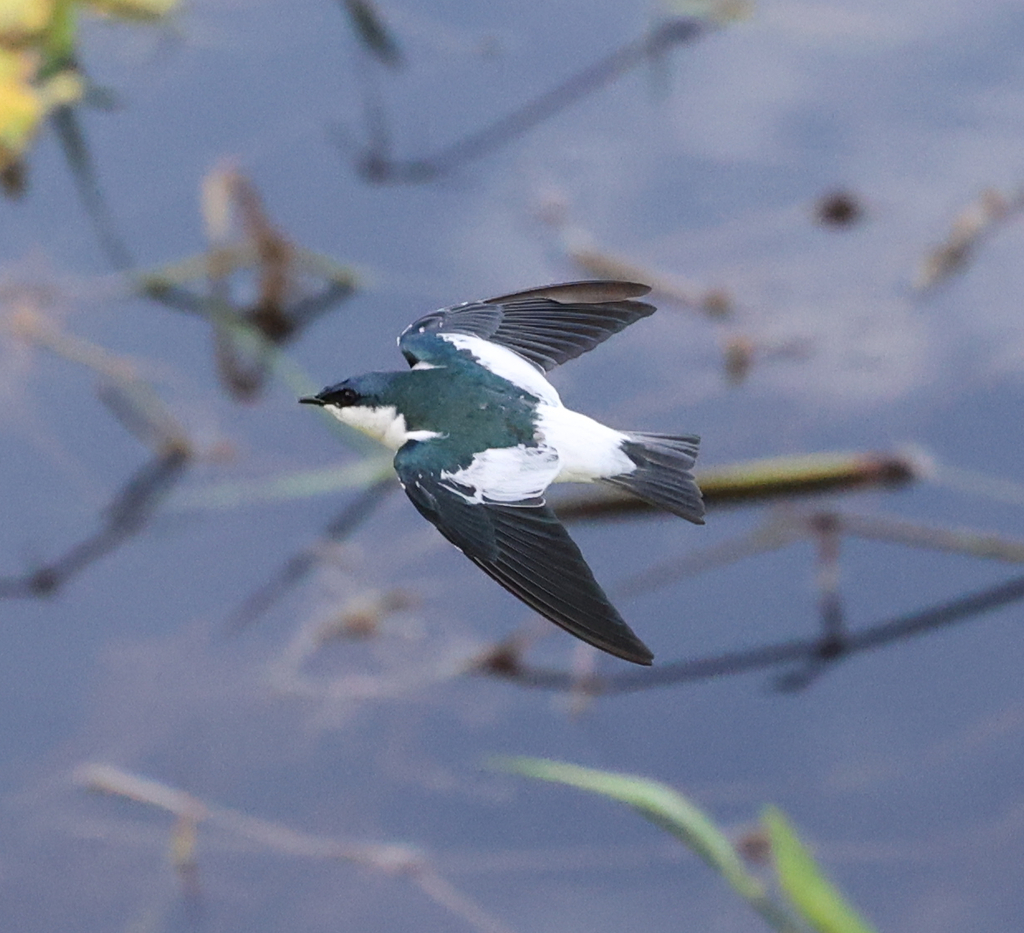
The adult white-winged swallow is 14 cm (5.5 in) long and weighs 14–17 g (0.49–0.60 oz). It has iridescent blue-green upperparts, white underparts and rump, and white edgings to the secondary flight feathers. The wings are otherwise black, along with the tail. It has dark brown eyes and a black bill and legs. The sexes are similar, although it is noted that the females have slightly less white on the wing. Juveniles have grayer underparts and are duller in general when compared to the adults. The juvenile also has less white on the wing. White-winged swallows can be distinguished from the similar mangrove swallow by the lack of a white line above its lores and a greater amount of white on its wings. The call is a harsh chirrup or a repeated, rising, buzz-like zweeed. The alarm call is short and harsh.
Range & habitat
The white-winged swallow is native to Argentina, Bolivia, Brazil, Colombia, Ecuador, French Guiana, Guyana, Paraguay, Peru, Suriname, Trinidad and Tobago, and Venezuela. Occasional vagrants reach Panama. They are usually not found on the Pacific coast, especially in the southern portion of South America. The species is usually found in or near lowland areas along bodies of water such as rivers or lakes, at elevations of about 500 m (1,600 ft). It is resident in most of its range, although in the most southerly part it is migratory. In Brazil and Argentina, it is only present from approximately mid-September to mid-April. Where this population winters is not well known, but it is most likely in the Guianas, Venezuela, and Colombia.
Wikipedia: “Distribution and habitat”
What it does
The white-winged swallow feeds primarily in flight at a low altitude, catching flying insects. It usually forages over water but may also feed over land. In between foraging attempts, it usually perches on branches near bodies of water. Flight paths are direct and they fly with a flapping flight.
Wikipedia: “Food and feeding”
Listen
Looking for field recordings…
Where it lives
Recorded sightings
—
geo-referenced records in GBIF, from museums, herbaria and field observers.
Drag the globe to turn it. Dots are where records exist, not a range map; darker means more records.
In the stacks
Searching the stacks…
Every page naming Tachycineta albiventer in the Biodiversity Heritage Library →
This page is assembled live from iNaturalist, GBIF, Wikipedia, the Source Library and the Internet Archive. It is not yet part of the hand-edited codex. iNaturalist taxon 11937.