- Plants
- ›Vascular Plants
- ›flowering plants
- ›Dicots
- ›beeches, oaks, walnuts, and allies
- ›birch family
- ›Corylus
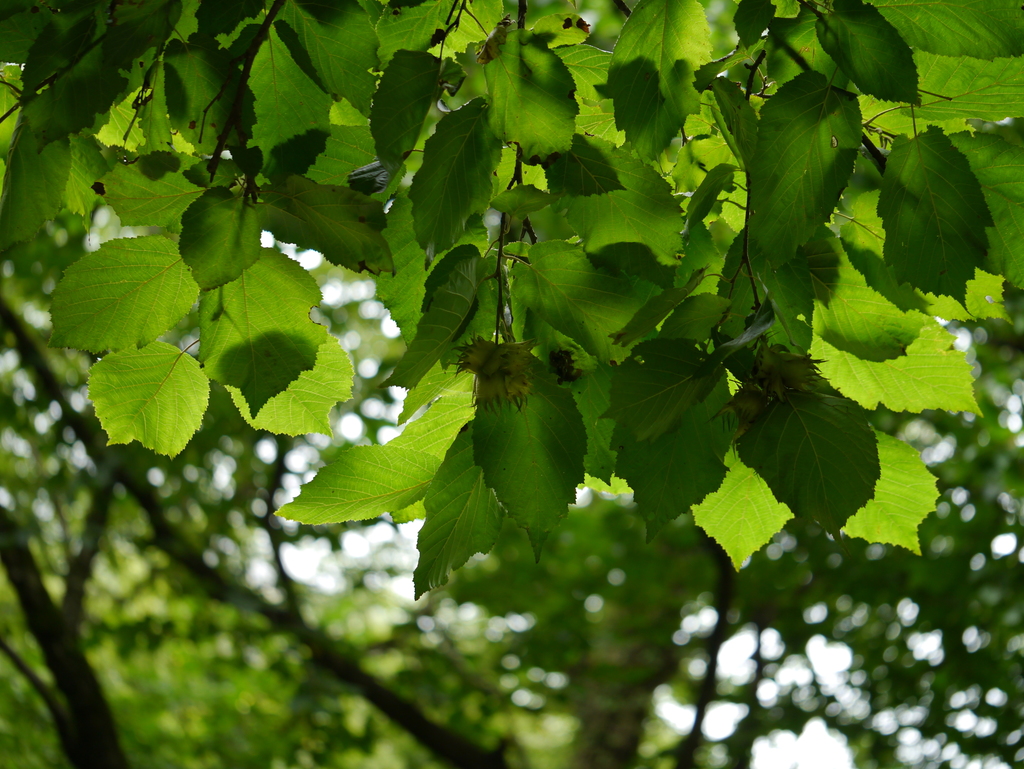
Corylus jacquemontii
Corylus jacquemontii (Jacquemont's hazelnut or Indian tree hazel) is a species of hazel, found in Asia, within the Himalayas and from Afghanistan through to W. Nepal. It is a small tree or shrub, with grey bark, ovate or obovate (teardrop-shaped) leaves, small flowers and small edible nuts, grouped in small clusters.
It has been used in many ways, not only as fuel source, fodder (for livestock) and timber but the trees also yield edible nuts for human consumption or for folk medicine uses.
From the article Corylus jacquemontii on Wikipedia (CC BY-SA), quoted section by section
Description
Corylus jacquemontii is a medium-sized, upright growing, deciduous tree. It grows up to 15–25 m (49.2–82.0 ft) tall. It has pale grey, or dark grey bark, which has deep vertical cracks that can help it be separated into small cork-like plates. The young twigs of the Corylus are yellowish-grey, rather sparsely pubescent (covered with short, soft hairs) and with longer, glandular hairs later in life. It flowers in India, between March and April. Elsewhere, it flowers between April and May. They are very, small flowers, in male catkins which are 2–4 cm (0.8–1.6 in) long and also female spikes, and they appear before the leaves. It has 6–15 cm (2.4–5.9 in) long and 5–12 cm (2.0–4.7 in) wide leaves, which are broadly ovate, or obovate (teardrop-shaped), with the tip of the leaf acuminate (tapering to a long point). They have double-toothed margins and are glabrous above (smooth) and pubescent under the veins below. They have a short petiole (leaf stalk), 12–25 mm (0.5–1.0 in) long. They are alternate spaced. It produces a seed capsule in a nut form, between September and October. They are produced in groups of 2–3, they are globose (rounded), and 12–16 mm (0.5–0.6 in) wide, with a thick shell. …
Range & habitat
Corylus jacquemontii is native to temperate and tropical areas between Europe and Central Asia.
Range. It is found in western Asia within Afghanistan, tropical Asia within India (in the states of Himachal Pradesh, Jammu-Kashmir, Uttaranchal), the Himalayas, and also Nepal. Some sources also add Pakistan.
Habitat. It is grows in moist oak forests, and shrubberies, and it is found at altitudes between 1,800 and 3,000 m (5,900 and 9,800 ft) above sea level, in the upper montane zones.
Wikipedia: “Distribution and habitat”
At the table
Corylus jacquemontii is used in many ways, not only as fuel (for house fires), fodder (for livestock) and timber (including logging,) but the trees also yield edible nuts for human as well as wildlife consumption. The edible nuts, of C. jacquemontii and Corylus colurna are often consumed by local human populations. Such as the Himalayan tribes, (Pangwal and Bhot of Himachal Pradesh). They are used either raw or cooked, and can be used with parched rice (dry roasted). Chauhan et al., (2014). An edible oil is also obtained from the seed. The nut is also used as a flavouring in various dishes. In the 1860s, Indian forester Hugh Cleghorn, recorded that nuts from this species were sold in the bazaar in Shimla, Himachal Pradesh, India. Also the wild animals; such as birds, insects, etc. also feed on the seeds of the species. After falling to the ground they can also eaten by small rodents like pica (such as Ochotona macrotis), flying squirrel, rats and even by the Himalayan brown bear (Ursus arctos isabellinus) as reported by Vaidya (2003). The leaves and young shoots are lopped (down) for use as cattle fodder, and as a fuel source along with maple (Acer spp.) and kharsu oak (Quercus semecarpifolia) in the Western Himalaya. It is used in folk medicine, such as a massage oil (made from the seed) of the species is used for relieving muscular pain. Nut rinds are used as dye. …
Wikipedia: “Uses”
How it is grown
This species is cultivated for its edible seed in Asia, and then nuts are distributed worldwide, but mainly to countries such as Turkey, Italy, Spain, France, Greece, India, Iran, Azerbaijan and China. It is generally an easily grown plant, as it succeeds in most soils, but is in general more productive of seeds/nuts when grown on soils of moderate fertility. As it does less well, in rich heavy soils or poor ones, It will grow well in a loamy soil. and is very suitable for alkaline soils, but it will not tolerate very acidic soils (a pH of below 7). Corylus jacquemontii trees are also fairly wind tolerant, and like other members of this genus, they can withstand transplanting well and they can be easily moved even when relatively large trees. They are cold hardy to USDA Hardiness Zone 5 (−20 °F to −10 °F). The trees could be used within gardens as an ornamental shade tree. Compatibility between Corylus jacquemontii, Corylus fargesii and Corylus ferrox have yet to be evaluated in hazelnut breeding programs. But it has potential as it is thought to have non-suckering rootstock. It maybe susceptible to EFB (Eastern Filbert Blight) but it had not yet been fully researched. Although a study in 2015 in the Republic of Georgia found the Corylus jacquemontii was susceptible to blight. Specimen trees have frequently set fruit (nuts) in Kew Gardens, UK.
Propagation. …
Wikipedia: “Cultivation”
Where it lives
Recorded sightings
—
geo-referenced records in GBIF, from museums, herbaria and field observers.
Drag the globe to turn it. Dots are where records exist, not a range map; darker means more records.
In the stacks
Searching the stacks…
Every page naming Corylus jacquemontii in the Biodiversity Heritage Library →
This page is assembled live from iNaturalist, GBIF, Wikipedia, the Source Library and the Internet Archive. It is not yet part of the hand-edited codex. iNaturalist taxon 1193972.