On eBird ↗
Fanti Sawwing
Live sightings near you, the range map, bar charts of when it is seen, and Macaulay Library photos and recordings.
Fanti Sawwing
Psalidoprocne obscura
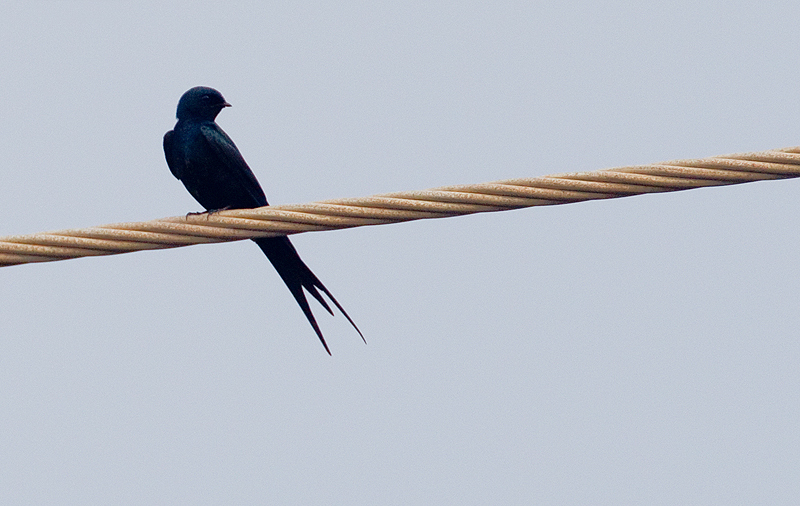
The Fanti saw-wing (Psalidoprocne obscura), also known as the Fanti rough-winged swallow, is a small passerine bird in the swallow family. The Fanti saw-wing is often described as the most beautiful of the swallows, owing to its uniformly shimmering green plumage.
From the article Fanti saw-wing on Wikipedia (CC BY-SA), quoted section by section
Description
This is a small swallow at 17 cm. Its plumage is glossy green. The tail is long and deeply forked. Sexes are similar, but the female has a shorter tail. Juveniles are brown with little gloss, and have short tails.
Range & habitat
The Fanti saw-wing breeds in the lowlands of southern west Africa from Senegal to Cameroon. It is mainly resident, apart from seasonal movements. This bird is found in open country, including light woodland, near water. Fanti saw-wings are graceful flyers and they generally feed on insects, including beetles, while airborne. They are typically seen low over water or grassland. The lined nests are built in a 60 cm burrow in a vertical bank. The clutch is two eggs.
Wikipedia: “Distribution and habitat”
Listen
Looking for field recordings…
Where it lives
Recorded sightings
—
geo-referenced records in GBIF, from museums, herbaria and field observers.
Drag the globe to turn it. Dots are where records exist, not a range map; darker means more records.
In the stacks
Searching the stacks…
Every page naming Psalidoprocne obscura in the Biodiversity Heritage Library →
This page is assembled live from iNaturalist, GBIF, Wikipedia, the Source Library and the Internet Archive. It is not yet part of the hand-edited codex. iNaturalist taxon 11949.