- Plants
- ›Vascular Plants
- ›flowering plants
- ›Dicots
- ›Roses, Elms, Figs, and Allies
- ›rose family
- ›Amygdaloideae
- ›Maleae
- ›Pyrus
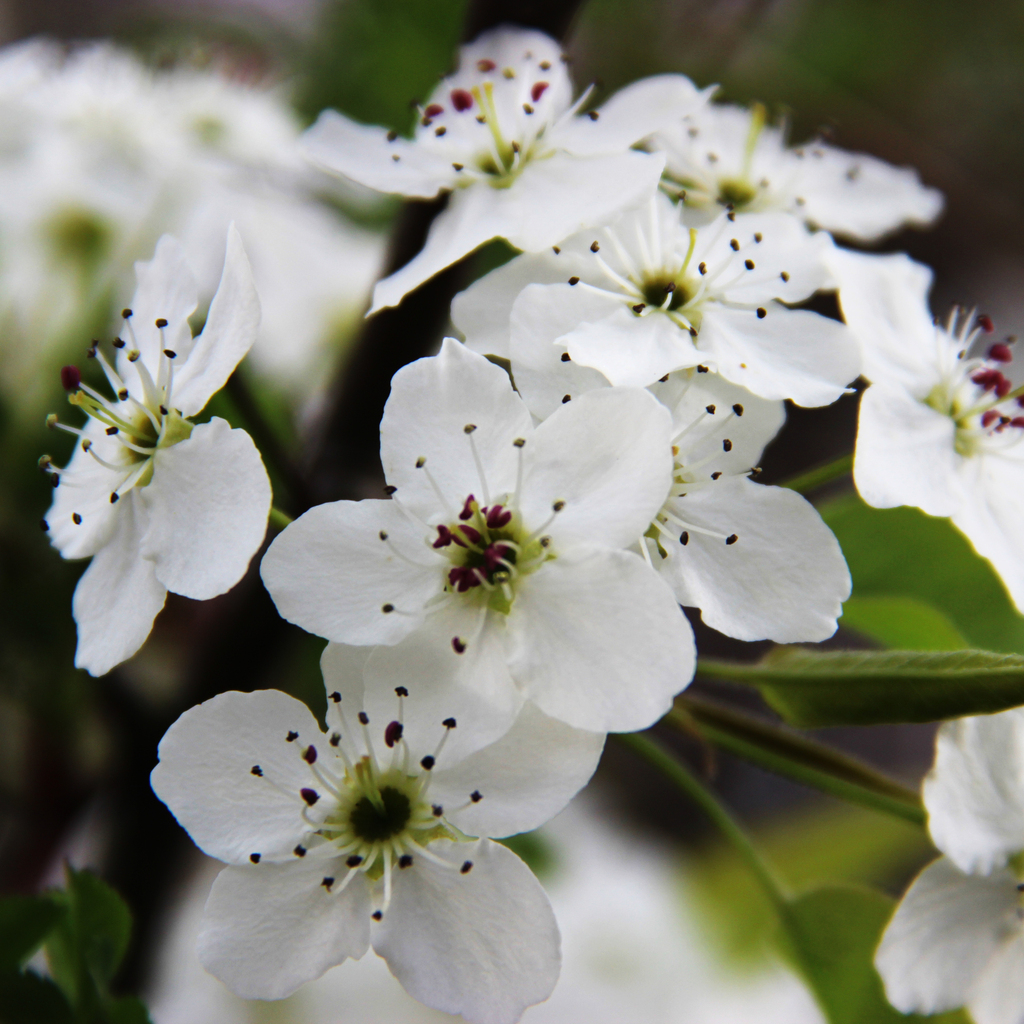
Callery pear
Pyrus calleryana
Pyrus calleryana, the Callery pear, is a species of pear native to China and Vietnam, in the family Rosaceae. It is a deciduous tree growing to 5 to 8 m (16 to 26 ft) tall, often with a conic to rounded crown. The leaves are oval, 4 to 8 cm (1.6 to 3.1 in) long, glossy dark green above, and slightly paler below. The white, five-petaled flowers are about 2 to 2.5 cm (0.79 to 0.98 in) in diameter. They are produced...
From the article Pyrus calleryana on Wikipedia (CC BY-SA), quoted section by section
Description
Pyrus calleryana is deciduous, growing to 5 to 8 m (16 to 26 ft) tall, often with a conical to rounded crown. The leaves are oval, 4 to 8 cm (1+1⁄2 to 3 in) long, glossy dark green above, and pale beneath. They have long petioles alternately arranged on branches. The white, five-petaled flowers are about 2 to 2.5 cm (3⁄4 to 1 in) in diameter. They are produced abundantly in early spring, before the leaves expand fully. The fruits (which are often assumed to be inedible due to their abundant, cyanide-laced seeds) of the Callery pear are small (less than 1 centimetre (3⁄8 in) in diameter) and hard, almost woody, until softened by frost, after which they are readily taken by birds, which disperse the seeds in their droppings. When fully softened, their fruit pulp is palatable to humans as well. In summer, the shining foliage is dark green and very smooth, and in autumn, the leaves commonly turn brilliant colors, ranging from yellow and orange to more commonly red, pink, purple, and bronze. …
Range & habitat
It is native to mainland China, Japan, the Korean Peninsula, and Taiwan. It is reported as introduced in the United States, Canada, Iraq, and the Western Himalayas region of India.
Wikipedia: “Distribution and habitat”
At the table
Pear wood (of any species) is among the finest-textured of all fruitwoods. It is prized for making woodwind instruments, and pear veneer is used in fine furniture. Pear wood is also among those preferred for preparing woodcuts for printing, either end-grained for small works or side-grained for larger. Callery pear has been used as rootstock for grafting such pear cultivars as Comice, Bosc, or Seckel, and especially for Nashi. Pyrus calleryana was first introduced into the United States in 1909 and 1916, largely influenced by the dedicated research of Frank N. Meyer, plant explorer for the US Department of Agriculture, commonly known for the discovery of the Meyer lemon, for agricultural experimentation, antedating recognition in the 1950s of the species' potential as an ornamental plant. Often considered inedible, Callery pears tend to lose their astringency when bletted by fall frosts. Other potential ways to use the fruit include cooking and winemaking, similar to their botanical cousin quince.
Wikipedia: “Uses”
How it is grown
Numerous cultivars of Callery pear are offered commercially, including 'Aristocrat', 'Autumn Blaze', 'Bradford', 'Capital', 'Chanticleer' (also known as 'Cleveland Select'), 'New Bradford', 'Redspire', and 'Whitehouse'.
In the United States. The trees were introduced to the U.S. by the United States Department of Agriculture facility at Glenn Dale, Maryland, as ornamental landscape trees in the mid-1960s. They became popular with landscapers because they were inexpensive, transported well, and grew quickly. Lady Bird Johnson promoted the tree in 1966 by planting one in downtown Washington, DC. The New York Times also promoted the tree, saying, "Few trees possess every desired attribute, but the Bradford ornamental pear comes unusually close to the ideal." In much of North America, these cultivars, particularly 'Bradford', are widely planted as ornamental trees. The trees are tolerant of a variety of soil types, drainage levels, and soil acidity. Their crown shape varies from ovate to elliptical, but may become asymmetric from limb loss due to excessive and unstable growth rate. The initial symmetry of several cultivars leads to their attempted use in settings such as industrial parks, streets, shopping centers, and office parks. Their dense clusters of white blossoms are conspicuous in early spring, with an odor often compared to rotting fish or semen. …
Wikipedia: “Cultivation”
In human culture
The species is named after Italian-French missionary Joseph-Marie Callery (1810–1862), a sinologue who sent specimens of the tree to Europe from China.
Wikipedia: “Etymology”
Where it lives
Recorded sightings
—
geo-referenced records in GBIF, from museums, herbaria and field observers.
Drag the globe to turn it. Dots are where records exist, not a range map; darker means more records.
In the stacks
Searching the stacks…
Every page naming Pyrus calleryana in the Biodiversity Heritage Library →
This page is assembled live from iNaturalist, GBIF, Wikipedia, the Source Library and the Internet Archive. It is not yet part of the hand-edited codex. iNaturalist taxon 119793.