- Plants
- ›Vascular Plants
- ›flowering plants
- ›Dicots
- ›carrots, ivies, and allies
- ›ivy family
- ›Aralioideae
- ›Aralia
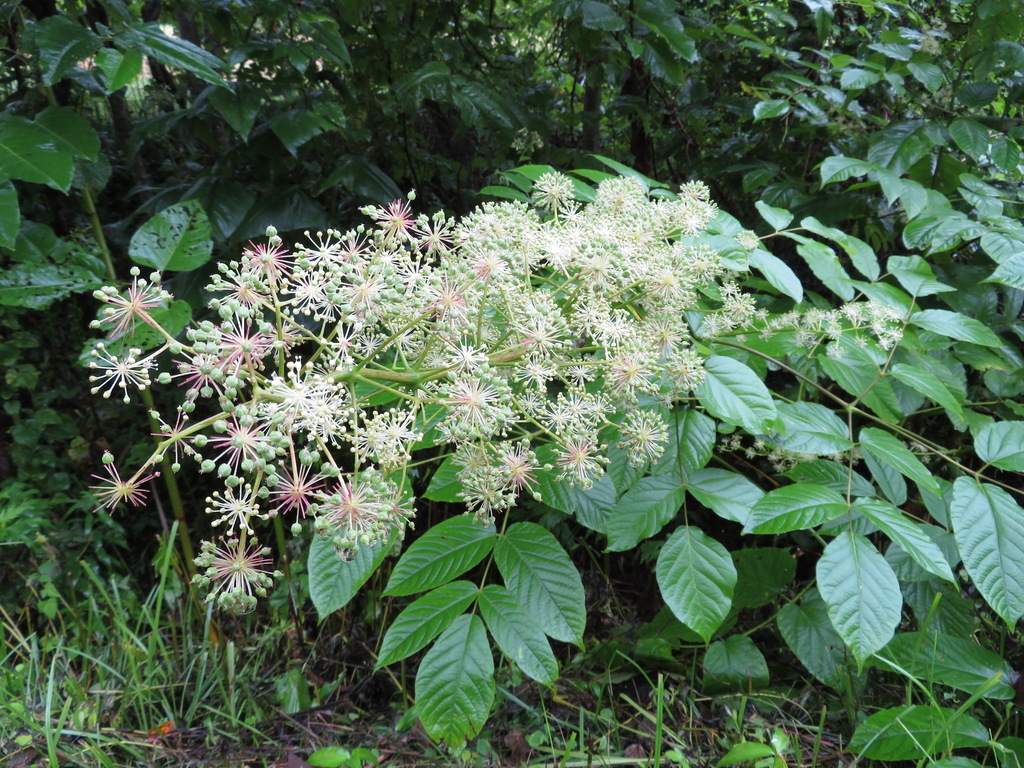
Aralia cordata
Aralia cordata is an upright herbaceous perennial plant growing up to 2 to 3 metres (6.6 to 9.8 ft) in height, native to Japan, Korea, Russian Far East, and eastern China. Its common names include spikenard, herbal aralia, udo (from Japanese: ウド), Japanese spikenard, and mountain asparagus. It is commonly found on the slopes of wooded embankments. Aralia cordata is a species of Aralia in the family Araliaceae.
The plant yields new shoots every spring, which are blanched and then eaten as a vegetable. In Korea, the dried root of the plant has been traditionally used as medicine. The young shoots have a strong yet pleasant distinct aromatic flavor. In addition to food and medicinal use, the plant is cultivated as an ornamental.
From the article Aralia cordata on Wikipedia (CC BY-SA), quoted section by section
Description
Aralia cordata is classified as a dicot and a eudicot. The leaves are alternate, large, and double to triple pinnate with leaflets 7 to 15 centimetres (2.8 to 5.9 in) long, and 5 to 10 centimetres (2.0 to 3.9 in) broad. The flowers are produced in large umbels of 30 to 45 centimetres (12 to 18 in) diameter in late summer, each flower small and white. The fruit is a small black drupe 3 millimetres (0.12 in) diameter, and may be toxic to humans. In the wild, the plant achieves a height of 1.2 to 1.8 metres (3.9 to 5.9 ft). It has golden leaves in the spring and an abundance of large bright green ones in the summer. It has a hefty and plump root stock with shoots 60 to 90 centimetres (2.0 to 3.0 ft) in length. It can reach optimal growth when planted in rich soil. During the summer it produces loose flower bunches 90 centimetres (3.0 ft) in length, which are attractive to bees and flies, making it ideal for beekeepers. It can be grown using seed or propagated from cuttings.
At the table
Per 100 grams of raw stem, Aralia cordata contains 220 mg of potassium, 7 mg of calcium, 9 mg of magnesium, 25 mg of phosphorus, 0.2 mg of iron, 0.1 mg of zinc and 4 mg of vitamin C.
Wikipedia: “Nutritional information”
How it is grown
Aralia cordata can be grown in normal, sandy, or clay soil with a neutral or acidic content of pH 5.0 to 7.5. Organic material should be added to clays and sands. It is an easy plant to grow, and does not require fertilizer. The plant grows rapidly, attaining a size up to 1.8 to 2.7 metres (5.9 to 8.9 ft) in height and width in a single growing season. It can tolerate freezing temperatures during winter, as it dies back and then re-grows in the spring, yielding for six years or more. It requires little labor; however the shoots require blanching if intended for food use. It must be grown in a climate of minimal to no drought, and can grow well in moist and rainy areas, and mountainous areas. It is generally grown in the wild, but can be grown in fields, cellars, or nurseries. The plant prefers light shade, but can grow in full shade, or in full sun, provided that it has a reliable water source.
The seed propagation requires numerous months of stratification for effective germination. Seeds generally do not germinate well directly after harvesting or in dry storage, but germinate well in cold moist sand. Low temperature treatments facilitate the germination process. Chilling treatments are useful to overcome the dormancy of seeds in dry storage. Domestic seeds germinate more effectively than wild ones. …
Wikipedia: “Growing conditions”
In human culture
Aralia cordata is widely grown for food in Japan. In the early 1900s it was imported into the United States; however, it did not become popularly commercialized. In Korea, the dried root has been traditionally used as medicine to treat inflammation, fever and pain.
Wikipedia: “History”
Where it lives
Recorded sightings
—
geo-referenced records in GBIF, from museums, herbaria and field observers.
Drag the globe to turn it. Dots are where records exist, not a range map; darker means more records.
In the old herbals & bestiaries

In the stacks
Searching the stacks…
Every page naming Aralia cordata in the Biodiversity Heritage Library →
This page is assembled live from iNaturalist, GBIF, Wikipedia, the Source Library and the Internet Archive. It is not yet part of the hand-edited codex. iNaturalist taxon 119830.