- Plants
- ›Vascular Plants
- ›flowering plants
- ›Dicots
- ›Legumes, Milkworts, and Allies
- ›Legumes
- ›Faboideae
- ›Desmodieae
- ›Desmodiinae
- ›Pedleya
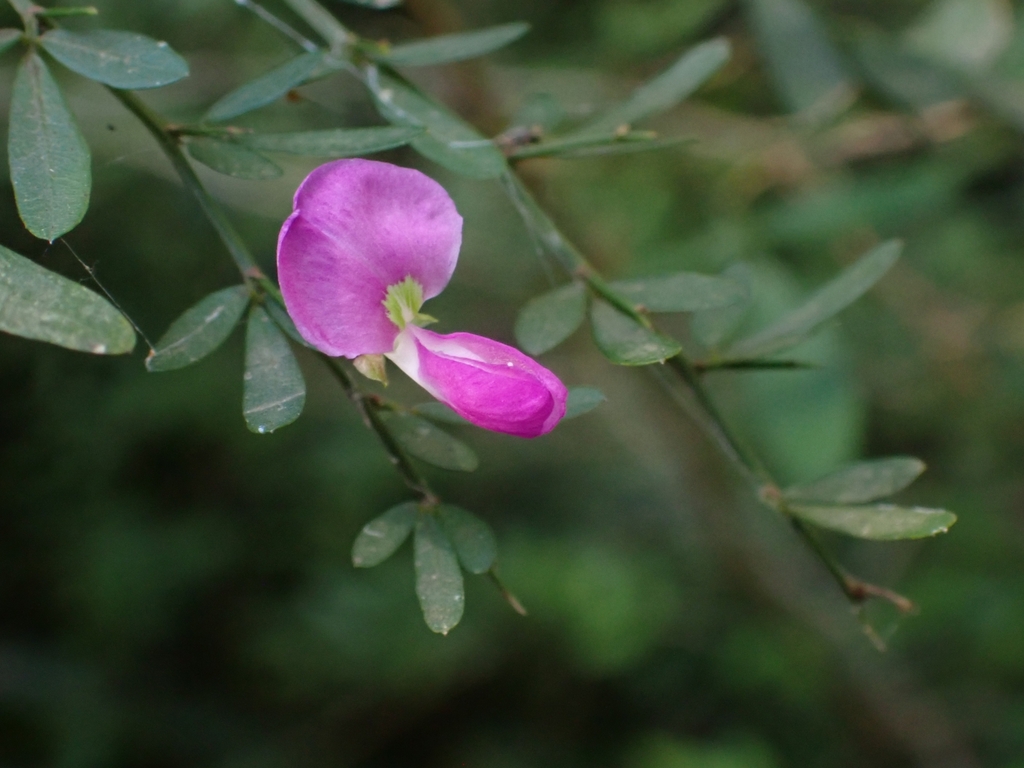
Pedleya acanthoclada
Pedleya acanthoclada, commonly known as thorny pea, is the only species of flowering plant in the genus Pedleya of the family Fabaceae. It is a small shrub with pink or purplish flowers, and leaves in groups of three.
From the article Pedleya on Wikipedia (CC BY-SA), quoted section by section
Description
Pedleya acanthoclada is a small shrub about 1 m (3 ft 3 in) high with stiff, smooth branches bearing thorns. The leaves are in groups of three and smooth, the middle leaf longer than lateral leaves, the apex rounded, the stipules about 1 mm (0.039 in) long and the petiole 2–4 mm (0.079–0.157 in) long. The pink to purple flowers are about 8 mm (0.31 in) long, in 1 or 2 pairs or clusters near the end of branches on a pedicel about 1 mm (0.039 in) long. Flowering occurs in summer and the fruit is a pod about 50 mm (2.0 in) long made up of 2-7 segments, each segment about 9–12 mm (0.35–0.47 in) long.
Range & habitat
Thorny pea is found growing mostly near rivers in the Lismore and Grafton regions of New South Wales.
Wikipedia: “Distribution and habitat”
Where it lives
Recorded sightings
—
geo-referenced records in GBIF, from museums, herbaria and field observers.
Drag the globe to turn it. Dots are where records exist, not a range map; darker means more records.
In the stacks
Searching the stacks…
Every page naming Pedleya acanthoclada in the Biodiversity Heritage Library →
This page is assembled live from iNaturalist, GBIF, Wikipedia, the Source Library and the Internet Archive. It is not yet part of the hand-edited codex. iNaturalist taxon 1198729.