- Animals
- ›Arthropods
- ›Hexapods
- ›Insects
- ›Winged and Once-winged Insects
- ›Cockroaches and Termites
- ›Typical Cockroaches and Termites
- ›Termites
- ›Typical Subterranean Termites
- ›Reticulitermes
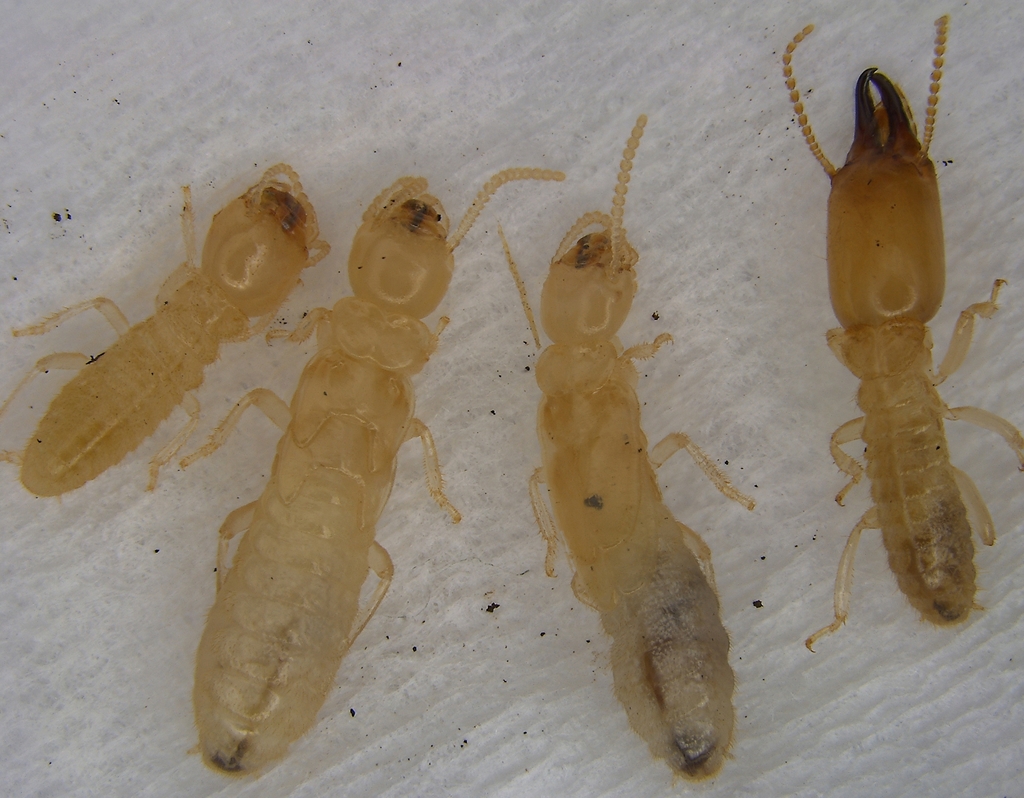
Eastern Subterranean Termite
Reticulitermes flavipes
Reticulitermes flavipes, the eastern subterranean termite, is the most common termite found in North America. These termites are the most economically important wood destroying insects in the United States and are classified as pests. They feed on cellulose material such as the structural wood in buildings, wooden fixtures, paper, books, and cotton. A mature colony can range from 20,000 workers to as high as 5 million workers and the primary queen of the colony lays 5,000 to 10,000 eggs per year to add to this total.
From the article Reticulitermes flavipes on Wikipedia (CC BY-SA), quoted section by section
Description
Eastern subterranean termites, like other social insects, share resources and divide labor based on a caste system. They live in loosely associated societies called colonies which are composed of both males and females. The termites in the colony are generally organized into the worker caste, the soldier caste, and the reproductive caste.
Worker caste. Workers are about 3 mm long and are blind, wingless, soft-bodied, creamy white to grayish-white with a round head. They make up the majority of the termites that actually eat the wood. They are sterile and forage for food and water, construct and repair shelter tubes, feed and groom other termites, care for eggs and young, and participate in colony defense.
Soldier caste. Soldier termites are also wingless and resemble workers except that they have a large, rectangular, yellowish-brown head with long black mandibles. The soldiers’ primary function is colony defense and the mandibles are mainly used for crushing enemy ants which may invade the colony. Additionally, R. flavipes has a fontanelle (frontal gland pore) on the forehead from which it secretes a blend of terpenoid compounds. These secretions are synthesised de novo and are also used to defend the colony from predators such as ants. The soldier caste only makes up 1 to 2% of the entire colony. …
Range & habitat
The eastern subterranean termite (R. flavipes) is the most widely distributed Reticulitermes species. It occurs throughout the eastern United States, including Texas, and can be found as far north as southern Ontario. In 2006, R. flavipes was also recorded in Oregon, on the West coast of the United States. Reticulitermes santonensis in France is now understood to be a synonym of R. flavipes. The species is now believed to originate in the southeastern United States and to be exotic or invasive in southern Canada, Europe (France, Germany, Italy, the Netherlands), South America (Uruguay, Chile), and the Bahamas.
Wikipedia: “Distribution”
What it does
R. flavipes are opportunistic, and a newly hatched termite can develop into any of a number of castes. At first, it becomes a worker termite and is most likely to remain one for its entire lifespan. Molting can change the worker into a pre-soldier and subsequently, a soldier. The soldier caste is a terminal stage which can no longer molt. R. flavipes also molts into nymphs, which are the precursors of winged adult termites called alates which are sexually mature. Nymphal termites are non terminal and can revert to the worker stage. These reverted nymphs are called pseudergates. Nymphs and workers can also develop into secondary and tertiary neotenic reproductives respectively.
Behavior. Because termites are social insects, they share many of their tasks. This can be seen throughout the caste system, where different castes take on different responsibilities for the betterment of the whole colony. R. flavipes cooperate in the rearing of young and also share their resources with the nest. Swarming is the sudden, dramatic appearance of R. flavipes alates in the daytime from February to April. After this behavior male and female alates lose their wings, pair up, and form new colonies. R. flavipes is mobile throughout its life and no permanent central nest area exists. Therefore, all termite castes can be found in any of the different sites occupied by a colony. …
Wikipedia: “Life cycle”
Listen
Looking for field recordings…
Where it lives
Recorded sightings
—
geo-referenced records in GBIF, from museums, herbaria and field observers.
Drag the globe to turn it. Dots are where records exist, not a range map; darker means more records.
In the stacks
Searching the stacks…
Every page naming Reticulitermes flavipes in the Biodiversity Heritage Library →
This page is assembled live from iNaturalist, GBIF, Wikipedia, the Source Library and the Internet Archive. It is not yet part of the hand-edited codex. iNaturalist taxon 119931.