- Animals
- ›Arthropods
- ›Hexapods
- ›Insects
- ›Winged and Once-winged Insects
- ›Ants, Bees, Wasps, and Sawflies
- ›Narrow-waisted Wasps, Ants, and Bees
- ›Ants, Bees, and Stinging Wasps
- ›Vespoid Wasps
- ›Hornets, Paper Wasps, Potter Wasps, and Allies
- ›Hornets and Yellowjackets
- ›Vespula
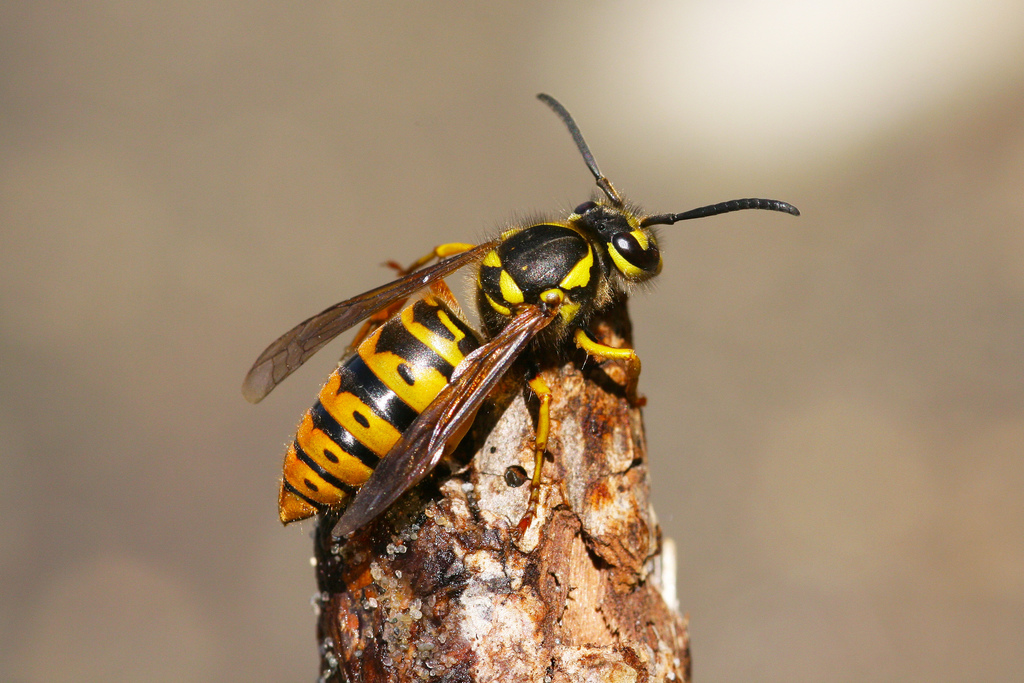
Eastern Yellowjacket
Vespula maculifrons
The eastern yellowjacket (eastern yellow jacket; Vespula maculifrons) is a wasp found in eastern North America. Although most of their nests are subterranean, they are often considered a pest due to their nesting in recreational areas and buildings. This yellow jacket is a social insect, living in colonies of hundreds to thousands of individuals. Along with their subfamily, Vespinae, this species demonstrates supportive parental care for offspring, separation of reproductive and sterile castes, and overlapping generations. They aggressively defend their nests from threats and are known to inflict painful stings.
From the article Eastern yellowjacket on Wikipedia (CC BY-SA), quoted section by section
Description
V. maculifrons can be differentiated from other wasp species due to its smaller size and abdominal pattern. The most recognizable features of V. maculifrons are the black and yellow lines on the head, thorax, and abdomen. While the body is curved and wider than the head, the abdomen narrows at its attachment to the thorax, which is thinner than the abdomen. The lines on the abdomen also differ based on caste, with the queens having one flared black line nearest the thorax followed by thinner black lines. Queens also have two black dots between each black line. Individuals of this species range in size from 12.7–15.9 mm (0.5–0.625 in). and weigh roughly 0.0014 oz (0.04 g). The queens are the largest, followed by the males, and then the workers. A V. maculifrons nest can range from 94–300 mm (3.7–11.8 in) in diameter, allowing for hundreds to thousands of workers inside. A large nest can contain 10,000 to 15,000 cells, with a little less than a third of them dedicated to the larger queen cells. The envelope of the nest is tan-brown to red-orange in color. It is constructed out of worn, decaying wood, which results in a fragile structure. These nests are typically subterranean, but have been found in various sites above ground, including buildings.
Wikipedia: “Description and identification”
Range & habitat
V. maculifrons is commonly found throughout eastern North America, extending as far as the Great Plains. In most areas where it is found, it is the most common yellowjacket species. In the spring, the queen selects where to locate the colony. Their subterranean nests are not deep, usually covered by less than 50 mm (2 in) of soil. However, nests have been found at depths ranging from just under the surface to 250 mm (9.8 in) deep. These nests are found in hardwood forests and on creek banks, as well as in urban and suburban areas. Within these areas, nests are typically built in sheltered places, which can include underground areas, tree stumps, and attics. Their nests are so frequently found in recreational and residential areas that they are considered a pest. The queen begins constructing and the initial structure of the nest by chewing wood and adding in saliva to make a quick-drying pulp to assemble the paper nest with. The first part of the nest constructed is the stalk, which eventually narrows into a cord before expanding again to form the first hexagonal cell. Other cells are then added to the sides of this first cell and an envelope is built around this first group of cells to form a miniature comb. The queen lays eggs in these cells and, once hatched, these become workers. …
Wikipedia: “Distribution and habitat”
What it does
Males of V. maculifrons tend to form loose aggregations, resembling leks, during mating. In one area, hundreds to thousands of males patrol prominent trees and bushes by constantly flying around them. Males typically patrol large areas randomly, rather than limiting to a few trees. If a male sees a female while patrolling, he flies closer to the female in a zigzag fashion and stops on a nearby leaf. This then allows the male to climb onto the female's gaster from behind. Other males do not try to approach an ongoing copulation, but a male might try to copulate immediately after. If a second mating occurs, sperm competition may favor the second male. As a result, males can prevent competition from another male by elongating copulation.
Wikipedia: “Male/male interactions”
Toxicity
Vespulakinins were first discovered in V. maculifrons. Yoshida et al 1976 discovered several of these bradykinin-like peptides including vespulakinin 1 and vespulakinin 2. They and the entire vespulakinin family are insecticidal and may prove useful for human purpose. Hymenoptera, the order (wasps, bees, ants, and sawflies) to which V. maculifrons belongs, is the leading cause of anaphylaxis in humans. Reactions are usually triggered by proteins in the venom.
Wikipedia: “Venom”
In human culture
Towards the end of the seasonal cycle, the gynes mate with multiple males. Then, around November to December, the colony begins to senesce. At this point, the queens undergo diapause, which is a dormancy period to avoid the adverse environmental conditions of winter. Few queens survive winter to start a new colony in the spring. Queens that survive winter typically exhibit larger overall body size, as well as a thin shape. However, specific genotypes and previous mating does not affect queen survival during this period.
Wikipedia: “Life history and survivorship curves”
Listen
Looking for field recordings…
Where it lives
Recorded sightings
—
geo-referenced records in GBIF, from museums, herbaria and field observers.
Drag the globe to turn it. Dots are where records exist, not a range map; darker means more records.
In the stacks
Searching the stacks…
Every page naming Vespula maculifrons in the Biodiversity Heritage Library →
This page is assembled live from iNaturalist, GBIF, Wikipedia, the Source Library and the Internet Archive. It is not yet part of the hand-edited codex. iNaturalist taxon 119994.