 NL·0615
Herbarium of the Nature Library
- Name
- Pavo muticus
- Family
- Phasianidae
- Native to
- Formerly NE India and Bangladesh to Southeast Asia and Java; now in fragmented populations in Yunnan (China), Myanmar, Thailand, Cambodia, Laos, Vietnam and Java
- Habitat
- Dry deciduous forest, Open woodland, Riverine forest
On eBird ↗
Green Peafowl
Live sightings near you, the range map, bar charts of when it is seen, and Macaulay Library photos and recordings.
Green peafowl
Pavo muticus
Also calledLǜ kǒngquè 绿孔雀 (Chinese) · Merak hijau (Indonesian/Malay) · Daung (Burmese)
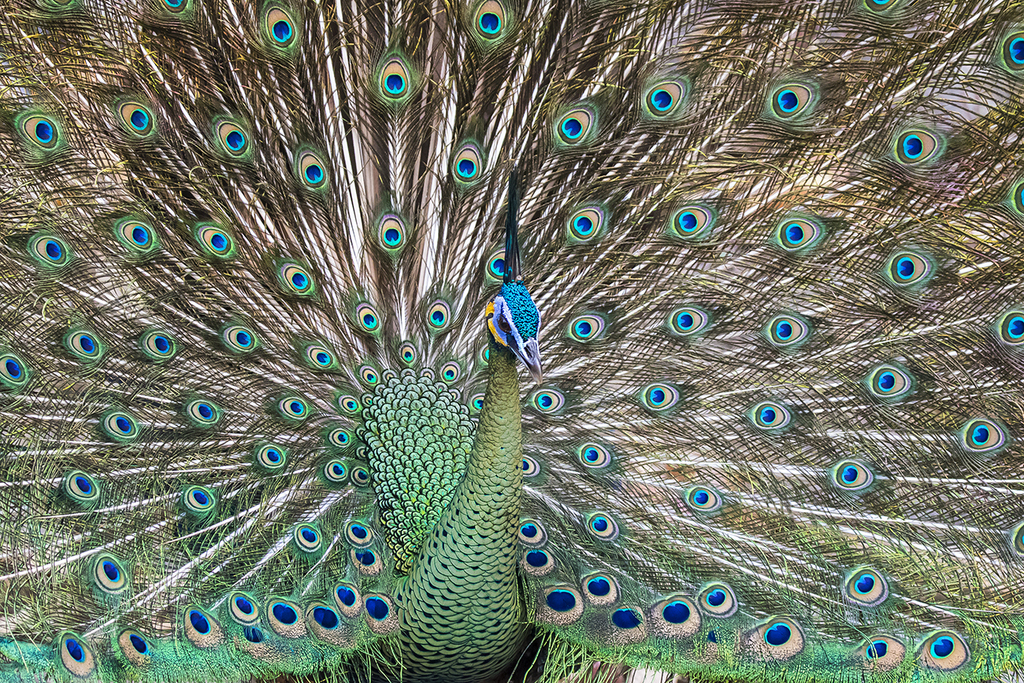
A tall, upright peafowl clad in shimmering green and bronze scales with a narrow tuft-like crest, the Southeast Asian counterpart of the Indian peafowl. Both sexes are brightly coloured, and the male carries a glittering train of eyespot feathers.
The green peafowl is a peafowl species native to the tropical forests of Southeast Asia and Southern China. It is the national bird of Myanmar. Formerly common throughout Southeast Asia, only a few isolated populations survive in Cambodia and adjacent areas of Vietnam. It has been listed as endangered on the IUCN Red List since 2009. This is primarily due to widespread deforestation, agriculture and loss of suitable habitat, severely fragmenting populations and contributing to an overall decline in numbers. The green peafowl is in demand for private and home aviculture and threatened by the pet trade, feather collectors and hunters for meat and targeted. Wikipedia
What it can do
- iMales raise a train of over 100 eyespotted feathers in display
- iiRoosts high in trees and calls loudly at dawn and dusk
- iiiCan fly strongly despite its size
In the field
Field marks
- aUpright, slim crest of tufts (not fan-shaped as in Indian peafowl)
- bGreen and bronze scaly neck and breast (not blue)
- cBare yellow-and-blue facial skin
- dFemales almost as colourful as males, but without the train
- Voice
- Loud, honking 'ki-wao' or 'aow-aaw', less shrill than the Indian peafowl
- Not to be confused with
- Indian peafowl male has a blue neck and fan-shaped crest, and the female is drab brown; hybrids ('Spalding' peafowl) occur in captivity.
- Where to see it
- Huai Kha Khaeng Wildlife Sanctuary (Thailand), Baluran National Park (Java), Cat Tien (Vietnam), and parts of Yunnan
- When
- Resident year-round; breeding display in the dry season
Listen
Looking for field recordings…
Life & habits
- Diet
- Seeds, grain, fruit, insects, small reptiles and frogs
- Habitat
- Open forest, riverbanks and forest edges with grassy clearings
- Size
- Males about 1.8–3 m including the train; females about 1–1.1 m
Feeds in clearings and on riverbanks in early morning and evening, retreating to dense cover; males display at traditional sites.
Where it lives
Recorded sightings
—
geo-referenced records in GBIF, from museums, herbaria and field observers.
Native range
Formerly NE India and Bangladesh to Southeast Asia and Java; now in fragmented populations in Yunnan (China), Myanmar, Thailand, Cambodia, Laos, Vietnam and Java
Drag the globe to turn it. Dots are where records exist, not a range map; darker means more records.
In the stacks
Searching the stacks…
Every page naming Pavo muticus in the Biodiversity Heritage Library →
Marginalia
The peacock was the emblem of the Burmese Konbaung kings and remains a national symbol of Myanmar.
Curiosity
A 2016 survey estimated fewer than 500 wild green peafowl left in China, all in Yunnan.
Kinship
Fact-checked: 2 corrections made to this sheet. Photographs: iNaturalist contributors under the licences shown. Records: GBIF.org. Historical plates: Source Library (CC BY-SA 4.0; originals public domain). Summary text: Nature Library editors and Wikipedia (CC BY-SA). Medicinal and edibility notes are historical and educational, not advice. iNaturalist taxon 1200.