- Plants
- ›Vascular Plants
- ›flowering plants
- ›monocots
- ›Agaves, Orchids, Irises, and Allies
- ›iris family
- ›Crocoideae
- ›Watsonieae
- ›Lapeirousia
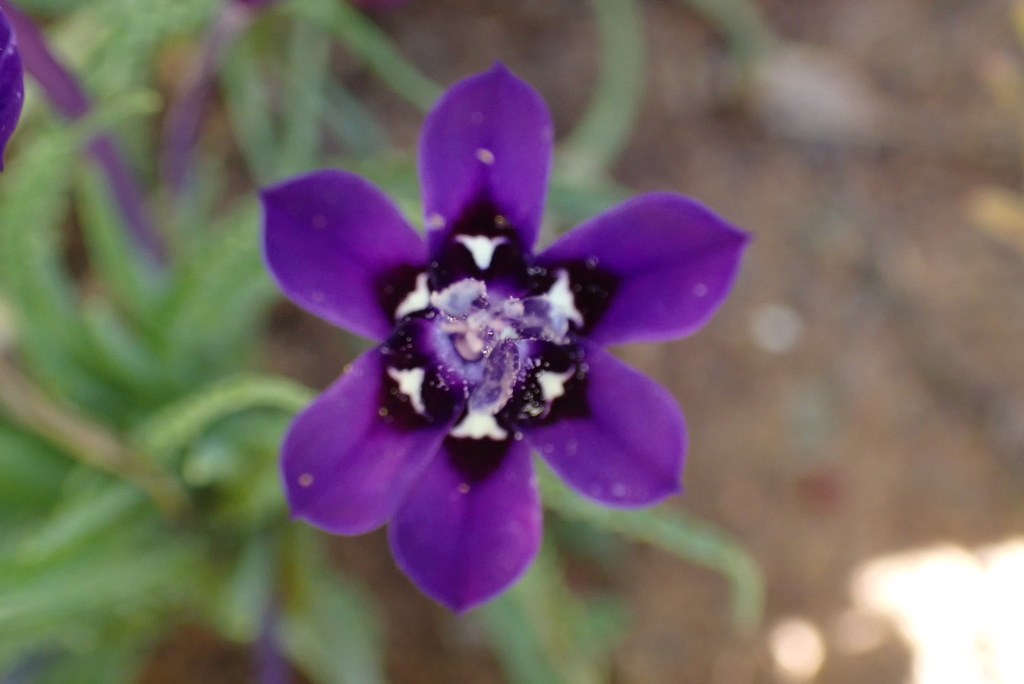
Cushion Kabong
Lapeirousia oreogena
Lapeirousia oreogena, known in English as cushion cabong and in Afrikaans as perskussing, is a species of tuberous geophyte in the Iris family, Iridaceae. It is found in a small area between the provinces of Northern Cape and Western Cape in South Africa. Lapeirousia oreogena was first described in 1897 by Rudolf Schlechter and then subsequently published in Contributions from the Bolus Herbarium by Peter Goldblatt in 1972.
The flowers of L. oreogena are pollinated by a single species of fly in the family Nemestrinidae, Prosoeca marinusi, a relationship described as one of the "most specialized systems" of coevolution among related plants. It is recognized by the Red List of South African Plants as being "least concern".
From the article Lapeirousia oreogena on Wikipedia (CC BY-SA), quoted section by section
Description
Lapeirousia oreogena is a tuberous geophyte in the Iris family, Iridaceae. It formerly was placed in the subgenus Lapeirousia, in the L. silenoides group, within the genus Lapeirousia, with recent genetic analysis showing that it belongs in Clade B, with its closest relative being Lapeirousia plicata. The plant grows out of a corm and lacks a stem, it is a perennial that reaches heights of 10 centimetres (3.9 in). It is described as a "striking species" by the Pacific Bulb Society, with linear to sword shaped outer leaves and undulated inner leaves. The leaves are described as being lanceolate in shape, ribbed, and tufted.
The flowers are actinomorphic, being star-shaped, rather than the two-lipped flowers that are common for the cabong genus Lapeirousia. The flowers of L. oreogena are protandrous, meaning the male sexual organs develop before the female. The flowers are scentless to the human nose. They are borne on an inflorescence at ground level, in the shape of a spiralling spike on slender, undulating bracts that are green in colour. Flowers per plant vary between year to year, in vigorous plants, they can have five spikes with up to 20 flowers per spike. …
Range & habitat
Lapeirousia oreogena has a fairly restricted distribution, on the northern extremity of the Cape Floristic Region of South Africa. It is found in clay soils in the Northwestern Cape region of South Africa. Namely the Calvinia District, to the Bokkeveld Plateau and the western Karoo, and Nieuwoudtville.
Habitat. Lapeirousia oreogena inhabits renosterveld on clay flats. In the Nieuwoudtville Wildflower Reserve, plants were found in dense patches in open grassy areas between boulder outcrops made of dolerite.
Wikipedia: “Distribution”
What it does
Lapeirousia oreogena is rhinomyophilous, a pollination syndrome referring to the pollination of flowers by flies with long mouthparts. The flowers of L. oreogena are pollinated by a single species of Nemestrinid fly in the genus Prosoeca, described as one of the "most specialized systems" of coevolution among related plants. 28 plants in the region converged to the same pollination syndrome as L. oreogena. The species of Prosoeca was formally named in 2018 as Prosoeca marinusi, which serves as the only or main pollinator for four species of plant. The flies hover in order to orient themselves and insert their proboscis into the tube. When the proboscis is inserted into the tube of sufficient length, as it feeds the fly grabs the tepals of the flower with all three pairs of legs through flexing its tibiae while the wings remain in motion. The pollinator fly is most active on mild and warm days from mid-afternoon and the early afternoon, and has a second flight period in the late afternoon. Flowers are visited between 3 and 5 seconds, pollen is adhered to the frons and thorax. It is the sole species that has pollen deposition on the frons and thorax, with other Lapeirousia species depositing pollen on the dorsum and upper frons. In order to facilitate the most efficient transfer of pollen, flies must be just out of reach of the bottom of the nectar tube. …
Wikipedia: “Pollination”
In human culture
The generic epiphet for the genus Lapeirousia is derived from Philippe-Isidore Picot de Lapeyrouse. The specific epiphet, oreogena, means "born of mountains." Lapeirousia oreogena was first described in 1897 by Rudolf Schlechter and then subsequently published in Contributions from the Bolus Herbarium by Peter Goldblatt in 1972. The English language name for the plant is "cushion cabong", in Afrikaans its name is perskussing, which means "purple cushion." It is also known as "purple laps" or "bluesy" in English. The Afrikaans name perskussing is shared with the related Babiana praemorsa.
== References ==
Wikipedia: “Etymology”
Where it lives
Recorded sightings
—
geo-referenced records in GBIF, from museums, herbaria and field observers.
Drag the globe to turn it. Dots are where records exist, not a range map; darker means more records.
In the stacks
Searching the stacks…
Every page naming Lapeirousia oreogena in the Biodiversity Heritage Library →
This page is assembled live from iNaturalist, GBIF, Wikipedia, the Source Library and the Internet Archive. It is not yet part of the hand-edited codex. iNaturalist taxon 120061.