- Plants
- ›Vascular Plants
- ›flowering plants
- ›monocots
- ›Aroids, Water Plantains, Seagrass, and allies
- ›Water-Plantain family
- ›Echinodorus
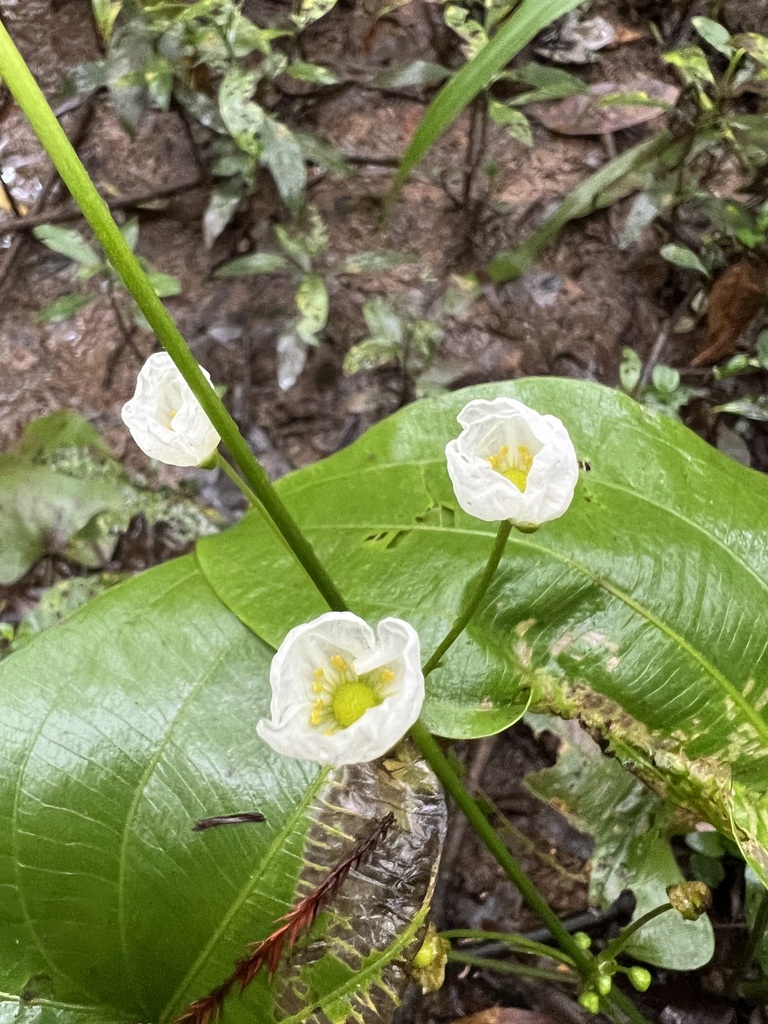
Creeping burhead
Echinodorus cordifolius
Aquarius cordifolius (formerly Echinodorus cordifolius), the spade-leaf sword or creeping burhead, is a species of aquatic plants in the Alismatales. It is native to Mexico, the West Indies, Central America, South America (as far south as Paraguay) and the southeastern United States (Texas to Florida and as far north as Iowa).
From the article Aquarius cordifolius on Wikipedia (CC BY-SA), quoted section by section
Description
Herbs, perennial, stout, to 100 cm (39 in); rhizomes present. Leaves emersed, submersed leaves mostly absent; petiole 5–6-ridged, 17.5–45 cm (6.9–17.7 in); blade with translucent markings distinct lines, ovate to elliptic, 6.5–32 ´ 2.5–19.1 cm, base truncate to cordate. Inflorescences racemes, of 3–9 whorls, each 3–15-flowered, decumbent to arching, to 62 ´ 8–18 cm, often proliferating; peduncles terete, 35–56 cm (14–22 in); rachis triangular; bracts distinct, subulate, 10–21 mm (0.39–0.83 in), coarse, margins coarse; pedicels erect to ascending, 2.1–7.5 cm (0.83–2.95 in). Flowers to 25 mm (1 in) wide; sepals spreading, 10–12-veined, veins papillate; petals not clawed; stamens 22; anthers versatile; pistils 200–250. Fruits oblanceolate, plump, 3–4-ribbed, abaxially 1-keeled, 2–3.5 ´ 0.9–1.5 mm; glands 3–4; beak terminal, 1–1.3 mm. 2n = 22. Echinodorus cordifolius is very easily recognized, as it is the only species with arching to decumbent inflorescences. In addition, it is the only one with papillate veins on the sepals.
How it is grown
Easily cultivated in neutral to soft water and tropical to sub-tropical temperatures. Rich substrate and good light. Common in the cultivated aquarium trade. Emersed plants readily produce flowers and seeds but it can be grown submersed as well. Most plants sold are grown emersed on plant farms. Once submerged, leaves may die off before underwater leaves develop. In the aquarium grow in the background as a specimen plant. Will soon outgrow a smaller aquarium but removing the floating leaves will help keep it smaller and submerse. Needs a large, deep aquarium to grow properly. CO2 infusion helps stronger growth. A heavy feeder and for optimum growth a rich substrate is needed, including clay. If grown emerse it is prone to attacks by aphids. Not fussy as to water conditions, tropical aquarium temperatures. Can be grown outdoors in warmer countries, won't tolerate frost. Likes a lot of light. Can be grown in or by the pond in warmer climes. The seeds can be sown in shallow water.
Wikipedia: “Cultivation”
Where it lives
Recorded sightings
—
geo-referenced records in GBIF, from museums, herbaria and field observers.
Drag the globe to turn it. Dots are where records exist, not a range map; darker means more records.
In the stacks
Searching the stacks…
Every page naming Echinodorus cordifolius in the Biodiversity Heritage Library →
This page is assembled live from iNaturalist, GBIF, Wikipedia, the Source Library and the Internet Archive. It is not yet part of the hand-edited codex. iNaturalist taxon 120212.