- Plants
- ›Vascular Plants
- ›flowering plants
- ›Dicots
- ›Mints, Plantains, Olives, and Allies
- ›Mint Family
- ›Ajugoideae
- ›Teucrium
- ›Teucrium core clade
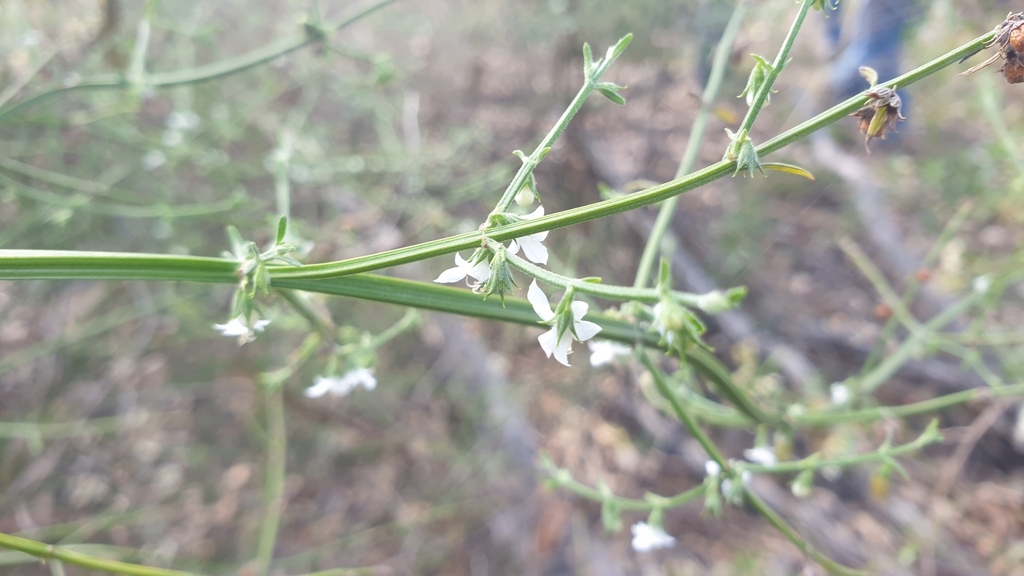
Teucrium betchei
Teucrium betchei is a species of flowering plant in the family Lamiaceae, and is endemic to eastern Australia. It is a perennial herb or undershrub with rod-like stems, linear to very narrow lance-shaped leaves and white flowers.
From the article Teucrium betchei on Wikipedia (CC BY-SA), quoted section by section
Description
Teucrium betchei is a perennial herb that typically grows to a height of 0.4–1 m (1 ft 4 in – 3 ft 3 in) and has rod-like stems that are square in cross-section. The leaves are arranged in opposite pairs, linear to very narrow lance-shaped, 10–40 mm (0.39–1.57 in) long, 1–4 mm (0.039–0.157 in) wide and more or less sessile. The flowers are mostly arranged in groups of three to five in upper leaf axils, each flower on a pedicel 1–3 mm (0.039–0.118 in) long. The five sepals are 4–6 mm (0.16–0.24 in) long, joined at the base for about half their length. The petals are white, the lower middle lobe 1–1.5 mm (0.039–0.059 in) long. Flowering mainly occurs in summer.
Range & habitat
Teucrium betchei grows in grassy woodland and on disturbed sites, mainly on the North West Slopes of New South Wales and the Darling Downs of south-eastern Queensland.
== References ==
Wikipedia: “Distribution and habitat”
Where it lives
Recorded sightings
—
geo-referenced records in GBIF, from museums, herbaria and field observers.
Drag the globe to turn it. Dots are where records exist, not a range map; darker means more records.
In the stacks
Searching the stacks…
Every page naming Teucrium betchei in the Biodiversity Heritage Library →
This page is assembled live from iNaturalist, GBIF, Wikipedia, the Source Library and the Internet Archive. It is not yet part of the hand-edited codex. iNaturalist taxon 1205701.