- Animals
- ›Molluscs
- ›Bivalves
- ›Autobranchia
- ›Heteroconchia
- ›Euheterodonta
- ›Imparidentia
- ›True Cockles, Tellins, and Allies
- ›Cardioidea
- ›true cockles
- ›Lymnocardiinae
- ›Adacnini
- ›Didacna
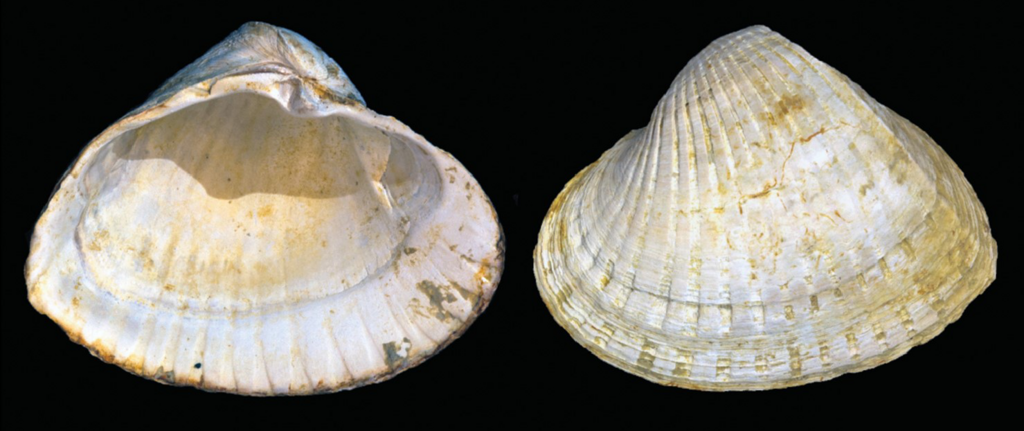
Didacna eichwaldi
Didacna eichwaldi is a brackish-water bivalve mollusc of the family Cardiidae, the cockles. It has an oval-triangular, rather thick, whitish or cream shell, up to 40–55 mm (1.6–2.2 in) in length, with flattened ribs and a distinctly sharp posterior ridge in juvenile individuals, which can be seen on the umbo in adults. The species is endemic to the Caspian Sea. It lives in the middle and southern parts of the lake at depths down to 35 m (115 ft) and...
From the article Didacna eichwaldi on Wikipedia (CC BY-SA), quoted section by section
Description
Didacna eichwaldi has an oval-triangular, thick, convex shell, with a moderately or strongly protruding umbo, 21–34 flattened radial ribs and a distinctly sharp posterior ridge in juveniles, which becomes smoother with age. The shell length is up to 40–55 mm (1.6–2.2 in), the height is up to 30–45 mm (1.2–1.8 in). The coloration is whitish or cream. The hinge consists of two cardinal teeth in the right valve and one cardinal tooth in the left valve. The juveniles sometimes have weakly developed lateral teeth.
Similar species. Didacna baeri has a more rounded oval shell, with a less protruding umbo and a smooth posterior ridge. Several fossil species resemble D. eichwaldi. Didacna nalivkini has a less elongated shell, with a less distinct posterior ridge on the umbo. Didacna eulachia differs by a more elongated and less equilateral shell, with a larger number of ribs. Didacna ovatocrassa has a less protruding umbo and a less distinct posterior ridge. The shell of Didacna subcrassa is less elongated.
Range & habitat
Didacna eichwaldi is endemic to the Caspian Sea. It lives in the middle and southern parts of the sea at depths down to 35 m (115 ft) and does not occur in desalinated areas.
Wikipedia: “Distribution and ecology”
Where it lives
Recorded sightings
—
geo-referenced records in GBIF, from museums, herbaria and field observers.
Drag the globe to turn it. Dots are where records exist, not a range map; darker means more records.
In the stacks
Searching the stacks…
Every page naming Didacna eichwaldi in the Biodiversity Heritage Library →
This page is assembled live from iNaturalist, GBIF, Wikipedia, the Source Library and the Internet Archive. It is not yet part of the hand-edited codex. iNaturalist taxon 1207349.