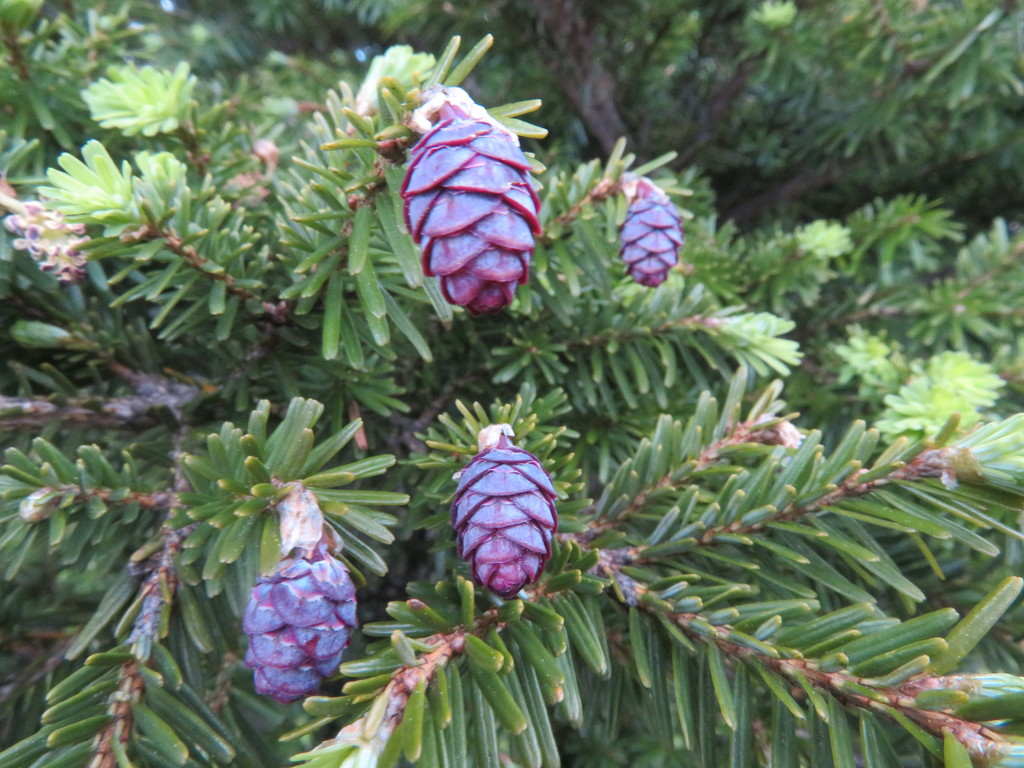
Chinese hemlock
Tsuga chinensis
Tsuga chinensis, commonly referred to as the Taiwan or Chinese hemlock, or in Chinese as tieshan (simplified Chinese: 铁杉; traditional Chinese: 鐵杉; pinyin: tiěshān; literally: "iron fir"), is a coniferous tree species native to China, Taiwan, Tibet and Vietnam. The tree is quite variable and has many recognised varieties, though some are also maintained to be separate species by certain authorities. The tree was recently discovered in the mountains of northern Vietnam, making that the southernmost...
From the article Tsuga chinensis on Wikipedia (CC BY-SA), quoted section by section
Description
Tsuga chinensis is a large tree with bark that is a blackish brown in colour. The scaly bark has irregular longitudinal breaks, and lenticels that are very inconspicuous. The outer bark is about 6 mm thick with alternating tiered layers of pale yellowish brown corky bark, and brown lignified fibrous bark. The newly formed periderm is a purplish red. The inner bark is about 4 to 5 mm (0.16 to 0.20 inches) thick and pale reddish brown in colour. It is fibrous in texture with minute, almost inconspicuous sclereid, or stone cell groups. The cambium as well as the newly formed phloem are nearly inconspicuous. Freshly cut wood is a pale yellowish white with inconspicuous wood rays. The branchlets that have leaf-cushions. The leaves are arranged spirally in a manner more or less 2-ranked. They are linear and flat in shape and olive green in colour. The upper side of the leaf is grooved and keeled, while the underside has 2 white stomatic bands. The apex of the leaves are emerginate and they measure 16 to 20 mm (0.63 to 0.79 inches) long. The petioles are crooked. The foliage is very similar to that of T. heterophylla, but T. chinensis has nodding shoots and the stomatic bands are paler and more sparse. Also the colour above is a paler yellowish-green. The stamenate flowers appear singly on one-year-old shoots, or in groups of 1 to 5 on two-year-old shoots. …
Range & habitat
T. chinensis is found in Taiwan, China (from Tibet to southern Shanxi province and Guangdong province), and northern Ha Giang province in Vietnam. In the very south of their range they are only found high in the mountains. For example, in Vietnam the tree is only found in mountains 1,300 to 1,700 m (4,300 to 5,600 feet) above sea level. In China it is present at altitudes of 1,000 to 3,500 m (3,300 to 11,500 feet) in the following provinces: Anhui, Fujian, southern Gansu, Guangdong, Guangxi, northern Guizhou, western Henan, western Hubei, Hunan, Jiangxi, southern Shaanxi, Sichuan, Tibet, Yunnan, and Zhejiang. This comprises the southern half of the country with a few population farther north. It is found primarily in mixed forests near river basins and in mountains and valleys. In Taiwan it is found mainly in Nantou County and Taoyuan City at heights of 1,700 to 3,500 m (5,600 to 11,500 feet) in mixed broadleaf forests. It can be found in Taiwans's Yushan National Park and Lalashan Preserve, as well as in China's Hailuogou Glacier Park in Sichuan province.
Wikipedia: “Range and habitat”
At the table
The timber obtained from T. chinensis is used in construction, furniture making, and as a support in mines. The bark is high in tannins, which is often extracted and used as a dye. The trunk is used as a source of resin. In addition, the roots, trunk, and branches are all used in the production of aromatic oils due to their pleasing scent.
== References ==
Wikipedia: “Uses”
Where it lives
Recorded sightings
—
geo-referenced records in GBIF, from museums, herbaria and field observers.
Drag the globe to turn it. Dots are where records exist, not a range map; darker means more records.
In the stacks
Searching the stacks…
Every page naming Tsuga chinensis in the Biodiversity Heritage Library →
This page is assembled live from iNaturalist, GBIF, Wikipedia, the Source Library and the Internet Archive. It is not yet part of the hand-edited codex. iNaturalist taxon 120847.