- Animals
- ›Arthropods
- ›Crustaceans
- ›Typical Crustaceans
- ›Malacostracans
- ›Decapods, Isopods, and allies
- ›Decapods and Krill
- ›Decapods
- ›Crabs, Lobsters, Shrimps, and Allies
- ›True Crabs
- ›Eubrachyuran Crabs
- ›Heterotrematan Crabs
- ›Spider Crabs and Decorator Crabs
- ›Kelp Crabs
- ›Pisinae
- ›Loxorhynchus
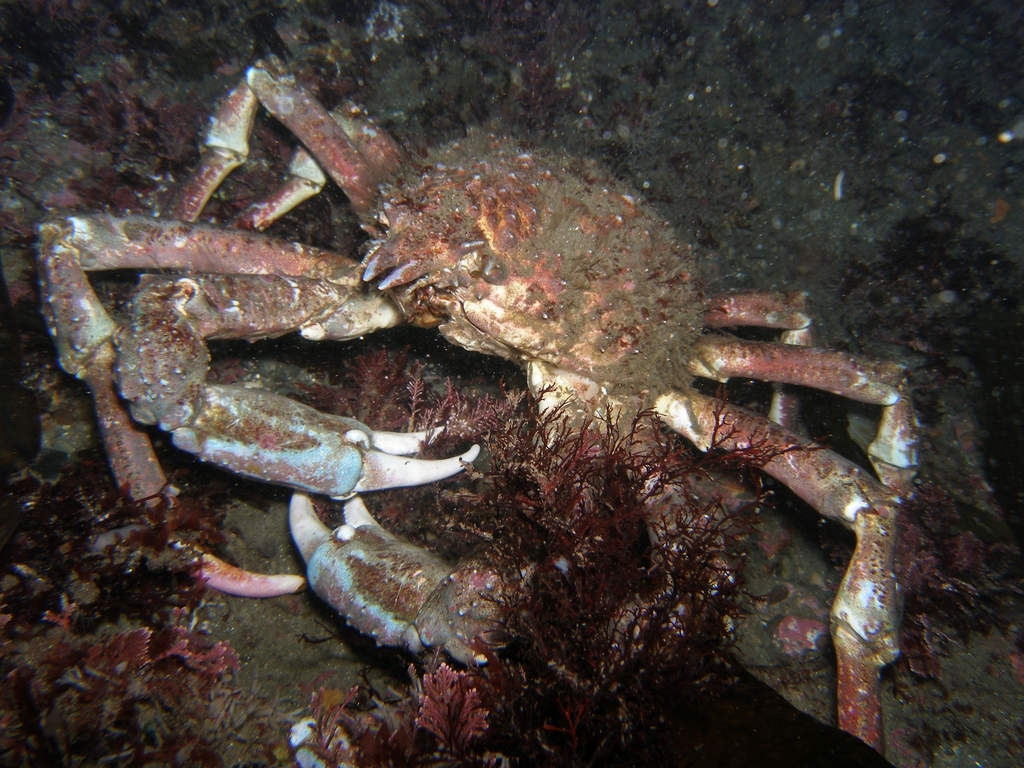
Sheep Crab
Loxorhynchus grandis
Loxorhynchus grandis, commonly known as the sheep crab or spider crab, is a species of crab in the family Epialtidae. It is the largest crab found on the California coast. The species was first described to science by William Stimpson in 1857. The type specimen was collected on the coast of California, near San Francisco. Fossils from the late Miocene epoch indicate that this species is at least 11.63 to 5.333 million years old.
From the article Loxorhynchus grandis on Wikipedia (CC BY-SA), quoted section by section
Description
The sheep crab has a carapace, four sets of walking legs, and a set of claws, or chelipeds. Males are larger than females. The carapace of a male can be over 9.6 inches (24 cm) across, while females can grow to 6.8 inches (17 cm). The carapace is tear-shaped with a wide, rounded posterior which tapers to a point at its snout, or rostrum. There is an obvious preorbital spine on the tip of the rostrum, which is sharply down-curved and deeply notched at its tip. The carapace is covered in short spines, or tubercles. The longest legs, the second pair of walking legs, is longer than the carapace is wide, so sheep crabs can reach an overall width of 57 centimetres (22 in). While the exoskeleton, or shell, is reddish, brown, or blue-green, this is often masked. Young crabs deliberately attach algae, bryozoans, hydroids, sponges, and other creatures to their exoskeletons as a form of camouflage to hide from predators. Animals larger than 8 centimetres (3.1 in) cease to decorate themselves. This species stops molting when it reaches sexual maturity, however, and a layer of algae often develops on the long-lived adult exoskeleton, giving these crabs a green appearance.
Range & habitat
This crab lives in coastal waters from Cordell Bank, California to Punta San Bartolome, Baja California. It is found in waters between 6 metres (20 ft) and 152 metres (499 ft) deep. Sheep crabs are quite mobile, achieving speeds of 0.4 kilometres per hour (0.25 mph), foraging on soft and rocky bottoms, as well as pilings. This species is migratory, spending the warm months of the year in shallow waters and the cooler months in deeper waters.
Wikipedia: “Distribution and habitat”
What it does
Sheep crabs are gonochoric, which is to say that individuals are either male or female. They form aggregations, piles of dozens or hundreds of crabs. The aggregations which have been studied in detail are composed only of adults and included females and at least one male. Sheep crabs are typically solitary, and it has been hypothesized that the purpose of the aggregations is to increase the concentration of a chemical signal, a pheromone, from the females to attract males for mating. A male crab grasps a female for mating and delivers a sperm packet. A female can store sperm for later use, if no males are available. Fertilization takes place internally, and the fertilized eggs are then glued to the exterior of the female's abdomen. Females brood their eggs to protect them from predation. Broods may contain 125,000 to 500,000 eggs. The development of the eggs can be discerned by their color. Orange eggs are the freshest, red are of intermediate development, and brown can be seen to have eyes and are ready to be released. Brooding females have been found year-round suggesting that there is no strong seasonal peak in reproduction. The length of the brooding period is unknown. After release from the female, larval crabs are free swimming plankton. …
Wikipedia: “Reproduction and life history”
Where it lives
Recorded sightings
—
geo-referenced records in GBIF, from museums, herbaria and field observers.
Drag the globe to turn it. Dots are where records exist, not a range map; darker means more records.
In the stacks
Searching the stacks…
Every page naming Loxorhynchus grandis in the Biodiversity Heritage Library →
This page is assembled live from iNaturalist, GBIF, Wikipedia, the Source Library and the Internet Archive. It is not yet part of the hand-edited codex. iNaturalist taxon 120957.