- Animals
- ›Molluscs
- ›Gastropods
- ›Heterobranchs
- ›Euthyneura
- ›Tectipleura
- ›Eupulmonata
- ›Common Land Snails and Slugs
- ›Helicina
- ›Oleacinoidei
- ›Oleacinoidea
- ›Spiraxidae
- ›Euglandininae
- ›Euglandina
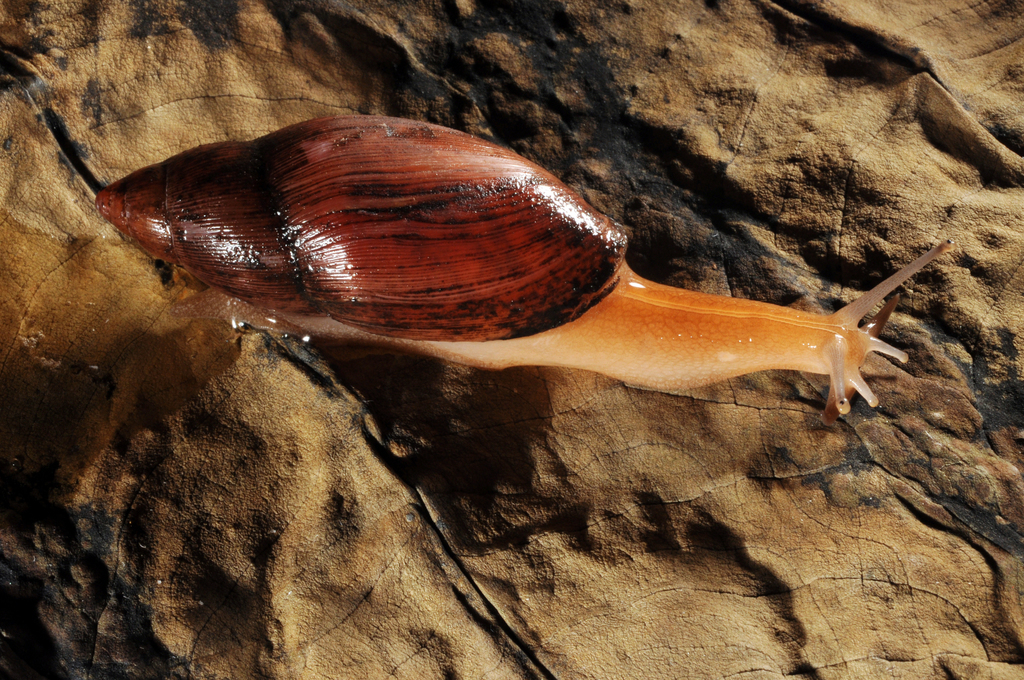
Rosy Wolfsnail
Euglandina rosea
Euglandina rosea, the rosy wolfsnail or cannibal snail, is a species of medium-sized to large predatory air-breathing land snail, a carnivorous terrestrial pulmonate gastropod mollusk in the family Spiraxidae.
This species is a fast and voracious predator, hunting and eating other snails and slugs. The rosy wolfsnail was introduced into Hawaii in 1955 as a biological control for the invasive African land snail, Lissachatina fulica. This snail is responsible for the extinction of an estimated eight native snail species in Hawaii. This has caused the snail to be added to the IUCN's top 100 most invasive species.
From the article Euglandina rosea on Wikipedia (CC BY-SA), quoted section by section
Description
The rosy wolfsnail lives around 24 months. The snail takes 30–40 days to hatch and is then considered young (before sexual maturity). Sexual maturity begins between 4 and 16 months after hatching. The snail is relatively fast moving at about 8 mm/s. The snail has a light grey or brown body, with its lower tentacles being long and almost touching the ground. The shell has usual dimensions of 76 mm long and 27.5 mm in diameter. The shape of the shell tapers to a point at both ends (fusiform) with a narrow oval- to crescent-shaped opening and a shortened axis of the spiral shell near the opening (truncated columella). The shell has a brownish pink color. The full-grown adult snail ranges in size from 7–10 cm in length.
Range & habitat
The rosy wolfsnail is native to the Southeastern United States, including Florida and Georgia. Other species of the genus are native to South and Central America. They have also been spotted in Oslo Norway.
Wikipedia: “Distribution and habitat”
What it does
This species is found naturally in the Southern United States, usually in hardwood forests and urban gardens. It is a fast and voracious predator, hunting and eating other snails and slugs. The smaller prey species are ingested whole or sucked out of their shells. This gives it the nickname "the cannibal snail". Rosy wolfsnails use slime trails to track their prey and potential mates, resulting in rosy wolfsnails following these trails more than 80% of the time they are alive. The rosy wolfsnail prefers to consume smaller snails because these are quicker and easier to eat.
The rosy wolfsnail is specialized for carnivory, its buccal mass being totally contained within a beak-like rostrum that can be extended, thus allowing the toothed radula to be ejected past the mouth and into the snail's prey. The radula is enlarged and has teeth specialized into elongated cones. The four main mammalian predators for the rosy wolfsnail are rats, tenrecs, pigs, and mongooses. The rats consume the snail by chewing the top of the shell off. The tenrecs crack the shell into large pieces. The pigs have a tendency to crush the shell completely. The mongooses attack the body of the snail. Cannibalism among adults has also been seen in the rosy wolfsnail. …
Wikipedia: “Ecology”
Where it lives
Recorded sightings
—
geo-referenced records in GBIF, from museums, herbaria and field observers.
Drag the globe to turn it. Dots are where records exist, not a range map; darker means more records.
In the stacks
Searching the stacks…
Every page naming Euglandina rosea in the Biodiversity Heritage Library →
This page is assembled live from iNaturalist, GBIF, Wikipedia, the Source Library and the Internet Archive. It is not yet part of the hand-edited codex. iNaturalist taxon 121012.