- Plants
- ›Vascular Plants
- ›flowering plants
- ›Dicots
- ›Gentians, Dogbanes, Madders, and Allies
- ›madder family
- ›Rubioideae
- ›Morindeae
- ›Morinda
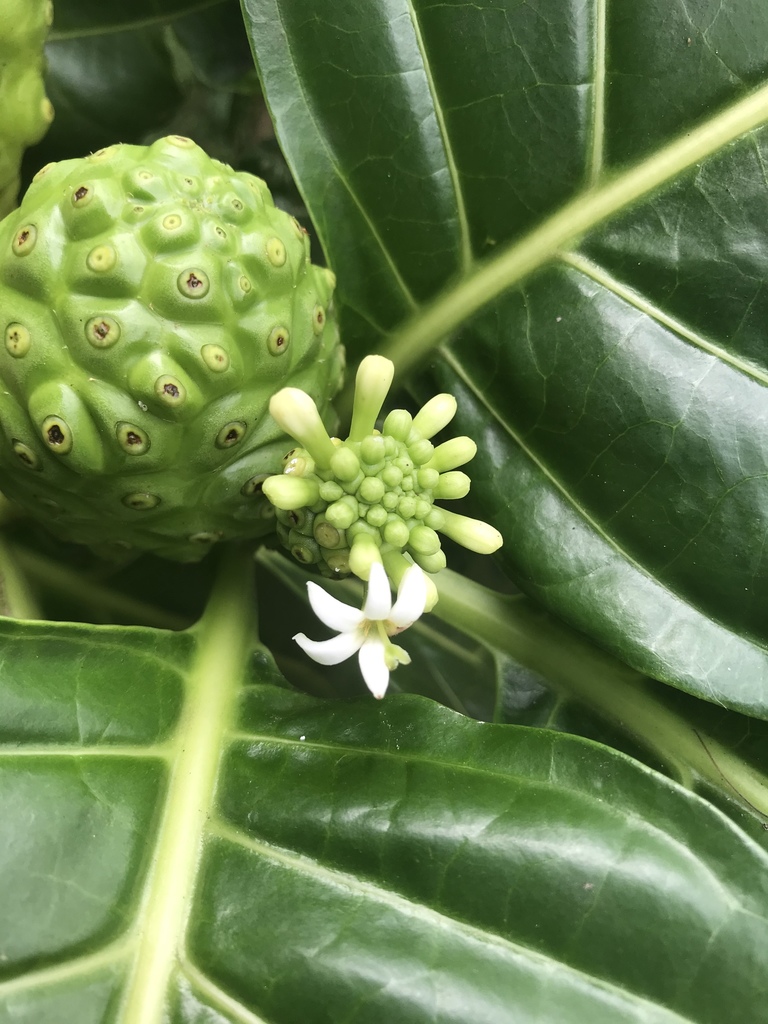
Noni
Morinda citrifolia
Morinda citrifolia is a fruit-bearing tree in the coffee family, Rubiaceae. It is commonly known as noni or Indian mulberry, among many other names.
Native to Southeast Asia and Australasia, the species was spread across the Pacific by Polynesian sailors. It is now cultivated throughout the tropics and is widely naturalised.
From the article Morinda citrifolia on Wikipedia (CC BY-SA), quoted section by section
Description
Morinda citrifolia is a shrub or small tree up to 6 metres (19+1⁄2 ft) tall, with grey-brown bark. The twigs are more or less square in cross-section and often fleshy. Stipules are present, very broad and obtuse at the apex, measuring up to 2 centimetres (3⁄4 in) wide and long. The large glabrous leaves are arranged in opposite pairs on the twigs, reaching up to 25 cm (10 in) long by 13 cm wide. They are elliptic to ovate in shape and have 6–9 pairs of lateral veins. Domatia are usually present as dense tufts of hairs in the junctions of the lateral veins with the midrib. The inflorescences are dense heads of flowers produced at the apex of the branch. They are leaf-opposed, replacing one leaf in the pair. There may be up to 90–100 flowers in the head, but only a few open at a time. The flowers are white and tubular with five lobes, measuring about 15 cm long and across. The fruit is a multiple fruit consisting of fused drupes, each containing four seeds. They are initially green, transitioning through pale yellow to white or grey, and when ripe they emit a pungent odour similar to blue cheese. They are irregularly ellipsoid or ovoid, and may reach up to 9x6 cm.
Phenology. The plants flower and fruit throughout the year. It is common to see flowers and fruit in varying stages of development on a plant at any given time.
Chemistry. …
Range & habitat
Native to Southeast Asia and Australasia, the species was spread across the Pacific by Polynesian sailors. It is now cultivated throughout the tropics and is widely naturalised. Morinda citrifolia grows in shady forests and on open rocky or sandy shores. It takes 18 months for the plant to mature, and yields 4 to 8 kg (8.8 to 17.6 lb) of fruit per month throughout the year. It is tolerant of saline soils, drought conditions, and secondary soils. It can be found in various environments including volcanic terrains and clearings or limestone outcrops, as well as in coral atolls. It can grow up to 9 m (30 ft) tall and has large, simple, dark green, shiny, and deeply veined leaves.
Wikipedia: “Distribution and habitat”
What it does
Morinda citrifolia is attractive to weaver ants, which make their nests by using the leaves of this tree. These ants protect the plant from some plant-parasitic insects. The smell of the fruit also attracts fruit bats, which aid in dispersing the seeds. Drosophila sechellia, a type of fruit fly endemic to the Seychelles, feeds exclusively on these fruits.
Wikipedia: “Ecology”
At the table
A variety of beverages (juice drinks), powders (from dried ripe or unripe fruits), cosmetic products (lotions, soaps), oil (from seeds), and leaf powders (for encapsulation or pills) have been introduced into the consumer market.
Culinary. Indigenous peoples used the fruit as emergency food during famines. Therefore, it is also called "starvation fruit". Despite its strong smell and bitter taste, the fruit was nevertheless eaten as a famine food, and, in some Pacific Islands, even as a staple food, either raw or cooked. Southeast Asians and Aboriginal Australians consume fresh fruit with salt or cook it with curry. The seeds are edible when roasted. In Thai cuisine, the leaves known as bai-yo are used as a leaf vegetable and are the main ingredient of Kaeng bai-yo, cooked with coconut milk. The fruit luk-yo is added as a salad ingredient to some versions of green papaya salad. In Cambodia, the leaves are an essential part of the national dish fish amok. The fruit powder contains carbohydrates and dietary fibre in moderate amounts. These macronutrients reside in the fruit pulp, as M. citrifolia juice has sparse nutrient content.
Traditional medicine. Green fruit, leaves, and root or rhizomes might have been used in Polynesian cultures as a general tonic, in addition to its traditional place in Polynesian culture as a famine food. …
Wikipedia: “Uses”
Where it lives
Recorded sightings
—
geo-referenced records in GBIF, from museums, herbaria and field observers.
Drag the globe to turn it. Dots are where records exist, not a range map; darker means more records.
In the old herbals & bestiaries

Serpentum et Draconum Historiae
Ulisse Aldrovandi · 1640 · p.422

Garden of Malabar, Vol. 1
Hendrik van Rheede · 1683 · p.163

Jan Moninckx; Maria Moninckx — Moninckx Atlas, vol. 1 (1686)
Jan Moninckx; Maria Moninckx · 1687 · p.43

Hortus Eystettensis
Basilius Besler · 1640 · p.319

Hortus Eystettensis
Basilius Besler · 1640 · p.77

The Natural History of Carolina, Florida and the Bahama Islands, Vol. 1
Mark Catesby · 1777 · p.164

The Natural History of Carolina, Florida and the Bahama Islands, Vol. 1
Mark Catesby · 1777 · p.143

The Natural History of Carolina, Florida and the Bahama Islands, Vol. 1
Mark Catesby · 1777 · p.128

Book of Herbs
Hieronymus Bock (Tragus) · 1546 · p.689

History of Rare Plants Observed in Pannonia
Carolus Clusius · 1583 · p.632

History of Rare Plants Observed in Pannonia
Carolus Clusius · 1583 · p.300

Hortus Eystettensis
Basilius Besler · 1640 · p.133
In the stacks
Searching the stacks…
Every page naming Morinda citrifolia in the Biodiversity Heritage Library →
This page is assembled live from iNaturalist, GBIF, Wikipedia, the Source Library and the Internet Archive. It is not yet part of the hand-edited codex. iNaturalist taxon 121022.