- Animals
- ›Molluscs
- ›Cephalopods
- ›Octopuses, Squids, and Cuttlefishes
- ›Squids and Cuttlefishes
- ›Inshore Squids
- ›Pencil Squids
- ›Sepioteuthis
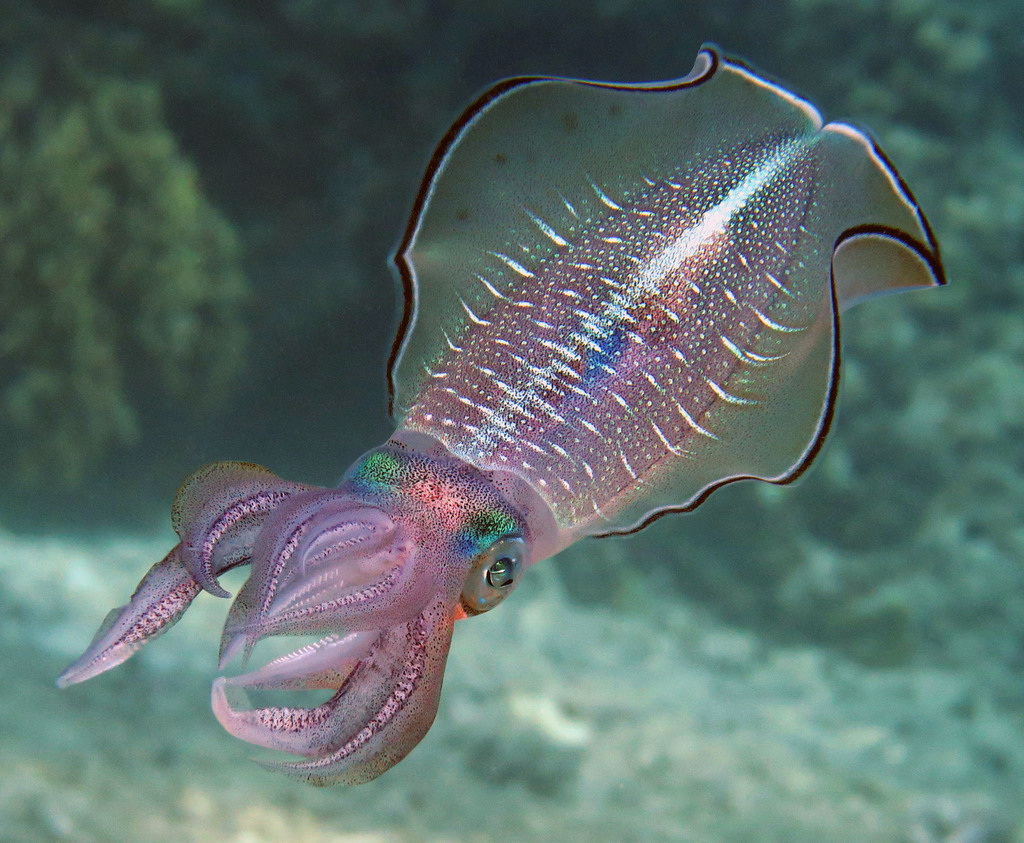
Bigfin Reef Squid
Sepioteuthis lessoniana
Sepioteuthis lessoniana, commonly known as the bigfin reef squid, tiger squid, glitter squid, oval squid, or northern calamari, is a species complex in the loliginid squid family. It is one of the three currently recognized species belonging to the genus Sepioteuthis. Studies in 1993, however, have indicated that bigfin reef squids may comprise several cryptic species, that are very similar and closely related.
Bigfin reef squids are characterised by a large oval fin that extends throughout the margins of its mantle, giving them a superficial similarity to cuttlefish. They are small to medium-sized squids, averaging 3.8 to 33 centimetres (1.5 to 13.0 in) in length. They exhibit elaborate mating displays and usually spawn in May, but it can vary by location. The paralarvae resemble miniature adults and are remarkable for already having the capability to change body colouration upon hatching. Bigfin reef squids have the fastest recorded growth rates of any large marine invertebrate, reaching 600 g (1.3 lb) in only four months. They are a short-lived species, with a maximum recorded lifespan of 315 days.
From the article Bigfin reef squid on Wikipedia (CC BY-SA), quoted section by section
Description
Like other members of the genus Sepioteuthis, bigfin reef squids are easy to distinguish from other squids in that they possess thick and muscular oval fins that extend around almost the entire mantle. The fins extend about 83 to 97% of the mantle length and are 67 to 70% of the mantle length in width. Because of these fins, bigfin reef squids are sometimes mistaken for cuttlefish, a fact reflected by their scientific names. A narrow blue or white line is visible at the point of attachment of the fins to the mantle. A fleshy ridge is also present where the fins meet at the back of the squid. The mantles of bigfin reef squids are cylindrical, tapering to a blunt cone at the posterior. The mantle is usually 4 to 33 cm (1.6 to 13.0 in) long in males and 3.8 to 25.6 cm (1.5 to 10.1 in) long in females. Both sexes can reach a maximum mantle length of 38 cm (15 in). Adult males weigh 403.5 to 1,415 g (0.890 to 3.120 lb), while adult females are 165 to 1,046 g (0.364 to 2.306 lb). Both sexes can attain a maximum documented weight of 1.8 kg (4.0 lb). The forward margin of the mantle on the ventral side is concave. Their eyes are large and covered entirely by a transparent secondary cornea. They are greenish at the base. A pair of prominent ridges (olfactory crests) are present on the ventral surface of the head at the rear edge of the eyes. …
Range & habitat
The bigfin reef squid is a neritic warm water-dwelling squid. They are usually found 0 to 100 m (0 to 328 ft) below the water's surface. They tend to remain close to the shoreline, near rocks and reefs. They are slightly more active during the night and will move to deeper waters or find cover in daytime. Large numbers of juveniles can often be found hiding beneath floating driftwood. The bigfin reef squid is the most widespread species in the genus Sepioteuthis. It is found in temperate and tropical regions of the Indian Ocean and the western Pacific Ocean. Their original range extends east to the Hawaiian Islands, west to the Red Sea, north to Japan, and south to Australia and New Zealand (42°N to 42°S and 32°E to 154°W). The range has also expanded to include parts of the Mediterranean Sea. In 2002, bigfin reef squids were first documented in the Gulf of İskenderun of the southeastern Mediterranean Sea. They may have already existed in significant populations in the area prior to their discovery in 2002, as they have acquired a common name among the fishermen of the Aegean Sea – σουπιοκαλάμαρο (soupiocalamaro, literally "cuttlefish-like squid"). It is a Lessepsian migrant, reaching the Mediterranean Sea through the Suez Canal.
Wikipedia: “Distribution and habitat”
What it does
The bigfin reef squid eats a variety of different marine organisms. Its main prey are usually prawns and other crustaceans, and fish. Captive specimens were observed to consume one fish every 2 to 25 hours. Bigfin reef squids are, in turn, preyed upon by tuna, marlin, swordfish, and other predator fish and groundfish.
Wikipedia: “Diet and predators”
In medicine
The bigfin reef squid is the first squid species to have been cultured for more than one generation. It is remarkable for its ability to readily adapt to being confined in tanks, and is one of the few squid species of which the entire life span has been observed under laboratory conditions. Bigfin reef squids are also valuable sources for squid giant axons used in research in neuroscience and physiology. Unlike axons of other animals, squid axons are very large. Those of bigfin reef squids can range in diameter from 350 to 560 μm (in contrast to the typical 1 μm for humans). In life, these giant axons are used by the squids to coordinate escape jetting behaviour, enabling the squid to contract its muscles in a split second directly from the brain.
Wikipedia: “Biomedical research”
Where it lives
Recorded sightings
—
geo-referenced records in GBIF, from museums, herbaria and field observers.
Drag the globe to turn it. Dots are where records exist, not a range map; darker means more records.
In the stacks
Searching the stacks…
Every page naming Sepioteuthis lessoniana in the Biodiversity Heritage Library →
This page is assembled live from iNaturalist, GBIF, Wikipedia, the Source Library and the Internet Archive. It is not yet part of the hand-edited codex. iNaturalist taxon 121187.