- Animals
- ›Arthropods
- ›Hexapods
- ›Insects
- ›Winged and Once-winged Insects
- ›Ants, Bees, Wasps, and Sawflies
- ›Narrow-waisted Wasps, Ants, and Bees
- ›Ants, Bees, and Stinging Wasps
- ›Bees and Apoid Wasps
- ›Bees
- ›Mason, Leafcutter, Carder, and Resin Bees
- ›Megachilinae
- ›Osmiini
- ›Osmia
- ›Osmia
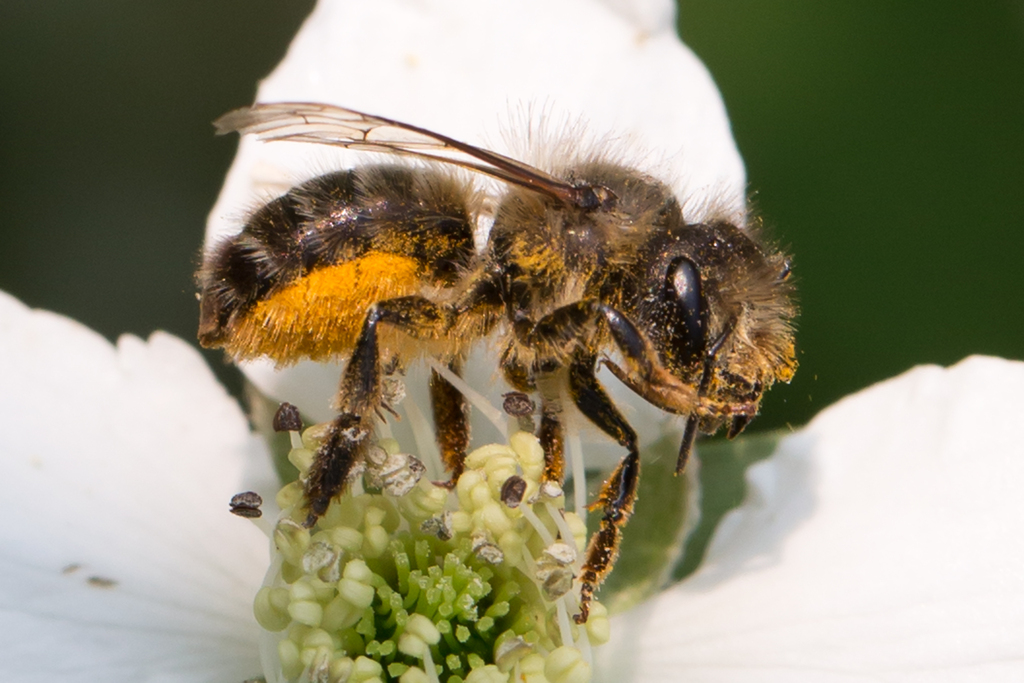
Horn-faced Mason Bee
Osmia cornifrons
Osmia cornifrons, also known as the horned-face bee, is a species of solitary bee indigenous to Northern Asia. Physically, this species of bee is recognized for its horn-like extensions originating from its lower face. Populations of O. cornifrons have been recorded in multiple locations, including Japan, Korea, China, and Russia. O. cornifrons are more docile as compared to other species of bees and are less prone to sting when aggravated.
From the article Osmia cornifrons on Wikipedia (CC BY-SA), quoted section by section
What it does
This species of bee has been utilized for its effectiveness in pollinating flowers at a rapid rate. A single bee can visit up to 2,500 flowers a day and will spend 4–8 minutes per flower. Osmia cornifrons has a high flower constancy, signifying that the bee will return to the same species of flower. Both males and females will create a nest within 130 meters of a crop field; however, nest locations have been noted to exceed this distance; some being situated 700 meters away. It is a diurnal species that is most active between 6AM–8PM, depending on the location of the sun. They will avoid foraging during raining spells, as they are not well suited to fly in that type of weather. O. cornifrons is more adept to humid environments and performs optimally in regions that have consistent humidity, however, are capable of functioning in cooler environments. This ability to perform in a wide range of environmental temperatures makes them highly valued bees for crop pollination as well as making them more effective pollinators than honeybees.
Wikipedia: “Crop pollination”
In human culture
Osmia cornifrons was first introduced in Japan in the 1940s and were managed for crop pollination. Over a 50-year time period, use of O. cornifrons gradually increased until more than half of the apple orchards in Japan utilized this species. In 1977, O. cornifrons was introduced in the northeastern United States in an attempt to increase pollination productivity of fruit crops. This species was reintroduced multiple times during the following years.
Wikipedia: “History”
Listen
Looking for field recordings…
Where it lives
Recorded sightings
—
geo-referenced records in GBIF, from museums, herbaria and field observers.
Drag the globe to turn it. Dots are where records exist, not a range map; darker means more records.
In the stacks
Searching the stacks…
Every page naming Osmia cornifrons in the Biodiversity Heritage Library →
This page is assembled live from iNaturalist, GBIF, Wikipedia, the Source Library and the Internet Archive. It is not yet part of the hand-edited codex. iNaturalist taxon 121508.