- Plants
- ›Vascular Plants
- ›flowering plants
- ›Dicots
- ›beeches, oaks, walnuts, and allies
- ›beech family
- ›Quercus
- ›Quercus
- ›Lobatae
- ›Phellos
- ›Quercus phellos
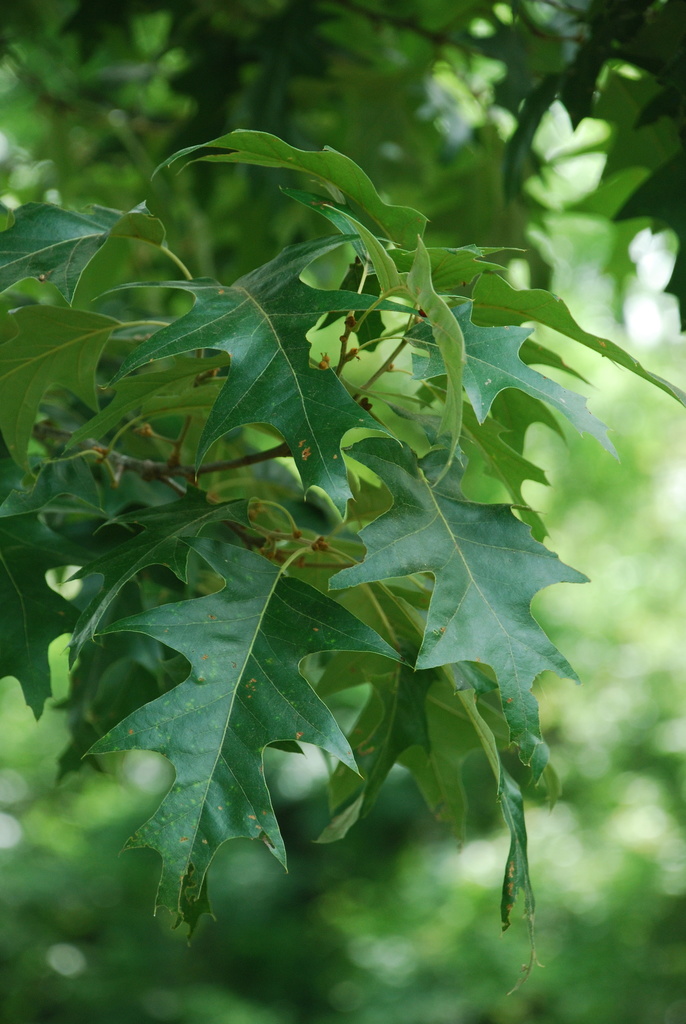
cherrybark oak
Quercus pagoda
Quercus pagoda, the cherrybark oak, is one of the most highly valued red oaks in the southern United States. It is larger and better formed than southern red oak and commonly grows on more moist sites. Its strong wood and straight form make it an excellent timber tree. Many wildlife species use its acorns as food, and cherrybark oak makes a fine shade tree. Cherrybark oak was formerly considered to be a subspecies of southern red oak, Quercus falcata, subsp pagodifolia.
From the article Quercus pagoda on Wikipedia (CC BY-SA), quoted section by section
Description
Size: Cherrybark oaks often attain heights of 30 to 40 meters (100 to 130 feet) and trunk diameters of 91 to 152 centimeters (36 to 60 inches), making it among the largest of the red oaks in the South. The tallest known cherrybark oak, as well as the tallest measured tree east of the Mississippi River, is a 204-foot specimen in Vanderburgh County, Indiana. It is one of the hardiest and fastest-growing oaks. It grows well on more sites than any other bottomland oaks except perhaps willow and water oaks. Diameter growth typically ranges from 7.6 to 15.2 cm (3 to 6 in) per decade. Bark: The name 'cherrybark' comes from its similarity to the bark of black cherry. The bark is gray and has scaly, narrow ridges.
Foliage: The name pagoda refers to the tiered shape of cherrybark's leaves, which are reminiscent of the shape of a pagoda. Its simple, alternate leaves generally have V-shaped bases, deeply incised lobes (5 to 11), and short, broad, uncurved tips. The species is unusual in that the lobes are not necessarily paired on opposite sides of the leaf, instead appearing alternate or sometimes haphazard in arrangement. The leaves are 18 to 25 cm (7 to 10 in) long and up to 18 cm wide. Leaves are dark green, smooth, and shiny on the surface; undersides are paler and pubescent.
Twigs: The twigs are thick and brown or gray, hairy when young. …
Range & habitat
Cherrybark oak has a disjunct (discontinuous) distribution. It is common in the Carolinas and in the lower Mississippi Valley but rare in Georgia and Florida in between. There are also scattered, outlying populations as far north as New Jersey and as far west as Texas and Oklahoma. Cherrybark oak very often grows on the best loamy sites on first bottom ridges, well-drained terraces, and colluvial sites.
Wikipedia: “Distribution and habitat”
What it does
Many wildlife species use cherrybark acorns as a substantial part of their diets. Common species are the gray and fox squirrel, white-tailed deer, raccoon, and many birds (such as wild turkey, blue jay, wood duck, and common grackle).
Wikipedia: “Ecology”
At the table
Cherrybark oak usually has a relatively branch-free merchantable bole in contrast with other bottomland red oaks such as water and willow oak. Because of its good form and quality, cherrybark is regarded as one of the best red oaks. The wood is heavy, hard, and coarse grained. It is used for interior finishing, veneer, general construction, furniture, and cabinets. The color is light reddish brown.
Wikipedia: “Uses”
How it is grown
Natural reproduction occurs on areas protected from fire and grazing. Being intolerant of shade, cherrybark oak requires full light for development, which in turn promotes heavy competition from herbs, vines, and brush. Seedling development is typically good in old fields with well-drained loamy soils. Acorn supply is one of the principal determinants of the amount of natural cherrybark oak reproduction. Other factors include microclimate, soil properties, and stand variables. Seedling development is related to overhead release, with large openings needed. Cherrybark oak is often found as individual trees in mixed stands, where it usually occurs in a dominant or codominant position. Sometimes it is found in groups where it dominates a stand. Cherrybark cannot tolerate suppression for very long. It is classed as intolerant of shade and probably becomes established only in openings. Cherrybark oak hybridizes easily with willow oak (Q. phellos) producing the vigorous Louisiana oak, Quercus x Ludoviciana. The cherrybark oak is slightly less cold resistant than the southern red oak.
Wikipedia: “Cultivation”
Where it lives
Recorded sightings
—
geo-referenced records in GBIF, from museums, herbaria and field observers.
Drag the globe to turn it. Dots are where records exist, not a range map; darker means more records.
In the stacks
Searching the stacks…
Every page naming Quercus pagoda in the Biodiversity Heritage Library →
This page is assembled live from iNaturalist, GBIF, Wikipedia, the Source Library and the Internet Archive. It is not yet part of the hand-edited codex. iNaturalist taxon 121690.