- Animals
- ›Arthropods
- ›Hexapods
- ›Insects
- ›Winged and Once-winged Insects
- ›Ants, Bees, Wasps, and Sawflies
- ›Narrow-waisted Wasps, Ants, and Bees
- ›Ants, Bees, and Stinging Wasps
- ›Vespoid Wasps
- ›Hornets, Paper Wasps, Potter Wasps, and Allies
- ›Paper Wasps
- ›Polistini
- ›Polistes
- ›Fuscopolistes
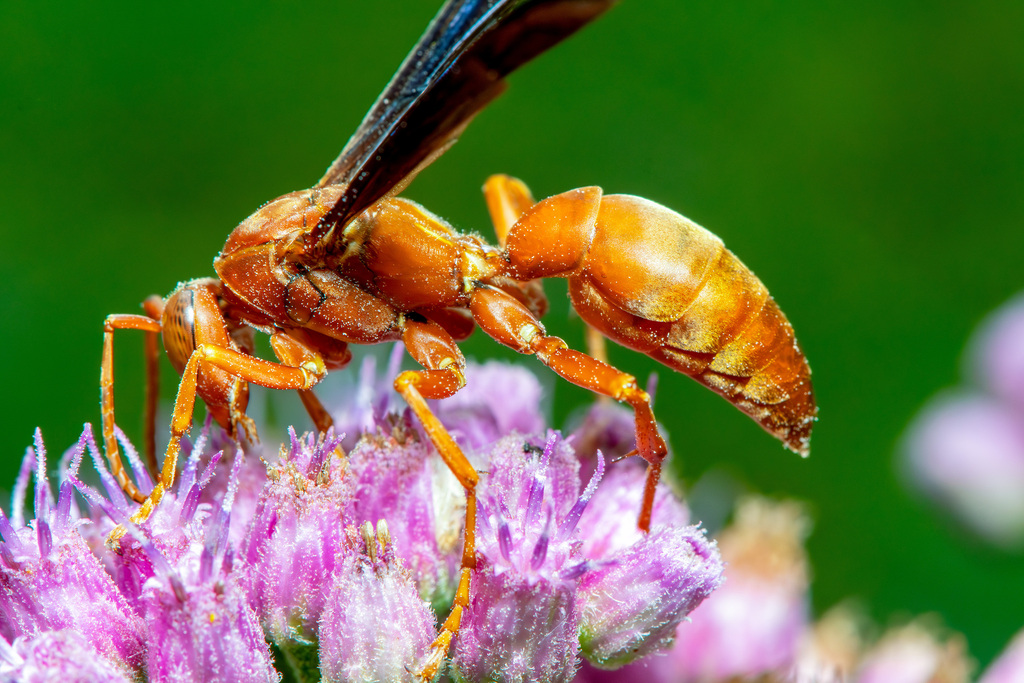
Fine-backed Red Paper Wasp
Polistes carolina
Polistes carolina is one of two species of red paper wasp found in the eastern United States (the other being Polistes rubiginosus) and is noted for the finer ridges on its propodeum. It is a social wasp in the family Vespidae and subfamily Polistinae. The species is native to the United States from Texas to Florida, north to New York, and west to Nebraska. The wasp's common name is due to the reddish-brown color of its head and body. P. carolina prefer to build their nests in protected spaces.
From the article Polistes carolina on Wikipedia (CC BY-SA), quoted section by section
Description
Both sexes of P. carolina are about 25–32 mm (0.98–1.26 in) long with black wings of lengths ranging from 15–25 mm (0.59–0.98 in). P. carolina is often confused with P. rubiginosus due to its strikingly similar reddish-brown coloring. Females can be separated by the bare genae of P. carolina in contrast to the silvery pubescence on the genae P. rubiginosus. Both sexes can also be differentiated by the coarser transverse ridging of the propodeum of P. rubiginosus when compared with P. carolina. Additionally, female P. carolina specimens have mostly bare malar spaces (the distance between the lower eye orbit and the mouth).
Sexual dimorphism. Females of Polistes carolina are usually completely ferruginous (rust in color) with the possibility of black markings forming spots around their eyes, lines on the dorsal surface of the scape, narrow lateral stripes on their scuta, or an incomplete median stripe on their propodea. Bands on sternum 2 or terga 3 and 4 can also be present. Additional very restricted yellow markings can be observed on mandibles, clypei, inner orbits, terga 1, the outer surfaces of the tibiae, and tarsi. Females also have more triangular faces with shorter antennae. Males often have more developed black or brown markings such as spots on the midfemur and sterna. Yellow markings vary, but have been reported on the face and sterna 1 through 4. …
Wikipedia: “Description and identification”
Range & habitat
P. carolina is most commonly found in the eastern United States (along with another "red paper wasp", Polistes rubiginosus) from Nebraska to Texas and along the Atlantic coast from New York to Florida. It has also been recorded as an adventitious species in Ontario, Canada, and was introduced to Bermuda. It prefers to nest in protected areas such as hollow trees and is often observed in woodlands. However, given the opportunity, it will also construct nests near humans, such as the undersides of roofs.
Wikipedia: “Distribution and habitat”
What it does
In P. carolina, several foundresses mate; however, each foundress only mates once. The absence of early males in P. carolina is unique when compared to other Polistes species. This lack of early males, however, indicates that female workers do not become inseminated queens in this species as is common in other wasp species.
Wikipedia: “Mating behavior”
Listen
Looking for field recordings…
Where it lives
Recorded sightings
—
geo-referenced records in GBIF, from museums, herbaria and field observers.
Drag the globe to turn it. Dots are where records exist, not a range map; darker means more records.
In the stacks
Searching the stacks…
Every page naming Polistes carolina in the Biodiversity Heritage Library →
This page is assembled live from iNaturalist, GBIF, Wikipedia, the Source Library and the Internet Archive. It is not yet part of the hand-edited codex. iNaturalist taxon 121792.