- Animals
- ›Arthropods
- ›Crustaceans
- ›Typical Crustaceans
- ›Barnacles and Copepods
- ›Barnacles and Allies
- ›Barnacles
- ›Normal Barnacles
- ›Thoracican Barnacles
- ›Symmetrical Sessile Barnacles
- ›Balanoidea
- ›Balanidae
- ›Amphibalaninae
- ›Amphibalanus
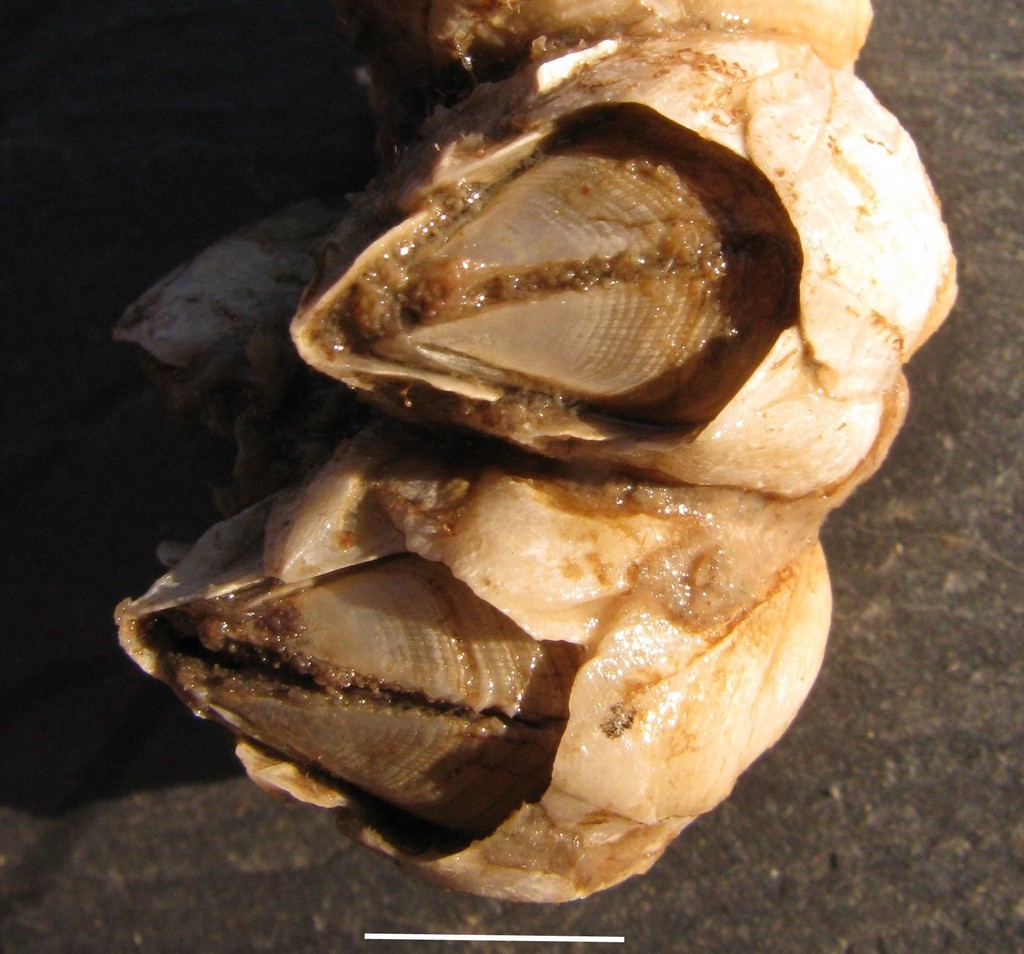
Ivory Barnacle
Amphibalanus eburneus
Amphibalanus eburneus, the ivory barnacle or American acorn barnacle, is a species of acorn barnacle in the family Balanidae. It occurs on the east coast of North America, the Caribbean Sea and Gulf of Mexico.
From the article Ivory barnacle on Wikipedia (CC BY-SA), quoted section by section
Description
The ivory barnacle is a medium-sized, cone-shaped sessile barnacle with a white test composed of fused plates. It has a diamond-shaped operculum protected by a hinged lid formed from two triangular halves each consisting of two plates, a tergum and a scutum. It can grow to a height of 2.5 cm (0.98 in) but most individuals are much smaller. This barnacle can be confused with the white bay barnacle (Balanus improvisus) but that species is smaller, only growing to a height of 6 mm (0.24 in). Another similar species is the striped barnacle (Balanus amphitrite) but that has vertical pink lines on the test.
Range & habitat
The native range of the ivory barnacle extends from Nova Scotia to the Caribbean Sea and Gulf of Mexico but it has extended this range as a result of fouling the bottoms of ships and because its larvae are sometimes transported in ballast water. It was first seen in Pearl Harbor, Hawaii in 1929 and is now common in all the main islands. It is found, sometimes in great numbers, from low tide mark to depths of 37 m (121 ft) attached to hard surfaces including rocks, mollusc shells, pilings, jetties and other man-made structures, ships' hulls and the roots of the red mangrove (Rhizophora mangle).
Wikipedia: “Distribution and habitat”
What it does
Ivory barnacles tend to aggregate with others and form dense populations. Each one is a hermaphrodite but cross fertilisation takes place when an individual protrudes its long penis and inserts it into the operculum of an adjoining individual where eggs have already developed. Sperm is deposited there, and the fertilised eggs are brooded in the mantle cavity. On hatching, the larvae are expelled into the water column and become planktonic. They pass through six naupliar stages and one cyprid stage over the course of one to two weeks. The nauplii feed on phytoplankton but the cyprid larvae do not feed. They search out sites for settlement, possibly following chemical cues from already established adults or testing the substrate for suitability. Once settled, they cement themselves by their heads to the surface and undergo metamorphosis into juvenile barnacles.
Wikipedia: “Reproduction”
Where it lives
Recorded sightings
—
geo-referenced records in GBIF, from museums, herbaria and field observers.
Drag the globe to turn it. Dots are where records exist, not a range map; darker means more records.
In the stacks
Searching the stacks…
Every page naming Amphibalanus eburneus in the Biodiversity Heritage Library →
This page is assembled live from iNaturalist, GBIF, Wikipedia, the Source Library and the Internet Archive. It is not yet part of the hand-edited codex. iNaturalist taxon 122023.