- Plants
- ›Vascular Plants
- ›Ferns
- ›Adder's-tongues, Fork Ferns, and Allies
- ›adder's-tongues and allies
- ›adder's-tongue family
- ›Botrychioideae
- ›Sceptridium
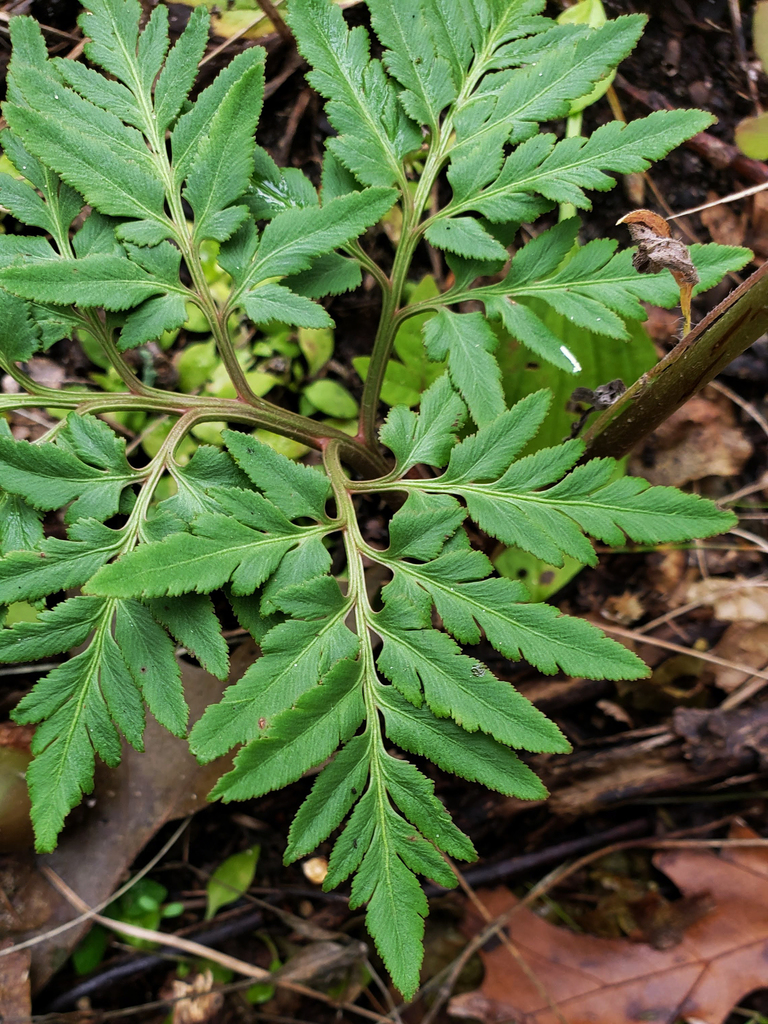
Cutleaf Grapefern
Sceptridium dissectum
Sceptridium dissectum is a common fern (or fern-ally) in the family Ophioglossaceae, occurring in eastern North America. Like other plants in this group, it normally only sends up one frond per year. It has long been the subject of confusion because the frond presents in one of two forms, either the normal form (forma obliquum) that resembles other plants in the genus, or the skeletonized form (forma dissectum).
This is the most common grape fern throughout most of its range. It is a frequent denizen of disturbed lands, often growing with Diphasiastrum digitatum and Asplenium platyneuron. It has an unusual growing season, with the new frond emerging in July and dying back in May. The frond often turns from green to a bronze color during the winter.
From the article Sceptridium dissectum on Wikipedia (CC BY-SA), quoted section by section
Description
Sceptridium dissectum (Spreng.) Lyon has two separate fronds. The fertile frond looks superficially like a stalk of grapes while the other sterile frond is leafy. Sceptridium dissectum leaves are a light green during the spring and early summer, with the leaves becoming deciduous in late summer. The leaves usually turn a bronze color in late fall through winter. The grape like sporangia range from green to yellow. The petiole or stalk of the plant is green from top to bottom and glabrous as is the sterile frond. Sceptridium dissectum is a non-flowering plant. The sterile frond or leaf is mostly bipinnate. At first glance most think there are two separate fronds. The fertile stalk is joined to the stalk of sterile leaf blade near the rhizome. The sporangia resemble grapes which is why these types of ferns are known as grape ferns. The leaves on a sterile frond have lacy edges. Sceptridium dissectum stands six to fifteen inches tall. Sceptridium dissectum can stay a greenish bronze color through winter.
Range & habitat
Sceptridium dissectum ranges from Minnesota, south to northeastern Texas and across the east coast of the US. The habitats of the cutleaf grapefern are woodlands, sandy grasslands, the edge of swamps or ravines. One of the favored habitats of these plants are woodlands of deciduous forests where the cutleaf grapefern receives winter sun.
Wikipedia: “Distribution and habitat”
At the table
Wild turkey and ruffed grouse feed on the leaves, as do white-tailed deer.
== References ==
Wikipedia: “Uses”
How it is grown
Sceptridium dissectum is a homosporous fern, which means it only produces one kind of spore. Sceptridium dissectum is also perennial. The cutleaf grapefern typically grows in partial sunlight to medium shade. For soil conditions, the cutleaf grapefern grows in soil containing loam or sandy loam. The cutleaf grapefern also grows in moist to dry-mesic conditions. The cutleaf grapefern takes a long time to develop from its spores; the fern is dependent on mycorrhizal fungi for survival. The spores have to be in darkness for 3–4 weeks before any spore germination can occur. The longer the spores remain in darkness, the greater percentage of germination may occur. Spore germination and early gametophyte growth were also directly affected by the oxidation level of the supplied nitrogen source. The fern remains dependent on the fungi even after sterile and fertile leaves emerge. Unlike some members of the Ophioglossacae, Sceptridum dissectum does not always develop spores. Sceptridum dissectum only creates one leaf per year. The cutleaf grapefern is rumored to live for about 10 to 45 years. Because the cutleaf grapefern is so hard to cultivate, it is rarely used horticulturally.
Wikipedia: “Cultivation”
Where it lives
Recorded sightings
—
geo-referenced records in GBIF, from museums, herbaria and field observers.
Drag the globe to turn it. Dots are where records exist, not a range map; darker means more records.
In the stacks
Searching the stacks…
Every page naming Sceptridium dissectum in the Biodiversity Heritage Library →
This page is assembled live from iNaturalist, GBIF, Wikipedia, the Source Library and the Internet Archive. It is not yet part of the hand-edited codex. iNaturalist taxon 122085.