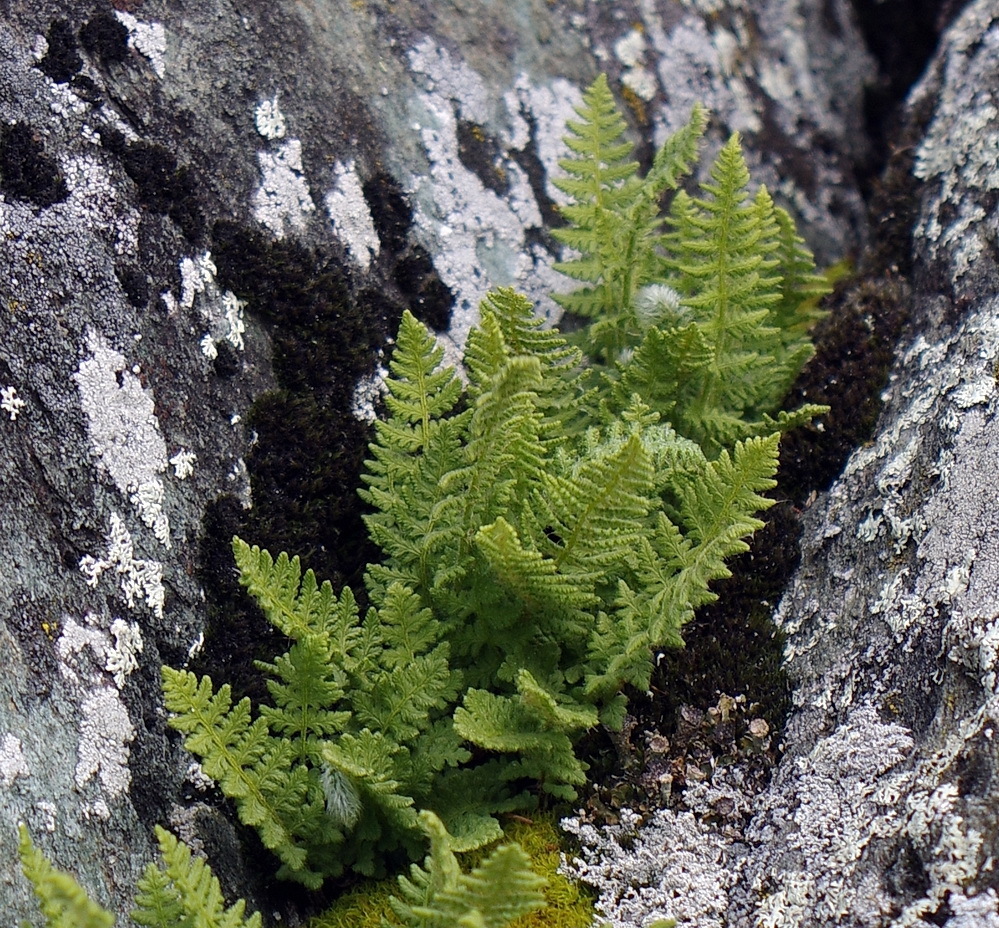
rusty woodsia
Woodsia ilvensis
Woodsia ilvensis, commonly known as oblong woodsia, is a fern found in North America and northern Eurasia. Also known as rusty woodsia or rusty cliff fern, it is typically found on sunny, exposed cliffs and rocky slopes and on thin, dry, acidic soils.
From the article Woodsia ilvensis on Wikipedia (CC BY-SA), quoted section by section
Description
The leaves are typically 6 inches long and 1 inch wide, with stiff, erected pointed tips and cut into 12 nearly opposite stemless leaflets. The underside of the leaves are covered in white woolly fibres, which later turn rusty brown.
Range & habitat
Its distribution is circumpolar. It is most abundant in Scandinavia, the Ural and Altai mountains and the eastern United States. It is also found in Japan, Alaska, Canada, coastal Greenland and various European locations including the Alps. It is considered "Threatened" or "Endangered" in the states of Illinois, Iowa, and Maryland and "Presumed Extirpated" in Ohio. Also found in West Virginia and North Carolina, it is the most common Woodsia species in the US. Its UK distribution is confined to Angus and the Moffat Hills in Scotland, north Wales and Teesdale and the Lake District in England. There are fewer than 90 wild clumps in the whole of the UK, where it is on the edge of its natural range and is considered to be "Endangered". For this reason it became a protected species in the UK in 1975 under the Conservation of Wild Creatures and Wild Plants Act.
Wikipedia: “Distribution”
Where it lives
Recorded sightings
—
geo-referenced records in GBIF, from museums, herbaria and field observers.
Drag the globe to turn it. Dots are where records exist, not a range map; darker means more records.
In the stacks
Searching the stacks…
Every page naming Woodsia ilvensis in the Biodiversity Heritage Library →
This page is assembled live from iNaturalist, GBIF, Wikipedia, the Source Library and the Internet Archive. It is not yet part of the hand-edited codex. iNaturalist taxon 122090.