- Animals
- ›Arthropods
- ›Crustaceans
- ›Typical Crustaceans
- ›Malacostracans
- ›Decapods, Isopods, and allies
- ›Amphipods, Isopods, and Allies
- ›Isopods
- ›Woodlice, Pillbugs, and Rock Slaters
- ›Woodlice and Pillbugs
- ›Crinocheta
- ›Porcellionid Woodlice
- ›Porcellio
- ›Porcellio scaber group
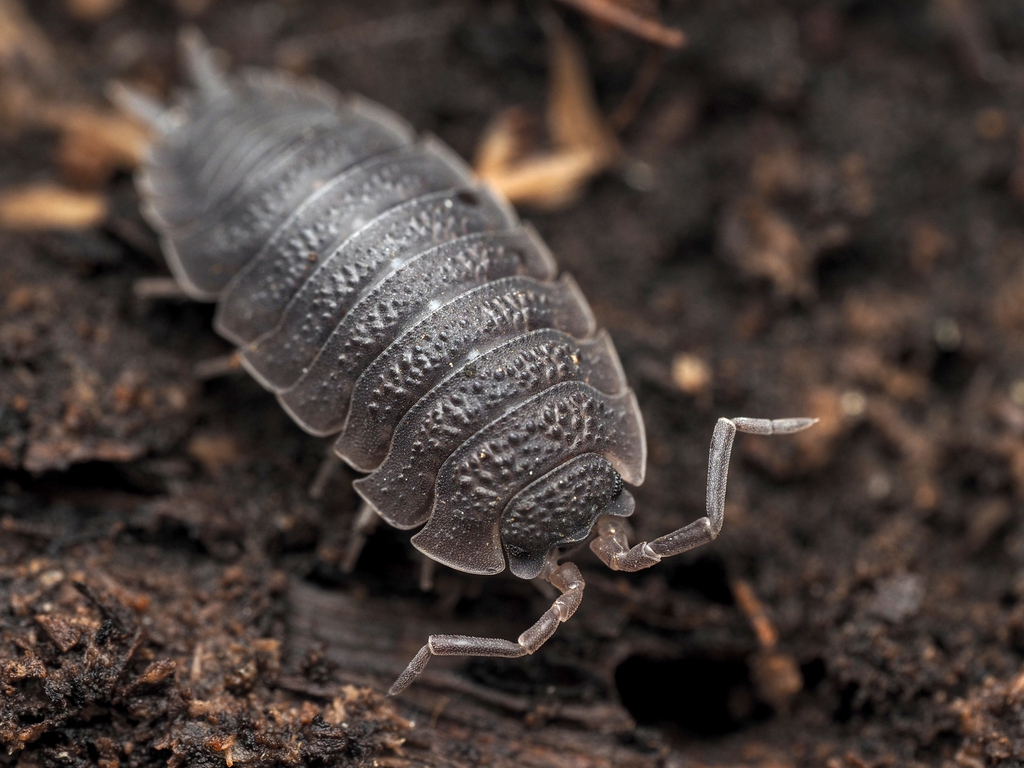
Common Rough Woodlouse
Porcellio scaber
Porcellio scaber (otherwise known as the common rough woodlouse or simply rough woodlouse), is a species of woodlouse native to Europe but with a cosmopolitan distribution. They are often found in large numbers in most regions, with many species (shrews, centipedes, toads, spiders and even some birds) preying on them.
From the article Porcellio scaber on Wikipedia (CC BY-SA), quoted section by section
Description
Porcellio scaber has an oval body, can grow up to 20 millimetres (0.79 in) long, and is usually a grey colour, paler underneath. Rare color morphs are commonly cultivated in captivity, which can additionally have brown, white, orange, yellow, or purplish coloring, and various patterns. Bright blue individuals have been documented, although their color is not a natural variation and is caused by an iridovirus. The dorsal (upper) surface of its segmented exoskeleton is covered in a series of small tubercles hence its common name. At the head it has two pairs of antennae, with the inner pair being very small. Two compound eyes are located on the dorsal side of the head, while the mouthparts are on the ventral (lower) side. There are 7 pairs of legs, corresponding to the 7 segments of the thorax. The short abdomen consists of 6 segments. On the ventral side of the abdomen there are two whitish pseudo-lungs, connected with pores to the outside air. At the rear end there is a small telson flanked by a pair of appendages known as uropods.
The females carry about 25 to 90 fertilized eggs until they hatch and are held in a fluid-filled sac at the ventral side of the abdomen for about 40–50 days. The young are reproductively mature after 3 months; the adult animals have a life expectancy of about two years.
Wikipedia: “Description and Life cycle”
Range & habitat
Porcellio scaber is found across Central and Western Europe. In the United Kingdom, it is one of the "big five" species of woodlice. It has also colonised North America, South Africa and other regions including the remote sub-Antarctic Marion island, largely through human activity. It is also the most common species of woodlice found in Australia.
Wikipedia: “Distribution”
What it does
Porcellio scaber is a detritivore – it mainly feeds on decaying leaf litter but will consume any rotting plant matter. Living plants are of limited nutritional value for these woodlice which prefer to feed on the bacteria and fungi which cause decay. P. scaber has very sensitive olfactory receptors that allow it detect the smell of microbial activity and to locate food.
Wikipedia: “Feeding”
Where it lives
Recorded sightings
—
geo-referenced records in GBIF, from museums, herbaria and field observers.
Drag the globe to turn it. Dots are where records exist, not a range map; darker means more records.
In the stacks
Searching the stacks…
Every page naming Porcellio scaber in the Biodiversity Heritage Library →
This page is assembled live from iNaturalist, GBIF, Wikipedia, the Source Library and the Internet Archive. It is not yet part of the hand-edited codex. iNaturalist taxon 122238.