- Animals
- ›Arthropods
- ›Crustaceans
- ›Branchiopods
- ›Fairy Shrimps
- ›Brine Shrimp and Fairy Shrimp
- ›Fairy Shrimps
- ›Chirocephalidae
- ›Eubranchipus
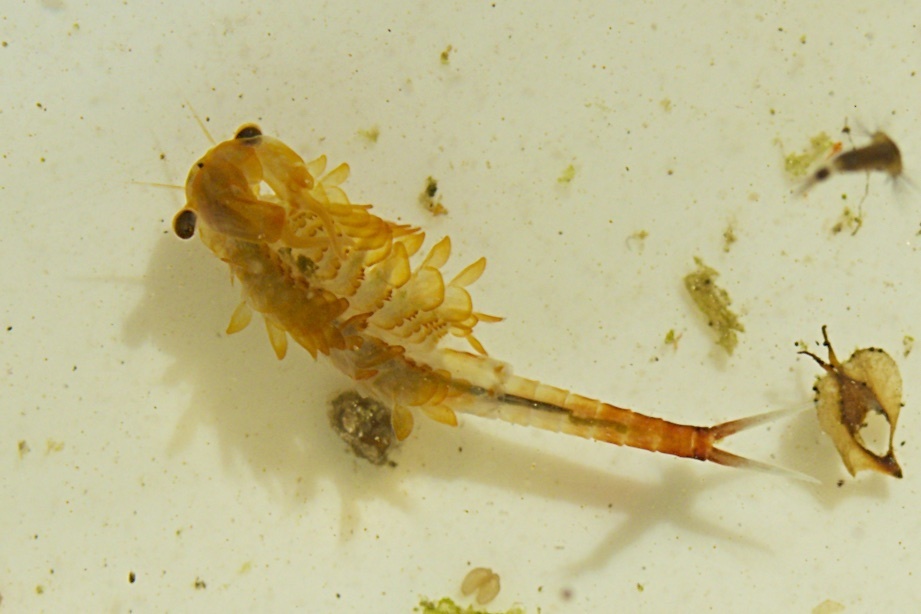
Springtime Fairy Shrimp
Eubranchipus vernalis
Eubranchipus vernalis, known generally as the springtime fairy shrimp or eastern fairy shrimp, is a species of freshwater fairy shrimp in the family Chirocephalidae. It inhabits cool, temporary, usually fish-free vernal pools in eastern North America and is active from late winter through spring.
From the article Eubranchipus vernalis on Wikipedia (CC BY-SA), quoted section by section
Description
Typical of other fairy shrimp, Eubranchipus vernalis has an elongate body and swims ventral side upward using a series of leaf-like appendages called phyllopods. Sexual dimorphism is most apparent at maturity: males have characteristically enlarged second antennae, while mature females have an ovisac situated above the genital segments at the base of the abdomen.
Adults are small, with reported lengths of about 10 to 25 mm (0.39 to 0.98 in). Males are typically a bit larger than females, with proportionally larger heads and enlarged antennae, although analysis of sex-specific length ranges has never been formally carried out for this taxon. Body color is usually described as light pinkish-orange, but individuals may also appear translucent white, bluish, or greenish, depending on diet and age; juveniles have been described as more orange than adults. Direct experimental work on color variation has not been reported for E. vernalis, but diet-related coloration has been demonstrated in another anostracan: β-carotene-fed Thamnocephalus platyurus developed orange appendages and green-bluish ovaries or oocytes, while individuals not fed β-carotene remained whitish. Like other members of Anostraca, E. …
Range & habitat
Eubranchipus vernalis ranges across the eastern North American seaboard, with verified records placed east of the Appalachian Mountains after its separation from Eubranchipus neglectus. Secondary summaries describe the species as occurring in vernal pools across the northeastern United States and adjacent parts of Canada, with records extending southward along the eastern side of the Appalachians. In New England, it is reported as widespread in southern areas, while farther north it is replaced more often by Eubranchipus bundyi. This species is strongly associated with low-alkalinity, low-conductivity temporary freshwater pools, which fill during the cool season and dry at some point later in the year. These may be supplied by snowmelt, spring rain, runoff, or seasonally elevated groundwater, and can occur in woodland depressions, kettle holes, swales, floodplains, old stream channels, and depressions within larger wetland systems. Suitable habitat must retain water long enough for development, while also drying often enough to prevent permanent fish populations from becoming established, since fish can exert strong predation pressure on the small, slow-moving shrimp in flooded pools. If a pool holds water through winter, it must remain deep enough to avoid freezing through completely, since freezing through may kill developing young. E. …
Wikipedia: “Distribution and habitat”
What it does
After pools refill in late winter or early spring, Eubranchipus vernalis hatch as metanauplii and develop through a series of molts and immature instars before reaching the 20-segmented adult form. Individuals mature rapidly, often before the pool dries, warms, or accumulates larger numbers of aquatic predators. Their active life stage is often brief, sometimes lasting only a few weeks in the pool. Female E. vernalis can reach sexual maturity in as little as 14 days after hatching when pools refill late, although average maturity for both sexes has been reported at about 45 days. Adults breed in spring, usually from March to May, before drying or warming ends the active season. Lifespan is strongly constrained by hydroperiod and temperature. Wild individuals have been reported to live from about 0.5 to 6 months, but survival is constrained by the persistence of water in the pool. E. vernalis is rarely found in water warmer than about 20 to 21 °C (68 to 70 °F), and warm-water exposure has been reported to reduce survival to only a few days. Mating occurs after males develop enlarged claspers and females carry eggs in the brood pouch. After mating, females release eggs into the water, where they settle into the pool substrate and often become buried among leaf litter. …
Wikipedia: “Life cycle and ecology”
Where it lives
Recorded sightings
—
geo-referenced records in GBIF, from museums, herbaria and field observers.
Drag the globe to turn it. Dots are where records exist, not a range map; darker means more records.
In the stacks
Searching the stacks…
Every page naming Eubranchipus vernalis in the Biodiversity Heritage Library →
This page is assembled live from iNaturalist, GBIF, Wikipedia, the Source Library and the Internet Archive. It is not yet part of the hand-edited codex. iNaturalist taxon 122272.