- Plants
- ›Vascular Plants
- ›flowering plants
- ›Dicots
- ›Woodsorrels, Quandongs, and Allies
- ›quandong family
- ›Elaeocarpus
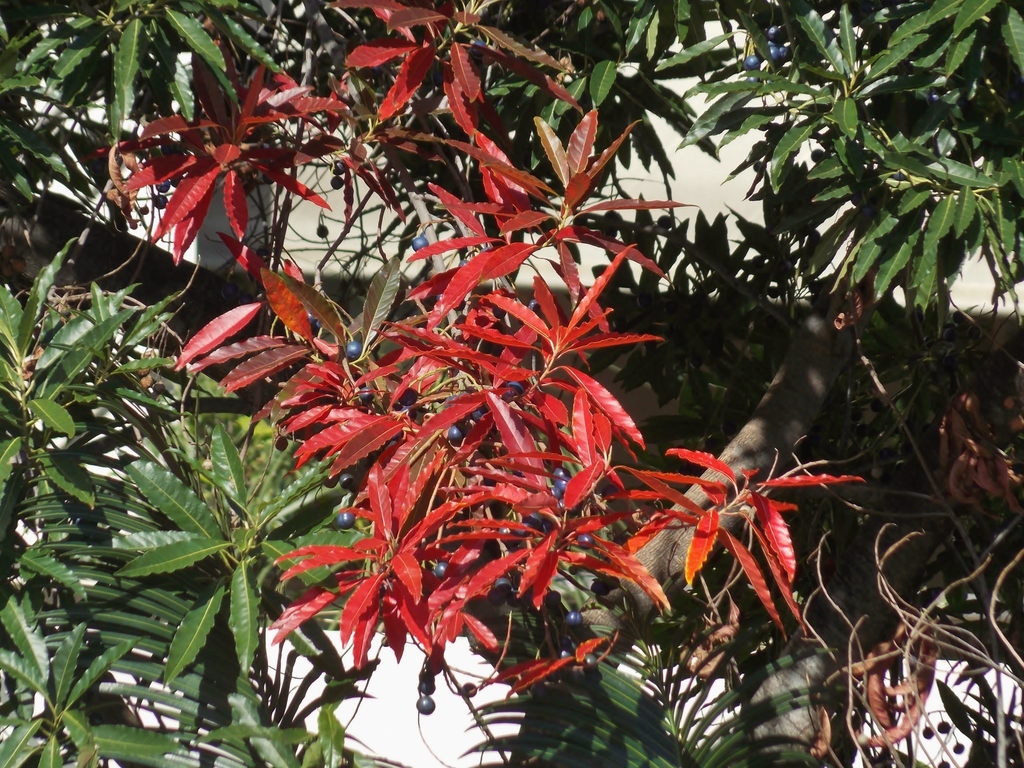
Blue Quandong
Elaeocarpus angustifolius
Elaeocarpus angustifolius is a species of flowering plant in the family Elaeocarpaceae, that is native from India to New Caledonia and northern Australia. It is a large evergreen tree, often with buttressed roots, and has leaves with wavy serrations, creamy white flowers and more or less spherical bright blue edible fruit.
In English, the tree is known as utrasum bean tree in India. In Sri Lanka, local names include woodenbegar and Indian bead tree. It is simply known as elaeocarpus in the Northern Territory of Australia. Other names used for this tree in Australia are Indian oil fruit and genitri. In Hawaii it (or the possible synonym E. grandis) is known as a blue marble tree.
From the article Elaeocarpus angustifolius on Wikipedia (CC BY-SA), quoted section by section
Description
According to M.J.E. Coode, Elaeocarpus angustifolius is a tree that typically grows to a height of 40 m (130 ft) and usually has buttress roots at the base of the trunk. The leaves are about 60–180 mm (2.4–7.1 in) long, 40–60 mm (1.6–2.4 in) wide with wavy serrations on the edges and tapering to a petiole 5–15 mm (0.20–0.59 in) long, but lacking a pulvinus. Old leaves often turn bright red before falling. The flowers are arranged in racemes up to 100 mm (3.9 in) long, each flower on a pedicel 9–16 mm (0.35–0.63 in) long. The five sepals are 8–11 mm (0.31–0.43 in) long and 1–2 mm (0.039–0.079 in) wide. The five petals are creamy white, egg-shaped to oblong, 12–15 mm (0.47–0.59 in) long and 3–4 mm (0.12–0.16 in) wide, the tip with linear lobes. There are between thirty-five and sixty stamens and the style is 11–18 mm (0.43–0.71 in) long and glabrous. The fruit is a more or less spherical, bright blue or purple drupe 15–23 mm (0.59–0.91 in) in diameter. Note, however, that Coode considered E. grandis to be the same species as E. angustifolius, and the above description applies to both taxa. Mature trees will grow massive buttresses which generally completely encircle the base of the trunk. …
Range & habitat
This species has a wide distribution stretching from the Himalayas in Nepal and India east to China and the Philippines, and south to Indonesia, Papua New Guinea and Australia.
China. It occurs in the wild in the provinces of Yunnan, Guangxi and Hainan.
Indian subcontinent. In the Indian subcontinent it grows in the Indo-Gangetic Plain in the foothills of the Himalayas. It grows on Sri Lanka, but it is not particularly common.
Pacific Islands. It is native to New Caledonia, Vanuatu, and the Santa Cruz Islands. It occurs on Fiji. In New Caledonia it occurs across Grande Terre (from Prony Bay to Poum), the Isle of Pines (île des Pins) and the Loyalty Islands (Lifou, Maré, Ouvéa). Note that E. angustifolius has often been imported from Australia to New Caledonia as an ornamental plant, and according to the Australians these plants may technically actually be E. grandis, although this is a moot point if these two names are synonyms. Specimens of E. angustifolius were planted in Oahu in the 1930s and have subsequently become naturalised in nearby forests. Note that the plants in Hawaii were introduced from Australia and may technically actually be E. …
Wikipedia: “Distribution”
What it does
It is typical of second-growth forest, large individuals found in what appears to be primary rainforest are believed to probably be elderly remnants of a time when the rainforest was less 'primary', i.e. when fires, storms or humankind disturbed it. It also is sometimes found in somewhat swampy sites, or at least along watercourses, and in more cultivated or even urban settings. In New Caledonia the property of growing in disturbed sites has been used in archaeology to look at the influence of humankind in the species composition of the rainforests. The long-term presence of humans increases the population of this species.
Writing from Ambon Island in the mid 17th century, Rumphius described that the fruits are gladly eaten by large birds, mentioning that especially wreathed hornbills can be found feeding upon them. Fruit bats also do so. E. angustifolius was found to be one among a few dozen species of relatively large-fruited rainforest plants eaten by double-wattled cassowaries in northern Australia. These trees are at present called E. grandis, but it is almost certain that these flightless birds feed on the fruit and likely disperse the seeds, whatever the taxonomic position—they have been found to eat all types of Elaeocarpus fruit, as well as fruit of this genus on Seram and the Aru Islands, where E. angustifolius is present. …
Wikipedia: “Ecology”
At the table
Hundreds of years ago this plant was an important article of international commerce, specifically, the burl-like stones containing the seeds. Rumphius describes that it was common practice across the islands of the Indonesian archipelago to trade in the stones, known as ganiter or ganitris in Malay, Javanese and Balinese—words known across the East Indies. Not all stones were valuable, the best were of a smaller size and were coloured deep brown. The stones often were collected from the defecations of cattle, for it was during the passage through the various stomachs of the cow that the stones gained the preferred colour, although less scrupulous dealers were wont to drown the stones in seawater to achieve a similar effect. Stones which had lain on the ground became a less appealing grey colour and thus had no value. A trader could collect some 3,000 Dutch pounds of the unsorted stones at a port in Java, Madura or Bali for only some 60 silver real, the merchant must then sort his cargo, retaining only the small and medium stones, and throwing out the rest. The middle-sized stones were not worth much, but for the small stones Hindus and Arab traders would pay good money, some 10 real for a handful of the stones, using them to make religious objects for their priests. …
Wikipedia: “Uses”
Where it lives
Recorded sightings
—
geo-referenced records in GBIF, from museums, herbaria and field observers.
Drag the globe to turn it. Dots are where records exist, not a range map; darker means more records.
In the stacks
Searching the stacks…
Every page naming Elaeocarpus angustifolius in the Biodiversity Heritage Library →
This page is assembled live from iNaturalist, GBIF, Wikipedia, the Source Library and the Internet Archive. It is not yet part of the hand-edited codex. iNaturalist taxon 122295.