- Plants
- ›Vascular Plants
- ›Ferns
- ›Potato Ferns and Allies
- ›potato ferns and allies
- ›potato fern family
- ›Angiopteris
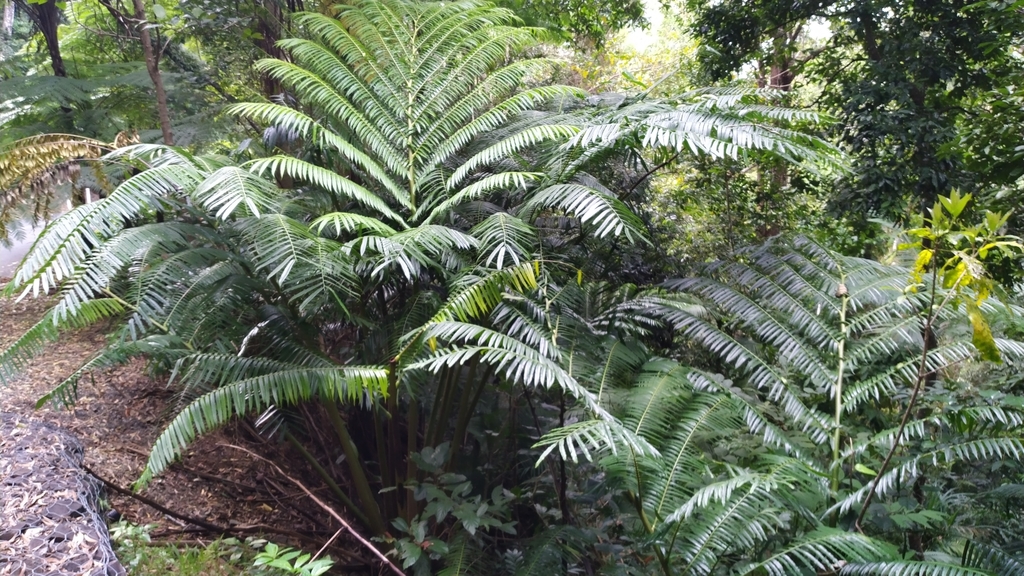
king fern
Angiopteris evecta
Angiopteris evecta, commonly known as the giant fern, is a rare plant occurring in eastern and northern Australia and the Malay Peninsula. Also found growing in nearby islands such as Borneo, Sumatra, New Guinea and various places in Polynesia, Melanesia and Madagascar. Listed as endangered in New South Wales, where it has been recorded growing in sub tropical rainforest, in the valley of the Tweed River. It is an invasive species in Hawaii and Jamaica.
From the article Angiopteris evecta on Wikipedia (CC BY-SA), quoted section by section
Description
Angiopteris evecta is a self-supporting evergreen perennial fern with very large bipinnate fronds. The trunk-like rhizome is massive, measuring up to 1 m (3 ft 3 in) in diameter. The older portions of the rhizome lie on the ground while the newer growth may rise vertically up to 1.2 m (3 ft 11 in) high. The arching, glossy green fronds, which emerge from the tip of the rhizome, may reach up to 9 m (30 ft) long and 2.5 m (8 ft 2 in) wide, with the fleshy green petiole (leaf stem) making up 2 m (6 ft 7 in) of that length. They are said to be the longest fern fronds in the world, and despite their enormous size they have no woody strengthening tissues in the fronds to keep them erect—instead they are supported entirely by the hydraulic pressure of the sap. On either side of the petiole where it arises from the rhizome there are flat, rounded, leathery, ear-shaped stipules, known as "auricles", which can measure up to 15 cm (5.9 in) in diameter. The fronds are bipinnate with about 9 to 12 pairs of pinnae measuring up to 150 cm (59 in) long and 45 cm (18 in) wide. Each pinnae carries about 30 to 40 pairs of pinnules that measure around 13 by 2 cm (5.1 by 0.8 in), and both the main rachis and the secondary rachillae (midribs) are pulvinate (swollen at the base). …
Range & habitat
Angiopteris evecta is native to southeast Asia and Oceania, from Sri Lanka and Bangladesh in the west through to Melanesia, Micronesia and Polynesia in the east, and from Japan in the north to northern and eastern Australia in the south. It has been introduced to most of the rest of tropical Asia, as well as Madagascar and parts of the tropical Americas. It has become naturalised in Hawaii, Jamaica, Costa Rica and Cuba. The species grows in rainforest on very rich soils, often of volcanic origin and prefers a very warm wet climate. It is usually an understorey plant in well developed rainforest, especially along creek banks in deep sheltered gullies where there is good drainage and a plentiful supply of fresh water, but is occasionally found in more exposed situations. The preferred annual mean temperature range is 19–27 °C (66–81 °F) and annual precipitation between 1,000 and 5,400 mm (39 and 213 in). It grows at elevations from sea level to 1,500 m (4,900 ft).
Wikipedia: “Distribution and habitat”
At the table
The starchy rhizomes are eaten after long processing to remove toxins, used to perfume coconut oil, to flavour rice and to produce an intoxicating drink. The 1889 book The Useful Native Plants of Australia records Indigenous Australians ate the pith of this fern.
Wikipedia: “Cultural uses”
In human culture
The genus name comes from Ancient Greek aggeion 'vessel', and pteris, 'fern', and is a reference to the sporangia. The species epithet is the Latin adjective evectus meaning to carry out, bring forth, raise, or elevate.
Wikipedia: “Etymology”
Where it lives
Recorded sightings
—
geo-referenced records in GBIF, from museums, herbaria and field observers.
Drag the globe to turn it. Dots are where records exist, not a range map; darker means more records.
In the stacks
Searching the stacks…
Every page naming Angiopteris evecta in the Biodiversity Heritage Library →
This page is assembled live from iNaturalist, GBIF, Wikipedia, the Source Library and the Internet Archive. It is not yet part of the hand-edited codex. iNaturalist taxon 122319.