- Fungi Including Lichens
- ›Basidiomycete Fungi
- ›Higher Basidiomycetes
- ›Mushrooms, Bracket Fungi, Puffballs, and Allies
- ›Russulales
- ›Milkcaps, Brittlegills and Allies
- ›Russula
- ›Heterophyllidiae
- ›Griseinae
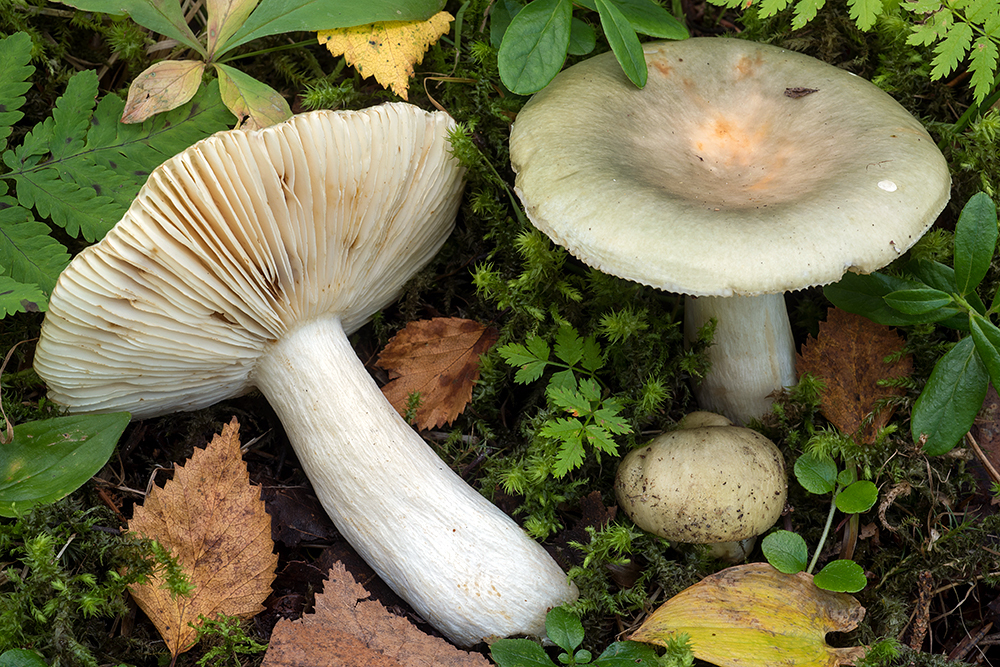
Green Brittlegill
Russula aeruginea
Russula aeruginea, also known as the grass-green Russula, the tacky green Russula, or the green Russula, is an edible Russula mushroom. Widely distributed in northern temperate regions, it is usually found under birch, mostly in pine forests. The very poisonous death cap can have a similar appearance, especially from above.
From the article Russula aeruginea on Wikipedia (CC BY-SA), quoted section by section
Description
The cap is flat when young, soon funnel shaped and weakly striped; somewhat sticky and shiny, pale green to light grey-green, more rarely olive green. It is often 4 to 10 cm (1.6 to 3.9 in) in diameter. The closely spaced gills are pale cream when young, later becoming light yellow when the spores mature. The stipe is white, occasionally with rust-coloured spots at the base, often rather short with longitudinal furrows. It measures 5–8 cm (2.0–3.1 in) long by 1–2 cm (0.4–0.8 in) thick. The flesh is white, brittle and without scent, with a mild taste. The spore print is cream-yellow. The spores are spherical to oval with ridges and warts on the surface, and measure 6–8 by 6–7 μm.
Similar species. The very poisonous death cap can have a similar appearance, especially from above. Green specimens of R. xerampelina (the crab brittlegill) are similar, but always smell of cooked shellfish. R. grisea and R. parazurea are also similar.
Range & habitat
R.aeruginea is widely distributed in northern temperate zones. Fruiting occurs from July to November in Europe, and in late summer to autumn in North America. It is also found in East Africa. The fruit bodies grow on the ground in woods, in troops in leaf litter or in grass. Thius species is ectomycorrhizal with birch, but also with found under conifers, particularly pine and spruce. This mushroom has been recorded as an occasional food of adults of the pleasing fungus beetle Tritoma angulata
Wikipedia: “Distribution and ecology”
Where it lives
Recorded sightings
—
geo-referenced records in GBIF, from museums, herbaria and field observers.
Drag the globe to turn it. Dots are where records exist, not a range map; darker means more records.
In the stacks
Searching the stacks…
Every page naming Russula aeruginea in the Biodiversity Heritage Library →
This page is assembled live from iNaturalist, GBIF, Wikipedia, the Source Library and the Internet Archive. It is not yet part of the hand-edited codex. iNaturalist taxon 122333.