- Plants
- ›Vascular Plants
- ›flowering plants
- ›monocots
- ›Agaves, Orchids, Irises, and Allies
- ›amaryllis, onions, and allies
- ›onion subfamily
- ›Allieae
- ›Allium
- ›Butomissa
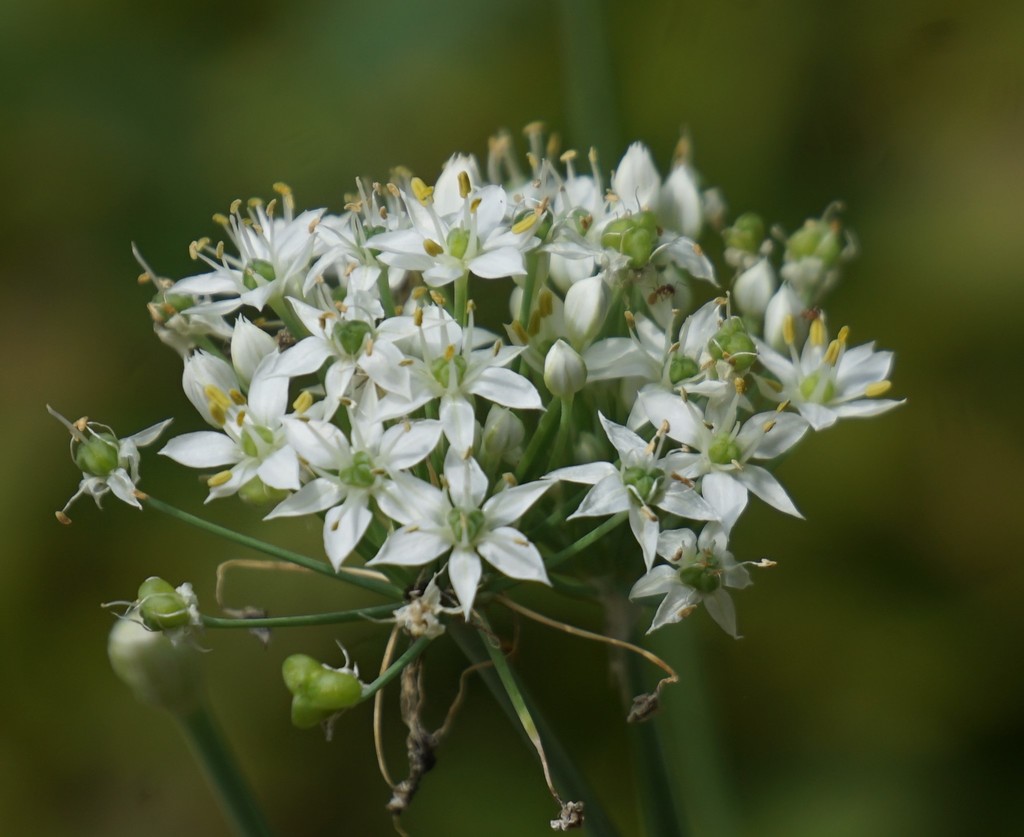
Garlic Chives
Allium tuberosum
Allium tuberosum (garlic chives, Oriental garlic, Asian chives, Chinese chives, Chinese leek) is a species of plant native to the Chinese province of Shanxi, and cultivated and naturalized elsewhere in Asia and around the world. It has a number of uses in Asian cuisine.
From the article Allium tuberosum on Wikipedia (CC BY-SA), quoted section by section
Description
Allium tuberosum is a rhizomatous, clump-forming perennial plant growing from a small, elongated bulb (about 10 mm; 13⁄32 inch, across) that is tough and fibrous. Unlike either onion or garlic, it has strap-shaped leaves with triangular bases, about 1.5 to 8 mm (1⁄16 to 5⁄16 in) wide. It produces many white flowers in a round cluster (umbel) on stalks 25 to 60 cm (10 to 24 in) tall. It grows in slowly expanding perennial clumps, but also readily sprouts from seed. In warmer areas (USDA zone 8 and warmer), garlic chives may remain green all year round. In cold areas (USDA zones 7 to 4b), leaves and stalks completely die back to the ground, and resprout from roots or rhizomes in the spring. The flavor is more like garlic than chives.
Range & habitat
Allium tuberosum originated in the Siberian–Mongolian–North Chinese steppes, but is widely cultivated and naturalised. It has been reported as growing wild in scattered locations in the United States (Illinois, Michigan, Ohio, Nebraska, Alabama, Iowa, Arkansas, and Wisconsin). However, it is believed to be more widespread in North America because of the availability of seeds and seedlings of this species as an exotic herb and because of its aggressiveness. This species is also widespread across much of mainland Europe and invasive in other areas of the world.
Wikipedia: “Distribution and habitat”
What it does
A late summer- to autumn-blooming plant, A. tuberosum is one of several Allium species known as wild onion and/or wild garlic that, in various parts of the world, such as Australia, are listed as noxious weeds or as invasive "serious high impact environmental and/or agricultural weeds that spread rapidly and often create monocultures".
Wikipedia: “Ecology”
At the table
Uses include as ornamental plants, including cut and dried flowers, and as a culinary herb. Garlic chives have been widely cultivated for centuries in East Asia for their culinary value. The flat leaves, the stalks, and immature, unopened flower buds are used as flavouring. Another form is "blanched" by regrowing after cutting under cover to produce white-yellow leaves and a subtler flavor.
China. The leaves are used as a flavoring in a similar way to chives or scallions, and as a stir fry ingredient. They are often used in dumplings with eggs, shrimp, and/or pork. A Chinese flatbread similar to the scallion pancake may be made with garlic chives instead of scallions. Garlic chives are also one of the main ingredients used with yi mein dishes. Its flowers are fermented to make garlic chive flower sauce (韭花酱). When the leaves of garlic chives are blanched by growing them in dark environments these are called jiǔhuáng (韭黄) or jiǔ cài huáng (韭菜黄), known in English as yellow garlic chives. These are considered a delicacy and are used in various stir fry dishes.
India. In Manipur and other northeastern states of India, it is grown and used as a substitute for garlic and onion in cooking, and is known as maroi nakuppi (ꯃꯔꯣꯏ ꯅꯥꯀꯨꯞꯄꯤ) or maroi nakupi (ꯃꯔꯣꯏ ꯅꯥꯀꯨꯄꯤ) in Meitei language (Manipuri). …
Wikipedia: “Uses”
How it is grown
Often grown as an ornamental plant in gardens, several cultivars are available. A. tuberosum is distinctive by blooming later than most native or naturalised species of Allium. It is cold-hardy to USDA zones 4–10 (−30 to +35 °F; −34 to 2 °C). Garlic chives are regarded as easy to grow in many conditions and may spread readily by seeds or can be intentionally propagated by dividing their clumps. A number of varieties have been developed for either improved leaf (e.g. 'Shiva') or flower stem (e.g. 'Nien Hua') production. While the emphasis in Asia has been primarily culinary, in North America, the interest has been more as an ornamental. 'Monstrosum' is a giant ornamental cultivar.
Wikipedia: “Cultivation”
Where it lives
Recorded sightings
—
geo-referenced records in GBIF, from museums, herbaria and field observers.
Drag the globe to turn it. Dots are where records exist, not a range map; darker means more records.
In the old herbals & bestiaries

Illustrated Compendium of Materia Medica (Vol. 3)
吳其濬 · 1848 · p.118

Herbarium Portatile, Oder Behendes Kräuter- und Gewächs-Buch: Darinn nicht allein 1363. so wol Einheimische als Außländndische Kräuter mit Lateinisch und Deutscher Benennung abgebildet, sondern auch die meisten, so in der Medicin gebräuchlich, kürtzlich erkläret werden
Panckow, Thomas · 1656 · p.86
In the stacks
Searching the stacks…
Every page naming Allium tuberosum in the Biodiversity Heritage Library →
This page is assembled live from iNaturalist, GBIF, Wikipedia, the Source Library and the Internet Archive. It is not yet part of the hand-edited codex. iNaturalist taxon 122343.