- Fungi Including Lichens
- ›Ascomycete Fungi
- ›Sac Fungi and Lichens
- ›Common Lichens
- ›Shield Lichens, Sunburst Lichens, Rosette Lichens, and Allies
- ›shield lichens, rim lichens, and allies
- ›bloodstain lichens
- ›Haematomma
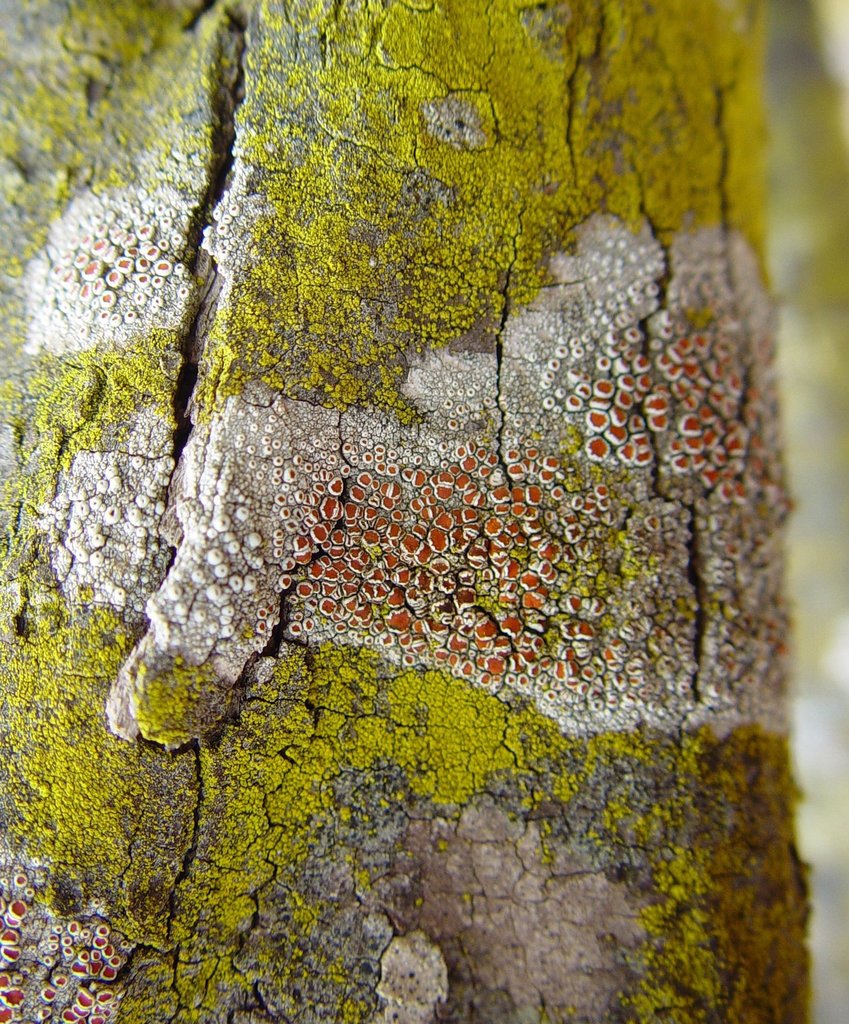
Haematomma eremaeum
Haematomma eremaeum is a bark-dwelling crustose lichen in the family Haematommataceae. It is a small lichen that grows on the bark of trees and shrubs in dry inland areas of Western Australia, where it appears as a greyish crust. The species is distinguished by its tiny red-coloured fruiting bodies, and by the presence of a rare chemical compound in its tissues. It was first formally described in 1982 when lichenologist Roderick Rogers revised the Australian species in its genus.
From the article Haematomma eremaeum on Wikipedia (CC BY-SA), quoted section by section
Description
The thallus of Haematomma eremaeum is crustose and typically grey to yellowish-grey. It is somewhat granular to areolate (broken into small, angular patches). It does not form soredia, and the cortex is poorly developed. The fruiting bodies (apothecia) are sessile and noticeably constricted at the base, reaching about 1 mm in diameter. They have a prominent thalline margin (a rim formed from thallus tissue) that may be smooth or slightly irregular, and an epruinose disc that is greyish-red to reddish-brown. Each ascus contains eight spores. The ascospores are helically coiled in the ascus and are asymmetric. They are transversely 5–11-septate (with 5–11 cross-walls) and measure about 35–55 × 5–7.5 micrometres (length × width). Chemically, the thallus contains atranorin and placodiolic acid, and the apothecia contain acetone-soluble pigments A and C. The epithecium reacts K+ by turning magenta to grey-magenta, with no colour diffusion.
Range & habitat
Haematomma eremaeum is a bark-dwelling species from southern Western Australia, described as endemic to a dry, mostly inland region. In eastern Australia, most Haematomma are largely confined to the humid coastal strip. In Western Australia the genus occurs well inland, and Haematomma eremaeum is associated with semi-arid areas where most rainfall occurs in winter. It has been collected on bark and twigs of woody plants, including dead twigs of Melaleuca hamulosa at the type locality, and also on Acacia (including dead Acacia and Acacia acuminata). Most Australian Haematomma favour smooth-barked trees; in the 1982 revision, Haematomma eremaeum was the only species described as common on rough bark. Reported localities span multiple inland and southern sites in Western Australia, including areas around Lake Barlee, Wongan Hills, Kondinin, Kulin, Pingelly, Boddington, and Lake King, as well as near Wagin and Borden. Lichenostigma hyalosporum is a lichenicolous (lichen-dwelling) fungus that grows on H. eremaeum.
== References ==
Wikipedia: “Habitat and distribution”
Where it lives
Recorded sightings
—
geo-referenced records in GBIF, from museums, herbaria and field observers.
Drag the globe to turn it. Dots are where records exist, not a range map; darker means more records.
In the stacks
Searching the stacks…
Every page naming Haematomma eremaeum in the Biodiversity Heritage Library →
This page is assembled live from iNaturalist, GBIF, Wikipedia, the Source Library and the Internet Archive. It is not yet part of the hand-edited codex. iNaturalist taxon 1225375.