Cassia
Cinnamomum aromaticum
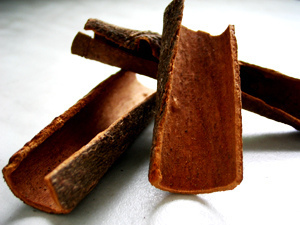
Cinnamomum cassia, called Chinese cassia or Chinese cinnamon, is an evergreen tree originating in southern China, and widely cultivated there and elsewhere in southern and eastern Asia (India, Indonesia, Laos, Malaysia, Taiwan, Thailand, and Vietnam). It is one of several species of Cinnamomum used primarily for their aromatic bark, which is used as a spice. In the United States, Chinese cassia is the most common type of cinnamon used. The buds are also used as a...
From the article Cinnamomum cassia on Wikipedia (CC BY-SA), quoted section by section
Description
The tree grows to 10–15 m (33–49 ft) tall, with greyish bark and hard, elongated leaves that are 10–15 cm (3.9–5.9 in) long and reddish when young.
In medicine
The part of the bark that is used to make spices is called the Cinnamomi cortex. Chinese cassia (called ròuguì; 肉桂 in Chinese) is produced primarily in the southern provinces of Guangxi, Guangdong, and Yunnan. It is considered one of the 50 fundamental herbs in traditional Chinese medicine. More than 160 phytochemicals have been isolated from Cinnamomum cassia. Coumarin found in C. cassia could damage the liver if consumed in larger amounts, therefore European health agencies have warned against consuming high amounts of cassia. (Coumarin is not influencing blood coagulation, but Dicoumarol, formed from Coumarin, does.) Other bioactive compounds found in the bark, powder and essential oils of C. cassia are cinnamaldehyde and styrene. In high doses, these substances can also be toxic to humans.
Wikipedia: “Traditional medicine and phytochemicals”
In human culture
A mention by Chinese herbalists suggests that cassia bark was used by humans at least as far back as 2700 B.C. It was a treatment for diarrhea, fevers, and menstrual issues. Cassia cinnamon was brought to Egypt around 500 B.C. where it became a valued additive to their embalming mixtures. The Bible suggests that it was part of the anointing oil used by Moses. The Greeks, Romans and ancient Hebrews were the first to use cassia bark as a cooking spice. They also made perfumes with it and used it for medicinal purposes. Cinnamon migrated with the Romans. It was established for culinary use by the 17th century in Europe.
Wikipedia: “History”
Where it lives
Recorded sightings
—
geo-referenced records in GBIF, from museums, herbaria and field observers.
Drag the globe to turn it. Dots are where records exist, not a range map; darker means more records.
In the old herbals & bestiaries

Ortus sanitatis
1491 · p.100

Garden of Health
1507 · p.80

The Great Herbary with all the figures of the herbs
1532 · p.119

The Great Herbary with all the figures of the herbs
1532 · p.120

Commentaries on the Six Books of Dioscorides
Pietro Andrea Mattioli · 1560 · p.142

Commentaries on the Six Books of Dioscorides on Medical Matter
Pietro Andrea Mattioli · 1563 · p.142

Commentaries on the Six Books of Pedanius Dioscorides on Medical Matter
Pietro Andrea Mattioli · 1565 · p.226

Discourses on the Six Books of Dioscorides
Dioscorides; Pietro Andrea Mattioli (comm.) · 1568 · p.238

A New Herbal, or History of Plants
Rembert Dodoens (trans. Henry Lyte) · 1578 · p.765

Six Groups of the History of Plants
Rembert Dodoens · 1583 · p.796

The Plants of Egypt
Prospero Alpini · 1592 · p.17

Compendium of Materia Medica
李時珍 · 1596 · p.27
In the stacks
Searching the stacks…
Every page naming Cinnamomum aromaticum in the Biodiversity Heritage Library →
This page is assembled live from iNaturalist, GBIF, Wikipedia, the Source Library and the Internet Archive. It is not yet part of the hand-edited codex. iNaturalist taxon 122782.