- Plants
- ›Vascular Plants
- ›flowering plants
- ›Dicots
- ›beeches, oaks, walnuts, and allies
- ›beech family
- ›Castanea
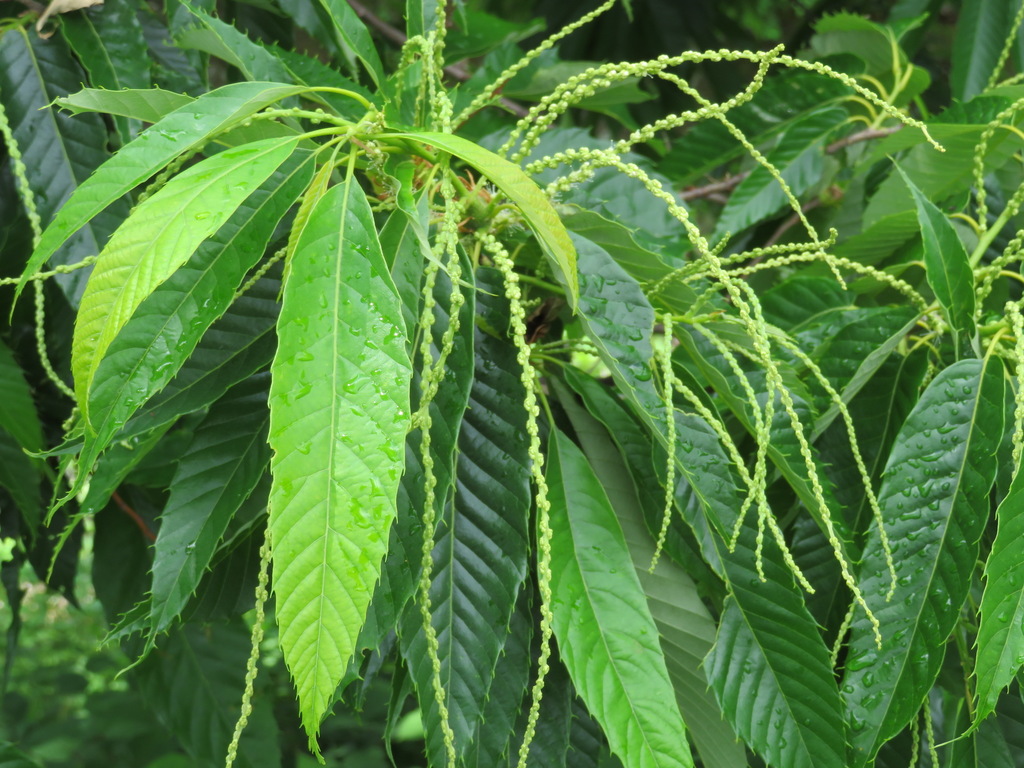
Japanese Chestnut
Castanea crenata
Castanea crenata, known as Korean chestnut, Korean castanea, and Japanese chestnut, is a species of chestnut originally native to Japan and South Korea. It is a small to medium-sized deciduous tree growing to 10–15 m tall. The leaves are similar to those of the sweet chestnut, though usually a little smaller, 8–19 cm long and 3–5 cm broad. The flowers of both sexes are borne in 7–20 cm long, upright catkins, the male flowers in the upper part and...
From the article Castanea crenata on Wikipedia (CC BY-SA), quoted section by section
Description
Castanea crenata is a small to medium-sized deciduous tree growing to 10–15 m (30–50 ft) tall. The leaves are similar to those of the sweet chestnut, though usually a little smaller, 8–19 cm (3+1⁄4–7+1⁄2 in) long and 3–5 cm (1+1⁄4–2 in) broad. The flowers of both sexes are borne in 7–20 cm (2+3⁄4–7+3⁄4 in) long, upright catkins, the male flowers in the upper part and female flowers in the lower part. They appear in summer, and by autumn, the female flowers develop into spiny cupules containing 3–7 brownish nuts that are shed during October.
At the table
Castanea crenata is an important tree in Japan and Korea for its heavy production of sweet, edible nuts. A number of cultivars have been selected for large nut size. It is also widely cultivated in eastern China and Taiwan. It is resistant to chestnut blight and to ink disease, and for these reasons is of importance in North America in the development of disease-resistant hybrids and genetic engineering of the American chestnut, which is susceptible to both fungal pathogens. Examples of Japanese chestnut cultivars are:
'Tsukuba' 'Tanzawa' 'Ginyose' 'Arima' 'Ishizuchi' 'Okkwanng' 'Porotan' 'Sandae' Examples of European × Japanese hybrid cultivars are:
'Colossal' 'Bouche de Betizac' 'Precoce Migoule' 'Labor Day' C. crenata produces more biomass in its stems when the nuts are smaller and planted deeper.
Wikipedia: “Cultivation and uses”
Where it lives
Recorded sightings
—
geo-referenced records in GBIF, from museums, herbaria and field observers.
Drag the globe to turn it. Dots are where records exist, not a range map; darker means more records.
In the stacks
Searching the stacks…
Every page naming Castanea crenata in the Biodiversity Heritage Library →
This page is assembled live from iNaturalist, GBIF, Wikipedia, the Source Library and the Internet Archive. It is not yet part of the hand-edited codex. iNaturalist taxon 122786.