- Plants
- ›Vascular Plants
- ›flowering plants
- ›Dicots
- ›beeches, oaks, walnuts, and allies
- ›walnut family
- ›Juglans
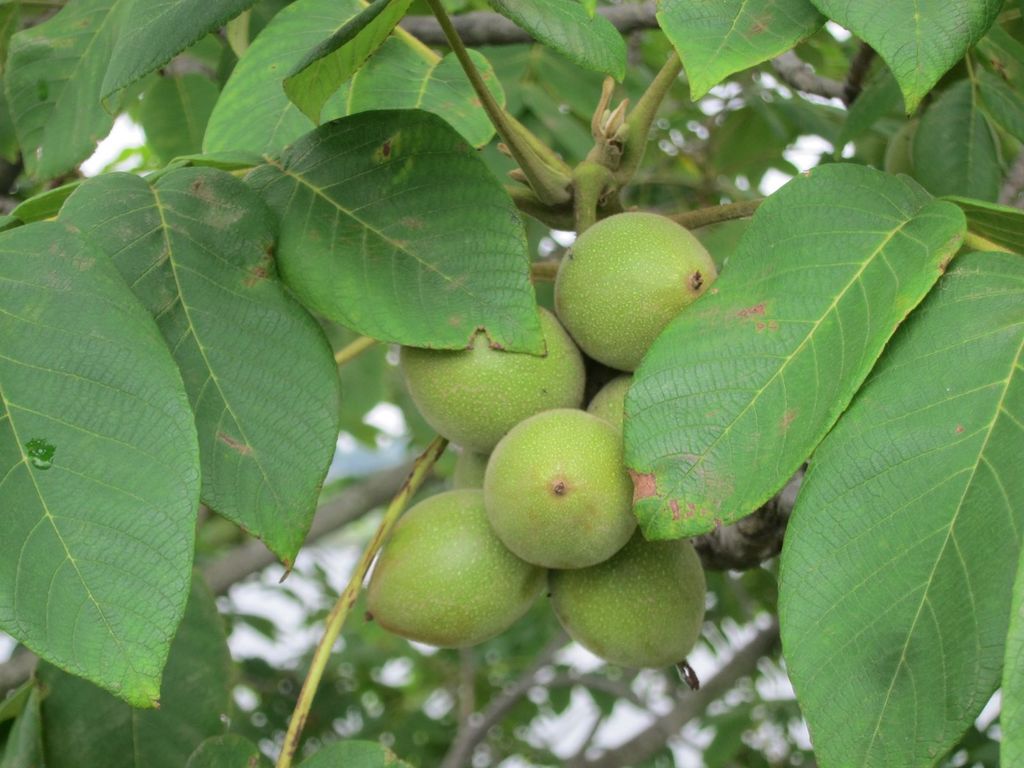
Japanese walnut
Juglans ailantifolia
Juglans ailantifolia (synonyms J. cordiformis and J. sieboldiana and J. mandshurica var. sachalinensis), the Japanese walnut (Japanese: 鬼胡桃 oni-gurumi), is a species of walnut native to Japan and Sakhalin. It is a deciduous tree growing to 20 m (66 ft) tall, rarely 30 m (98 ft), and 40–80 cm stem diameter, with light grey bark. The leaves are pinnate, 50–90 cm long, with 11-17 leaflets, each leaflet 7–16 cm long and 3–5 cm broad. The whole leaf is downy-pubescent, and a somewhat brighter, yellower...
From the article Juglans ailantifolia on Wikipedia (CC BY-SA), quoted section by section
Description
It is a deciduous tree growing to 20 m (66 ft) tall, rarely 30 m (98 ft), and 40–80 centimetres (16–31 in) stem diameter, with light grey bark. The leaves are pinnate, 50–90 cm (20–35 in) long, with 11–17 leaflets, each leaflet 7–16 cm (3–6+1⁄2 in) long and 3–5 cm (1–2 in) broad. The whole leaf is downy-pubescent, and a somewhat brighter, yellower green than many other tree leaves. The male flowers are inconspicuous yellow-green catkins produced in spring at the same time as the new leaves appear. The female flowers have pink/red pistils. The fruit is a nut, produced in bunches of 4–10 together; the nut is spherical, 3–5 cm long and broad, surrounded by a green husk before maturity in mid-autumn.
At the table
The edible nuts have an oily texture. The husks are also used to make a yellowish dye. The bold, decorative leaves and catkins produced in spring make it a popular ornamental tree in parks and large gardens. Unlike the closely related and very similar North American butternut, Japanese walnut is resistant to the canker disease caused by the fungus Sirococcus clavigignenti-juglandacearum. This has led to its being planted as a replacement for butternuts in North America. The two species hybridise readily; the resulting hybrid Juglans x bixbyi (otherwise known as J. cinerea x ailantifolia or 'buartnut') is also resistant to canker and is likewise planted as a replacement for butternuts. Japanese walnut is distinguished from butternut by its larger leaves and round (not oval) nuts. Prospect Rock Permaculture in Vermont has been backcrossing buartnuts with native butternuts, resulting in 'butterbuarts', which will most likely bear greater resemblance to the butternut parentage, although may also be more susceptible to the canker. The wood is light and takes polish well, but is of much lower quality than Persian walnut wood. It is often used to make furniture.
Wikipedia: “Uses”
Where it lives
Recorded sightings
—
geo-referenced records in GBIF, from museums, herbaria and field observers.
Drag the globe to turn it. Dots are where records exist, not a range map; darker means more records.
In the stacks
Searching the stacks…
Every page naming Juglans ailantifolia in the Biodiversity Heritage Library →
This page is assembled live from iNaturalist, GBIF, Wikipedia, the Source Library and the Internet Archive. It is not yet part of the hand-edited codex. iNaturalist taxon 122793.