- Plants
- ›Vascular Plants
- ›flowering plants
- ›Dicots
- ›Soapberries, Cashews, Mahoganies, and Allies
- ›citrus family
- ›Aurantioideae
- ›Citrus
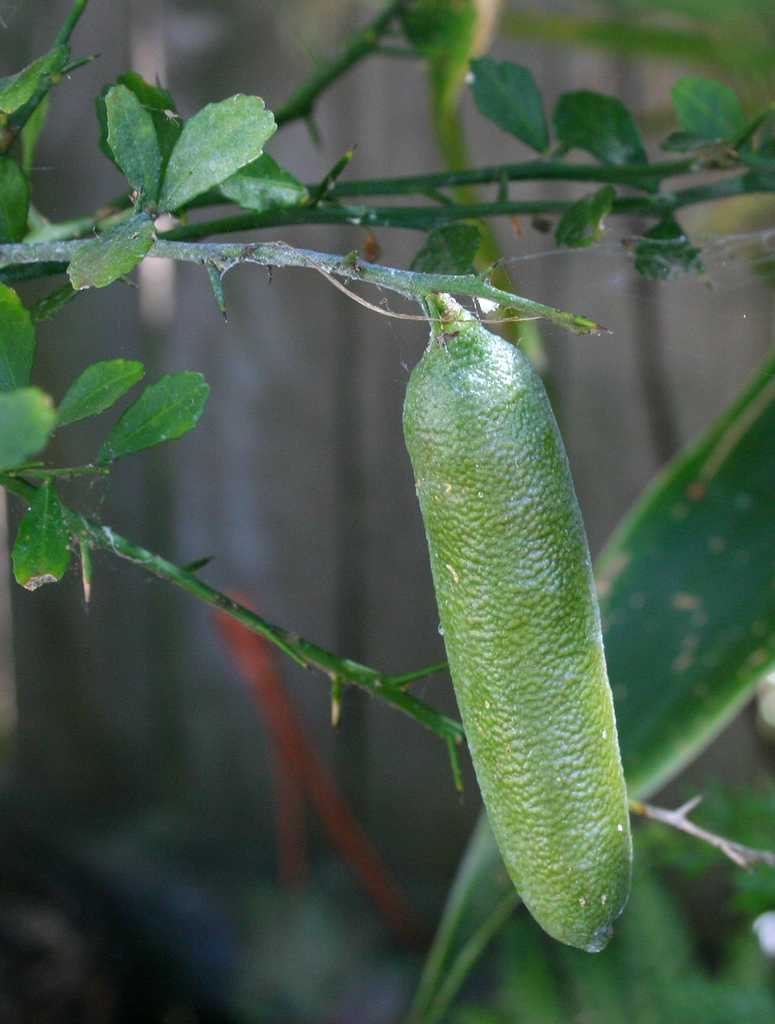
Finger Lime
Citrus australasica
The Australian finger lime plant (Citrus australasica) is a thorny understorey shrub or small tree of lowland subtropical rainforest and dry rainforest in the coastal border region of Queensland and New South Wales, Australia. It has edible fruits which are under development as a potential new commercial crop.
From the article Citrus australasica on Wikipedia (CC BY-SA), quoted section by section
Description
Citrus australasica is a shrub or small tree to about 10 m (33 ft) tall with sharp spines up to 2.5 cm (1 in) long in the leaf axils. The leaves are light green in colour, obovate or rhombic in shape, and arranged alternately along the twigs. They measure up to 2.5 cm (1 in) wide and long, but may reach 5 cm (2 in) long, and they may be faintly crenate (scalloped) towards the apex. Like many other plants in the genus, the leaves contain numerous oil glands and are aromatic when crushed. The flowers are either solitary or paired and are set on peduncles about 3 mm (0.12 in) long. The sepals are tiny, about 1.5 mm (0.06 in) long, the white petals are up to 9 mm (0.35 in) long. Stamens number between 20 and 25. The fruit is a botanical berry, cylindrical and tapered at both ends, slightly curved and about 8 cm (3.1 in) long. The skin is rough with numerous oil glands, and greenish yellow to pink. They contain numerous pale seeds about 7 mm (0.28 in) long.
Range & habitat
The finger lime is native to the southeastern corner of Queensland and the northeastern corner of New South Wales, from the area around Brisbane to the Clarence River. It grows in coastal rainforest and extends into neighbouring open forest, often on soils derived from basalt. It is favoured by disturbance.
Wikipedia: “Distribution and habitat”
In human culture
First Peoples living along the east coast of Australia used finger limes for hydration and to treat skin infections and cuts. The fruits contain the nutrients vitamin C, folate and potassium, as well as the antioxidants vitamin E and polyphenols, and research has shown the efficiency of vitamin C as a treatment for bacterial infections. Early settlers consumed the fruit and retained the trees when clearing for agriculture. Colonial botanists suggested that they should be cultivated, due to the lack of citrus alternatives.
Wikipedia: “History”
Where it lives
Recorded sightings
—
geo-referenced records in GBIF, from museums, herbaria and field observers.
Drag the globe to turn it. Dots are where records exist, not a range map; darker means more records.
In the stacks
Searching the stacks…
Every page naming Citrus australasica in the Biodiversity Heritage Library →
This page is assembled live from iNaturalist, GBIF, Wikipedia, the Source Library and the Internet Archive. It is not yet part of the hand-edited codex. iNaturalist taxon 122812.