- Plants
- ›Vascular Plants
- ›flowering plants
- ›monocots
- ›grasses, sedges, cattails, and allies
- ›grasses
- ›Pooideae
- ›Wheats, ryes, barleys and relatives
- ›Wheats, goatgrasses, and relatives
- ›Triticum
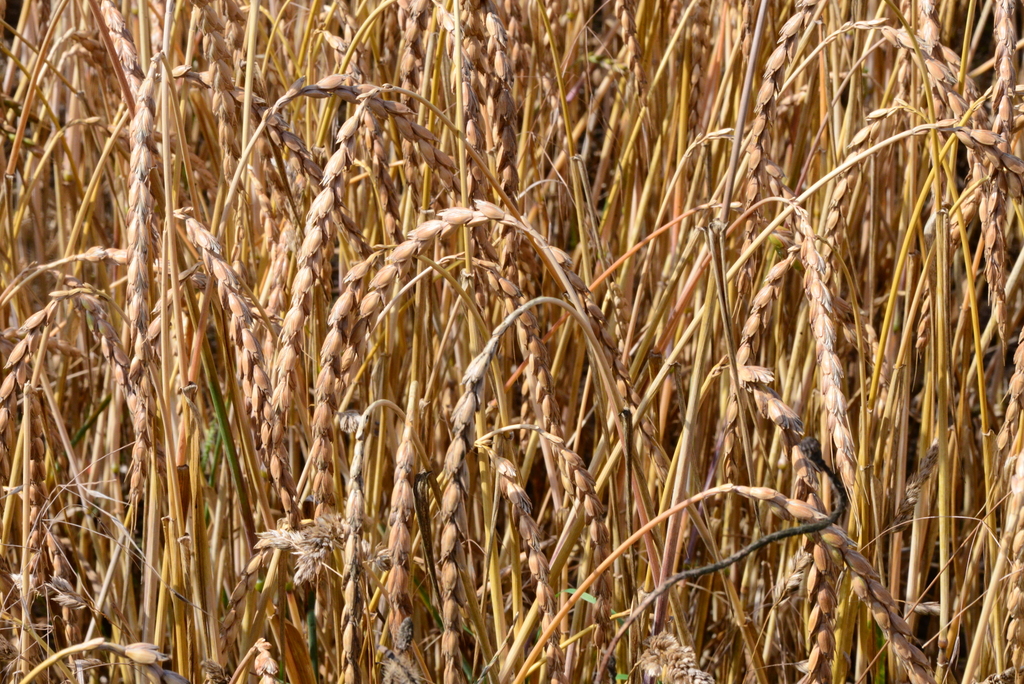
Spelt
Triticum spelta
Spelt (Triticum spelta), also known as dinkel wheat, is a species of wheat. It is a relict crop, eaten in Central Europe and northern Spain. It is high in protein. In Australia it is marketed as a health food.
Spelt was cultivated from the Neolithic period onward. It was a staple food in parts of Europe from the Bronze Age to the Middle Ages. It is used in baking, and is made into bread, pasta, and beer.
From the article Spelt on Wikipedia (CC BY-SA), quoted section by section
Description
Spelt is a species of Triticum, a large stout grass similar to bread wheat. Its flowering spike is slenderer than that of bread wheat; when ripe, it bends somewhat from the vertical. The spike is roughly four-edged. The axis of the spike is brittle and divided into segments; it shatters into separate segments when fully ripe. Spelt differs from bread wheat in that each seed (a caryopsis, botanically a fruit with its wall fused to the single seed inside) stays fully encapsulated by its husk.
At the table
A 100-gram (3+1⁄2-ounce) reference serving of uncooked spelt provides 1,400 kilojoules (340 kilocalories) of food energy and is a rich source (20% or more of the Daily Value) of protein, dietary fiber, several B vitamins, and numerous dietary minerals (table). Highest nutrient contents include manganese (143% DV), phosphorus (57% DV), and niacin (46% DV). Spelt contains about 70% total carbohydrates, including 11% as dietary fibre, and is low in fat (table). Spelt contains gluten, and is therefore suitable for baking, but this component makes it unsuitable for people with gluten-related disorders, such as celiac disease. In comparison to hard red winter wheat, spelt has a more soluble protein matrix characterized by a higher gliadin:glutenin ratio.
Wikipedia: “Nutrition”
How it is grown
Spelt has been cultivated since approximately 5000 BCE. In the fifth millennium BCE, there are archaeological remains in the north of Iraq and in Transcaucasia, north-east of the Black Sea. Much more evidence comes from Europe. Remains of spelt have been found in Denmark, Germany, and Poland from the later Neolithic (dating from 2500–1700 BCE). Evidence of spelt has been found from across central Europe from the Bronze Age. In the south of Germany and Switzerland in the Iron Age (750–15 BCE), it was a major type of wheat, while by 500 BCE, it had in addition become widespread in the south of Britain. There is evidence that spelt cultivation increased in Iron Age Britain as damp regions of the country with heavy soils tolerated by spelt were being settled. In the Middle Ages, spelt was cultivated in parts of Switzerland, Tyrol, Germany, northern France and the southern Low Countries. Spelt became a major crop in Europe in the 9th century CE, possibly because it is more suitable for storage and being husked makes it more adaptable to cold climates. Spelt was introduced to the United States in the 1890s. In the 20th century, spelt was replaced by bread wheat in almost all areas where it was still grown. The organic farming movement revived its popularity somewhat toward the end of the 20th century, as spelt requires less fertilizer. …
Wikipedia: “History of cultivation”
Where it lives
Recorded sightings
—
geo-referenced records in GBIF, from museums, herbaria and field observers.
Drag the globe to turn it. Dots are where records exist, not a range map; darker means more records.
In the old herbals & bestiaries

Ortus sanitatis
1491 · p.409

Garden of Health
Jacob Meydenbach · 1491 · p.409

Garden of Health (Hortus Sanitatis)
Jacob Meydenbach · 1491 · p.332

The Great Herbary with all the figures of the herbs
1532 · p.286

Notable Commentaries on the History of Plants
Leonhart Fuchs · 1542 · p.317

Book of Herbs
Hieronymus Bock (Tragus) · 1546 · p.522

Notable Commentaries on the History of Plants
Leonhart Fuchs · 1549 · p.315

On the Names of Plants
Hieronymus Bock (Tragus) · 1552 · p.714

Commentaries on the Six Books of Dioscorides
Pietro Andrea Mattioli · 1560 · p.370

Commentaries on the Six Books of Dioscorides on Medical Matter
Pietro Andrea Mattioli · 1563 · p.355

A New Herbal, or History of Plants
Rembert Dodoens (trans. Henry Lyte) · 1578 · p.480

Garden of Health
1507 · p.330
In the stacks
Searching the stacks…
Every page naming Triticum spelta in the Biodiversity Heritage Library →
This page is assembled live from iNaturalist, GBIF, Wikipedia, the Source Library and the Internet Archive. It is not yet part of the hand-edited codex. iNaturalist taxon 122840.