- Plants
- ›Vascular Plants
- ›flowering plants
- ›Dicots
- ›Soapberries, Cashews, Mahoganies, and Allies
- ›Cashew Family
- ›cashews, sumacs, and allies
- ›Rhus
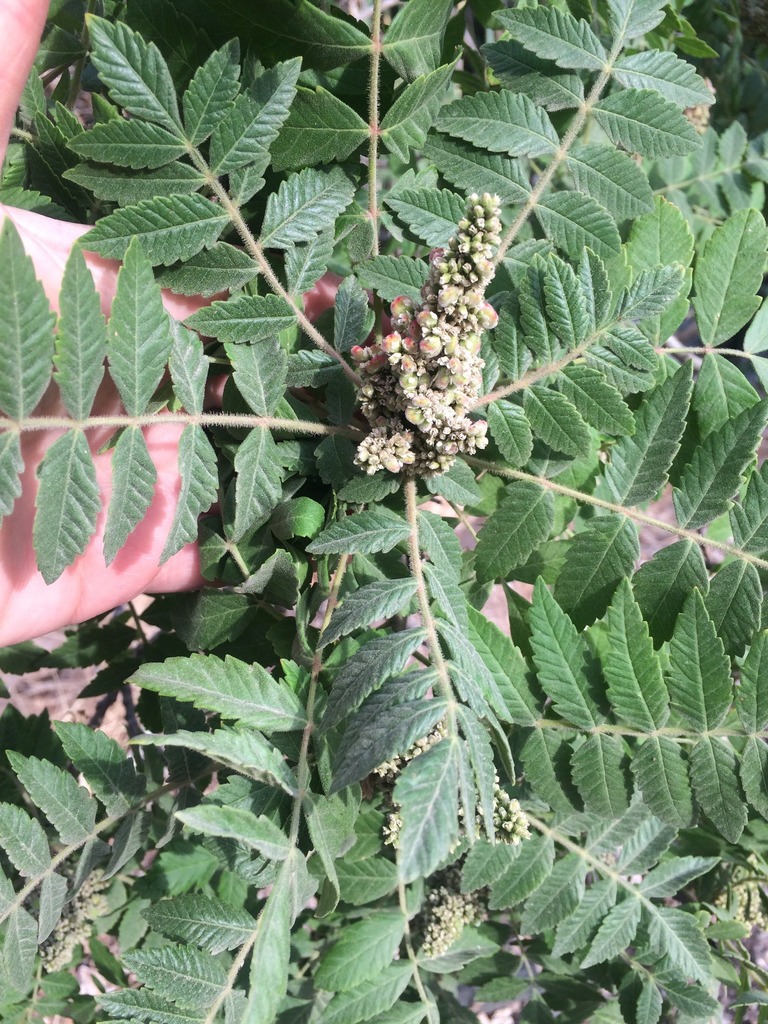
Tanner's sumac
Rhus coriaria
Rhus coriaria, commonly called Sicilian sumac, tanner's sumach, or elm-leaved sumach, is a deciduous shrub to small tree in the cashew family Anacardiaceae. It is native to southern Europe and western Asia. The dried fruits are used as a spice, particularly in combination with other spices in the mixture called za'atar.
From the article Rhus coriaria on Wikipedia (CC BY-SA), quoted section by section
Range & habitat
Rhus coriaria is native to southern Europe and western Asia, including the Eastern Mediterranean, Crimea, Caucasus and northern Iran, but is now naturalized in most of the Mediterranean Basin as well as Macaronesia.
Wikipedia: “Distribution and habitat”
At the table
The fruit has a sour taste; dried and crushed, it is a popular spice in the Middle East, used especially in the spice mixture za'atar. Immature fruits and seeds are also eaten. Mature fruits were also known well before lemons to the Europeans since the times of the ancient Romans, who appreciated its sourness and used it in vinaigrettes like lemons in modern times. It is traditionally used and also clinically investigated for lipid lowing effects. The leaves and the bark were traditionally used in leather tanning and contain tannic acid. Dyes of various colours, red, yellow, black, and brown, can be made from different parts of the plant. Oil extracted from the seeds can be used to make candles.
Wikipedia: “Uses”
How it is grown
Rhus coriaria is a hardy, drought-tolerant, deciduous shrub growing to 3 metres (10 ft) at a medium rate or to a small tree up to 5 m (16 ft) high. It prefers full sun. It is frost-sensitive and can be grown in USDA hardiness zones 8-11 and UK zone 9. The plant will grow in any type of soil that is deep and well-drained, including poor, rocky, alkaline or slightly acidic soils.
Wikipedia: “Cultivation”
In human culture
The word originally comes from Hebrew סמק, then through the Aramaic summāqā 'red', via Arabic, Latin, and French.
Wikipedia: “Etymology”
Where it lives
Recorded sightings
—
geo-referenced records in GBIF, from museums, herbaria and field observers.
Drag the globe to turn it. Dots are where records exist, not a range map; darker means more records.
In the old herbals & bestiaries


In the stacks
Searching the stacks…
Every page naming Rhus coriaria in the Biodiversity Heritage Library →
This page is assembled live from iNaturalist, GBIF, Wikipedia, the Source Library and the Internet Archive. It is not yet part of the hand-edited codex. iNaturalist taxon 122987.