- Plants
- ›Vascular Plants
- ›flowering plants
- ›monocots
- ›screwpines, stemona, and allies
- ›screwpine family
- ›Pandanus
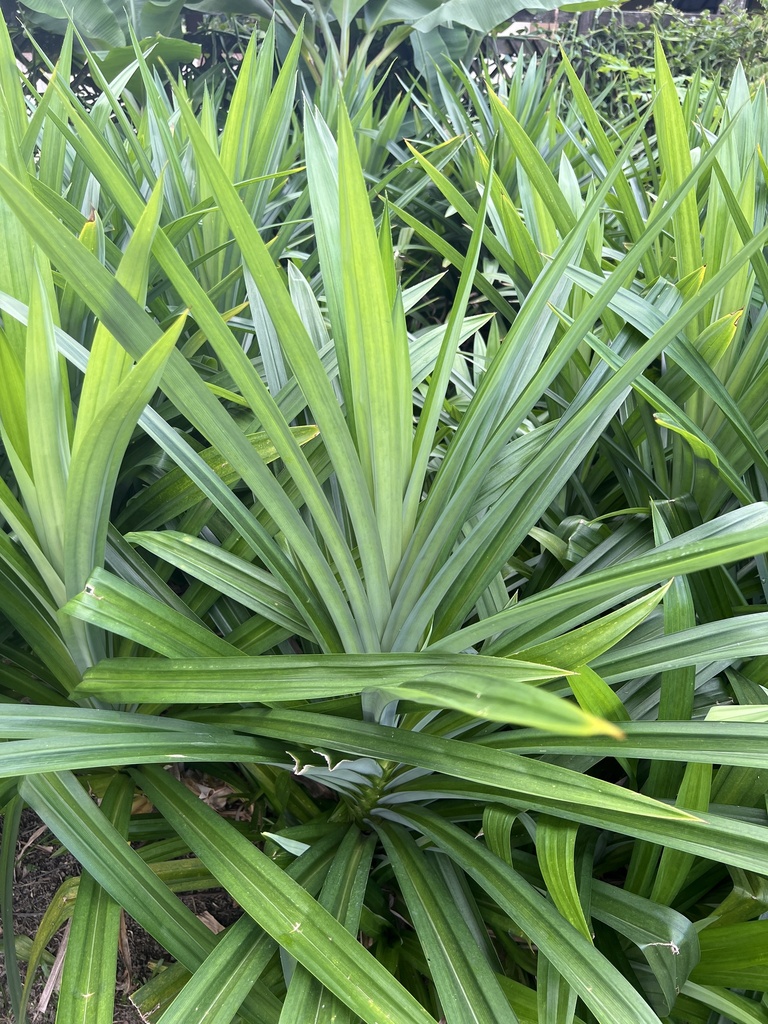
Pandan
Pandanus amaryllifolius
Pandanus amaryllifolius is a tropical plant in the Pandanus (screwpine) genus, which is commonly known as pandan (; Malay: [ˈpandan]). Its fragrant leaves are commonly used for flavoring in the cuisines of Southeast Asia, some South Asian cuisines (such as Sri Lankan cuisine) and in Hainanese cuisine from China.
From the article Pandanus amaryllifolius on Wikipedia (CC BY-SA), quoted section by section
Range & habitat
Pandanus amaryllifolius is a true cultigen, and it is believed to have been domesticated in ancient times. It is sterile and can only reproduce vegetatively through suckers or cuttings. It was first described from specimens from the Maluku Islands, and the rare presence of male flowers in these specimens may indicate that it is the origin of the species. However, as no other wild specimens have been found, this is still conjecture. The plant is grown widely throughout Southeast Asia and South Asia.
Wikipedia: “Occurrence and habitat”
At the table
The taste of pandan has been described as floral, sweet, grassy, as well as like vanilla. It often has a subtle flavor or scent. In the Philippines, Indonesia, Vietnam, Cambodia, Malaysia, and Singapore, it is commonly called pandan or pandan wangi (fragrant pandan). The green juice acquired from its leaf is used extensively in Philippine cuisine, Indonesian cuisine, and Malaysian cuisine as green food colouring and flavouring agents that give a pleasant aroma to traditional cakes such as kakanin and kue; including klepon, kue putu, dadar gulung, lapis legit, pandan cake, buko pandan salad, and buko pandan cake. The tied knot of bruised pandan leaf is also added into fragrant coconut rice to enhance the aroma. In Sri Lanka, it is called rambai (Tamil: ரம்பை) or rampe (Sinhala: රම්පේ ; ) and it is grown almost in every household. Most of the Sri Lankan dishes use these leaves for aroma along with curry leaves. In India, it is called annapurna leaves; In Odisha, annapurna leaves are used to lend aroma to rice and pithas, in Bangladesh, it is called pulao pata (পোলাও পাতা); and in the Maldives, it is called ran’baa along with the other variety of pandan there (Pandanus fascicularis), and is used to enhance the flavor of pulao, biryani, and sweet coconut rice pudding, or payesh if basmati rice is not used. …
Wikipedia: “Culinary”
In medicine
The leaves are used in the perfume industry and traditional medicine. P. amaryllifolius essence may substitute for vanilla essence. Studies have established repellent activity of P. amaryllifolius against American cockroaches (Periplaneta americana L.).
Wikipedia: “Fragrance and traditional medicine”
Where it lives
Recorded sightings
—
geo-referenced records in GBIF, from museums, herbaria and field observers.
Drag the globe to turn it. Dots are where records exist, not a range map; darker means more records.
In the old herbals & bestiaries

The Ambonese Herbal, Vol. 3
Georg Eberhard Rumphius · 1743 · p.233

Garden of Malabar, Vol. 1
Hendrik van Rheede · 1683 · p.201

Garden of Malabar, Vol. 1
Hendrik van Rheede · 1683 · p.199

Garden of Malabar, Vol. 1
Hendrik van Rheede · 1683 · p.196

Garden of Malabar, Vol. 1
Hendrik van Rheede · 1683 · p.194

Garden of Malabar, Vol. 1
Hendrik van Rheede · 1683 · p.193

Garden of Malabar, Vol. 1
Hendrik van Rheede · 1683 · p.192

The Ambonese Herbal, Vol. 3
Georg Eberhard Rumphius · 1743 · p.226

The Ambonese Herbal, Vol. 3
Georg Eberhard Rumphius · 1743 · p.225

The Ambonese Herbal, Vol. 3
Georg Eberhard Rumphius · 1743 · p.216

The Ambonese Herbal, Vol. 3
Georg Eberhard Rumphius · 1743 · p.219

Illustrated Compendium of Materia Medica (Vol. 28)
吳其濬 · 1848 · p.94
In the stacks
Searching the stacks…
Every page naming Pandanus amaryllifolius in the Biodiversity Heritage Library →
This page is assembled live from iNaturalist, GBIF, Wikipedia, the Source Library and the Internet Archive. It is not yet part of the hand-edited codex. iNaturalist taxon 123046.