- Plants
- ›Vascular Plants
- ›flowering plants
- ›Dicots
- ›pinks, cactuses, and allies
- ›Drosophyllum Family
- ›Drosophyllum
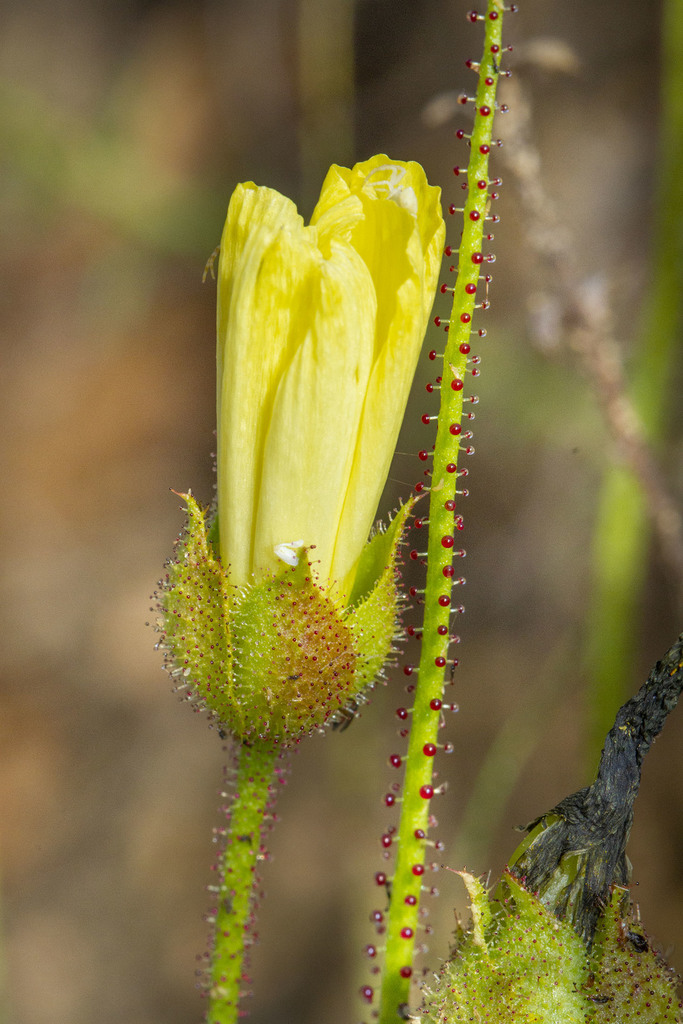
Portuguese sundew
Drosophyllum lusitanicum
Drosophyllum ( DROSS-oh-FIL-əm, rarely drə-SOF-il-əm) is a genus of carnivorous plants containing the single species Drosophyllum lusitanicum, commonly known as Portuguese sundew or dewy pine. In appearance, it is similar to the related genus Drosera (the sundews), and to the much more distantly related Byblis (the rainbow plants).
From the article Drosophyllum on Wikipedia (CC BY-SA), quoted section by section
Description
Drosophyllum lusitanicum is a perennial carnivorous plant with woody stems at the base, short, simple or rarely branched, tortuous or erect. Leaves are basal in a dense rosette, sessile, linear, sheathed, circinate, covered with sessile and pedunculated glands. The caulines are sessile, alternate, the upper bracteiform. Flowers are on top, racemiform or corymbiform and bear five 20–30 mm (0.79–1.18 in) yellow petals. The flower calyx has five lobes and is late deciduous. The plant has ten stamens and introrsal anthers. Gynoecium has five carpels. It has five styles, simple; capitate stigma. Fruit is in a unilocular capsule, and is partially divided into five locules, with irregular dehiscence by 3-5 teeth. Seeds are pear-shaped and rough, 2.5–3.0 mm (0.098–0.118 in) in diameter. The 10–20 cm (3.9–7.9 in) glandular leaves, which uncoil from a central rosette, lack the power of movement common to most sundews, but have the unusual characteristic of coiling 'outward' when immature (outward circinate vernation). Seed germination may be aided by scarification.
Range & habitat
Drosophyllum lusitanicum is native to the western Mediterranean region, through Portugal, southwest Spain and northern Morocco), and is one of the few carnivorous plants to grow in dry soil. It grows mainly in clearings of scrub (mainly heather), pine forests, evergreen forests (e.g. open cork oak) and sunny heaths. In dry places and silicon, gravel or shale substrates, somewhat disturbed. It is a strictly calcific species, from sea level up to 1,200 m (3,900 ft) in altitude.
Wikipedia: “Distribution and habitat”
What it does
The plant has a distinct sweet aroma, which attracts the insects upon which it preys. When insects land on the leaves, they find themselves stuck to the mucilage secreted by the stalked glands on the leaves. The more the insects struggle, the more ensnared they become, ultimately dying of suffocation or exhaustion. The plant then secretes enzymes which dissolve the insects and release the nutrients, which are then absorbed by the plant. The plant uses these nutrients to supplement the nutrient-poor soil in which it grows. The genus had always been assumed to be closely allied to Drosera, and was previously placed in the Droseraceae. Recent molecular and biochemical studies, however, place it in the monotypic Drosophyllaceae, as recommended by the Angiosperm Phylogeny Group, and allied with the Dioncophyllaceae (Triphyophyllum) and Ancistrocladaceae.
Wikipedia: “Ecology”
Where it lives
Recorded sightings
—
geo-referenced records in GBIF, from museums, herbaria and field observers.
Drag the globe to turn it. Dots are where records exist, not a range map; darker means more records.
In the stacks
Searching the stacks…
Every page naming Drosophyllum lusitanicum in the Biodiversity Heritage Library →
This page is assembled live from iNaturalist, GBIF, Wikipedia, the Source Library and the Internet Archive. It is not yet part of the hand-edited codex. iNaturalist taxon 123288.