- Plants
- ›Vascular Plants
- ›flowering plants
- ›Dicots
- ›magnolias, nutmegs, and allies
- ›custard-apples
- ›Annonoideae
- ›Annoneae
- ›Deeringothamnus
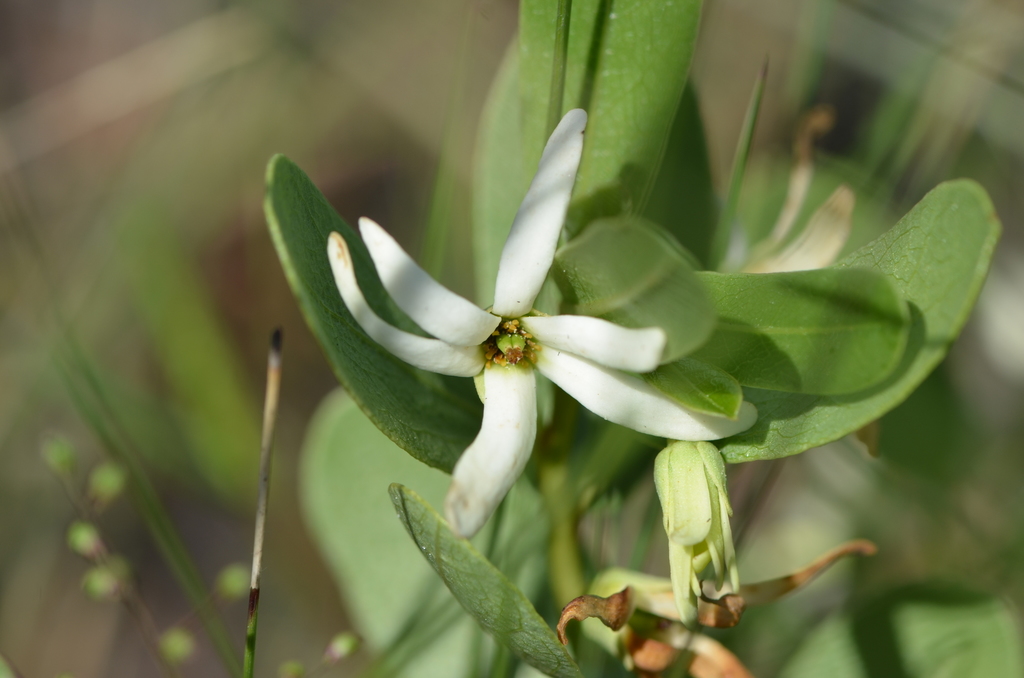
White Squirrel-banana
Deeringothamnus pulchellus
Deeringothamnus pulchellus is a rare species of flowering plant in the custard apple family known by the common names beautiful pawpaw, royal false pawpaw, and white squirrel banana. It is endemic to Florida in the United States, where there are perhaps 5000 plants remaining in severely fragmented habitat in three counties. The main threat to this species is habitat destruction and degradation. It was federally listed as an endangered species in 1986.
From the article Asimina pulchella on Wikipedia (CC BY-SA), quoted section by section
Description
This species is a small shrub growing not more than half a meter tall from a taproot. The leathery leaf blades are somewhat oval, oblong, or spatula-shaped, measuring 4 to 7 centimeters in length. The inflorescence is a solitary flower nodding or held upright on a short peduncle. The sweet-scented flowers have varying numbers of fleshy white or pink-tinged petals that measure 2 or 3 centimeters long. The sweet fragrance of the flowers in this species is caused by benzenoid compounds including veratrole, and the alcohol linalool. Its pollen is shed as permanent tetrads. The flowers are pollinated by a number of insects, including the beetle Mordella atrata and the thrips species Frankliniella bispinosa and Thrips hawaiiensis. The fruit is a large yellow-green berry that may be up to 7 centimeters long. One flower may yield several fruits. The berry contains a few seeds each about a centimeter long or slightly larger. This plant sometimes hybridizes with its relative, Asimina reticulata.
Range & habitat
It is endemic to Florida in the United States, where there are perhaps 5000 plants remaining in severely fragmented habitat spread across three counties: Charlotte, Lee, and Orange County. This plant occurs in slash pine woods on sandy substrates among other plant species, including saw palmetto, fetterbush (Lyonia lucida), shiny blueberry (Vaccinium myrsinites), dwarf live oak (Quercus minima), and tarflower (Bejaria racemosa). The Orange County occurrences are about 100 miles disjunct from the Charlotte and Lee populations.
Wikipedia: “Distribution”
Where it lives
Recorded sightings
—
geo-referenced records in GBIF, from museums, herbaria and field observers.
Drag the globe to turn it. Dots are where records exist, not a range map; darker means more records.
In the stacks
Searching the stacks…
Every page naming Deeringothamnus pulchellus in the Biodiversity Heritage Library →
This page is assembled live from iNaturalist, GBIF, Wikipedia, the Source Library and the Internet Archive. It is not yet part of the hand-edited codex. iNaturalist taxon 123474.