- Plants
- ›Vascular Plants
- ›flowering plants
- ›monocots
- ›palms, bullanocks, and allies
- ›palms
- ›Coryphoideae
- ›Cryosophileae
- ›Leucothrinax
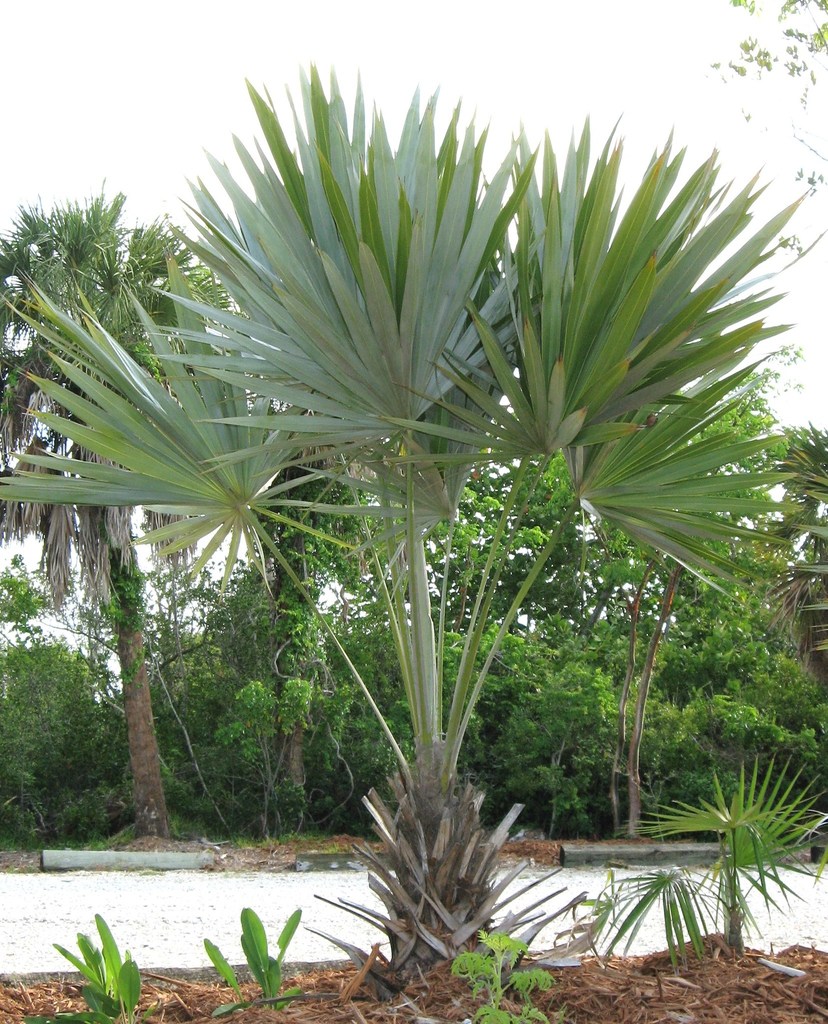
Key Thatch Palm
Leucothrinax morrisii
Leucothrinax morrisii, the Key thatch palm, is a small palm which is native to the Greater Antilles (except Jamaica), northern Lesser Antilles, The Bahamas and Florida and the Florida Keys in the United States.
Until 2008 it was known as Thrinax morrisii. It was split from the genus Thrinax after phylogenetic studies showed that its inclusion in Thrinax would render that genus paraphyletic. The generic name combines leuco (in reference to the whitish colour of its flowering stalks and the undersides of its leaves) with thrinax.
From the article Leucothrinax on Wikipedia (CC BY-SA), quoted section by section
Description
Leucothrinax morrisii is a palmate-leaved palm with solitary brown or grey stems 1–11 metres (3–36 ft) tall and 5–35 centimetres (2–14 in) in diameter. Leaves are pale blue-green or yellow-green, whitish on the undersides. Petioles are 27–84 cm (0.9–2.8 ft) long with split petioles. The leaflets are 33–75 cm (1.1–2.5 ft) long and 2.3–4.8 cm (1–2 in) wide. The inflorescences extend beyond the leaves and are 55–100 cm (1.8–3.3 ft) long. The fruit are white, and turn yellow as they mature.
Range & habitat
Leucothrinax morrisii is native to the Florida mainland and Keys, the Bahamas, Cuba, Hispaniola (in the Dominican Republic and Haiti), Puerto Rico, Navassa Island, Saint Barthélemy, both the U.S. and British Virgin Islands, and Saint Kitts and Nevis. It is found in dry, deciduous forests and scrub and coastal areas. In the Florida Keys it grows at the edge of hardwood hammocks and in pinelands, while in Puerto Rico, it is found on cliffs and on limestone and ultramafic ridges. It can tolerate drought, and frequent salt spray.
Wikipedia: “Distribution”
At the table
Stems of the plant are used for poles and the leaves are used for thatch and weaving.
== References ==
Wikipedia: “Uses”
Where it lives
Recorded sightings
—
geo-referenced records in GBIF, from museums, herbaria and field observers.
Drag the globe to turn it. Dots are where records exist, not a range map; darker means more records.
In the stacks
Searching the stacks…
Every page naming Leucothrinax morrisii in the Biodiversity Heritage Library →
This page is assembled live from iNaturalist, GBIF, Wikipedia, the Source Library and the Internet Archive. It is not yet part of the hand-edited codex. iNaturalist taxon 123479.