- Plants
- ›Vascular Plants
- ›flowering plants
- ›Dicots
- ›pinks, cactuses, and allies
- ›Old World pitcher plants
- ›Nepenthes
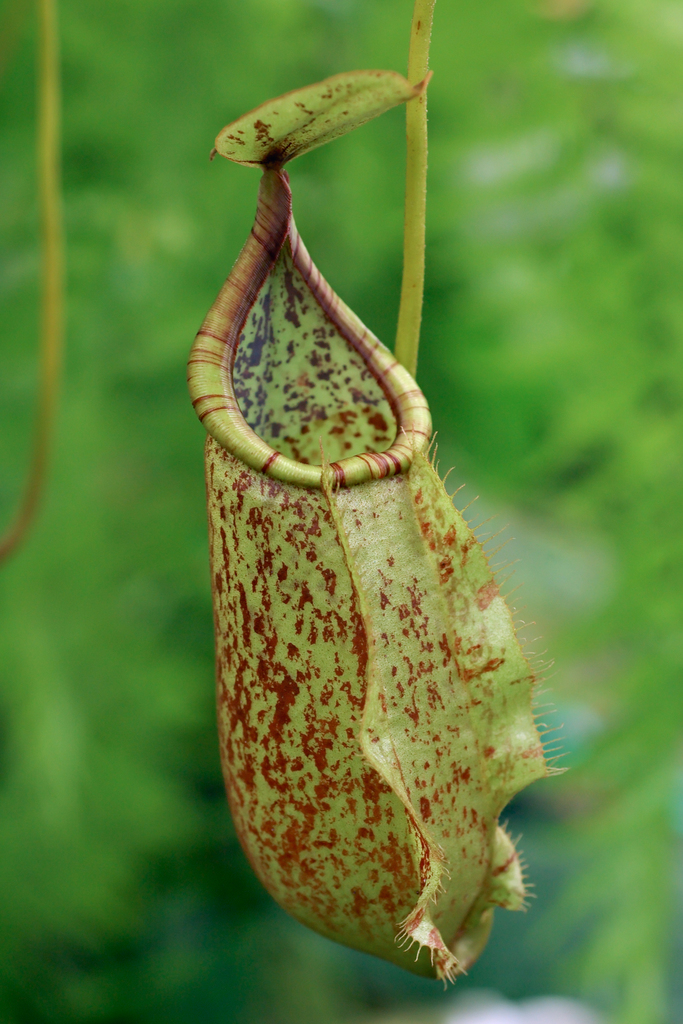
Raffles' pitcher-plant
Nepenthes rafflesiana
Nepenthes rafflesiana (/nɪˈpɛnθiːz ræˌfliːziˈɑːnə/; after Stamford Raffles), or Raffles' pitcher-plant, is a species of tropical pitcher plant. It has a very wide distribution covering Borneo, Sumatra, Peninsular Malaysia, and Singapore. Nepenthes rafflesiana is extremely variable, with numerous forms and varieties described. In Borneo alone, there are at least three distinct varieties. The giant form of this species produces enormous pitchers rivalling those of N. rajah in size.
From the article Nepenthes rafflesiana on Wikipedia (CC BY-SA), quoted section by section
Description
Nepenthes rafflesiana is a scrambling vine. The stem may climb to a height of 15 m (49 ft) and is up to 10 mm (0.4 in) thick. Internodes are up to 20 cm (7.9 in) long. Tendrils may be over 110 cm (43 in) long. The lower pitchers of N. rafflesiana are bulbous and possess well-developed fringed wings. These terrestrial traps rarely exceed 20 cm (7.9 in) in height, although the giant form of N. rafflesiana is known to produce pitchers up to 35 cm (14 in) long and 15 cm (5.9 in) wide. Upper pitchers are funnel-shaped and often bear a distinctive raised section at the front of the peristome. Both types of pitchers have a characteristically elongated peristome neck that may be 3 cm (1.2 in) or more in length. Pitcher colouration varies greatly from dark purple to almost completely white. The typical form of N. rafflesiana is light green throughout with heavy purple blotches on the lower pitchers and cream-coloured aerial pitchers. The inflorescence is a raceme and grows between 16 and 70 cm (6.3 and 27.6 in) tall. The red or purple flowers usually occur singly, or sometimes in pairs, on each flower-stalk. Young plants are wholly covered with long, caducous, brown or white hairs. Mature plants often have a sparse indumentum of short, brown hairs, though they may be completely glabrous.
Range & habitat
Nepenthes rafflesiana is a widespread lowland species. It is common in Borneo and parts of the Riau Archipelago, but has a restricted distribution in both Peninsular Malaysia and Sumatra. Nepenthes rafflesiana has only been recorded from the west coast of Sumatra, between Indrapura and Barus. It is also found in Singapore and on a number of smaller islands, including Bangka, Labuan, Natuna, and the Lingga Islands. Nepenthes rafflesiana generally occurs in open, sandy, wet areas. It has been recorded from kerangas forest, secondary formations, margins of peat swamp forest, heath forest, and seaside cliffs. It grows at elevations ranging from sea-level to 1,200 m (3,900 ft) or even 1,500 m (4,900 ft).
Wikipedia: “Distribution and habitat”
How it is grown
Nepenthes rafflesiana is very popular in cultivation; it is a lowland Nepenthes (enjoying hot, humid conditions most of the time, as found in tropical jungle lowlands) but can be grown as an intermediate, with cooler nights and less humidity. It is a comparatively hardy Nepenthes that is commonly recommended as a "first plant" to new Nepenthes growers. The plant should be grown in shaded conditions, diffuse sunlight, or in a large grow chamber under artificial lights. Watering and misting should be performed frequently, and preferably with distilled water, to avoid mineral build-up that is not only unsightly but that may damage the delicate roots of Nepenthes (and most other carnivorous plants). Standing water is inadvisable. A wet, well-draining potting medium is a necessity. Methods of feeding are varied – some growers feed freeze-dried bloodworms or Koi pellets (both available in the fish section of most pet stores); others prefer orchid mixes. No carnivorous plant should ever be fed mammalian meat – this will result not only in an unpleasant smell but also the probable rotting of the pitcher and potential death of the plant. The digestive enzymes present have not evolved to handle large prey items, and the rotting material gives opportunistic bacteria and fungi a chance to take hold.
Wikipedia: “Cultivation”
In human culture
Nepenthes rafflesiana was discovered by Dr. William Jack in 1819. In a letter from Singapore published in Curtis's Botanical Magazine, Jack wrote the following account:
It is impossible to conceive anything more beautiful than the approach to Singapore, through the Archipelago of islands that lie at the extremity of the Straits of Malacca. Seas of glass wind among innumerable islets, clothed in all the luxuriance of tropical vegetation and basking in the full brilliance of a tropical sky... I have just arrived in time to explore the woods before they yield to the axe, and have made many interesting discoveries, particularly of two new and splendid species of pitcher-plant [Nepenthes rafflesiana and Nepenthes ampullaria], far surpassing any yet known in Europe. I have completed two perfect drawings of them with ample descriptions. Sir S. Raffles is anxious that we should give publicity to our researches in one way or other and has planned bringing out something at Bencoolen. He proposes sending home these pitcher-plants that such splendid things may appear under all the advantages of elegant execution, by way of attracting attention to the subject of Sumatran botany. At the time the largest known species in the genus, N. …
Wikipedia: “Discovery and early history”
Where it lives
Recorded sightings
—
geo-referenced records in GBIF, from museums, herbaria and field observers.
Drag the globe to turn it. Dots are where records exist, not a range map; darker means more records.
In the stacks
Searching the stacks…
Every page naming Nepenthes rafflesiana in the Biodiversity Heritage Library →
This page is assembled live from iNaturalist, GBIF, Wikipedia, the Source Library and the Internet Archive. It is not yet part of the hand-edited codex. iNaturalist taxon 123555.