- Fungi Including Lichens
- ›Ascomycete Fungi
- ›budding yeasts
- ›budding yeasts
- ›Budding Yeasts
- ›Debaryomycetaceae
- ›Meyerozyma
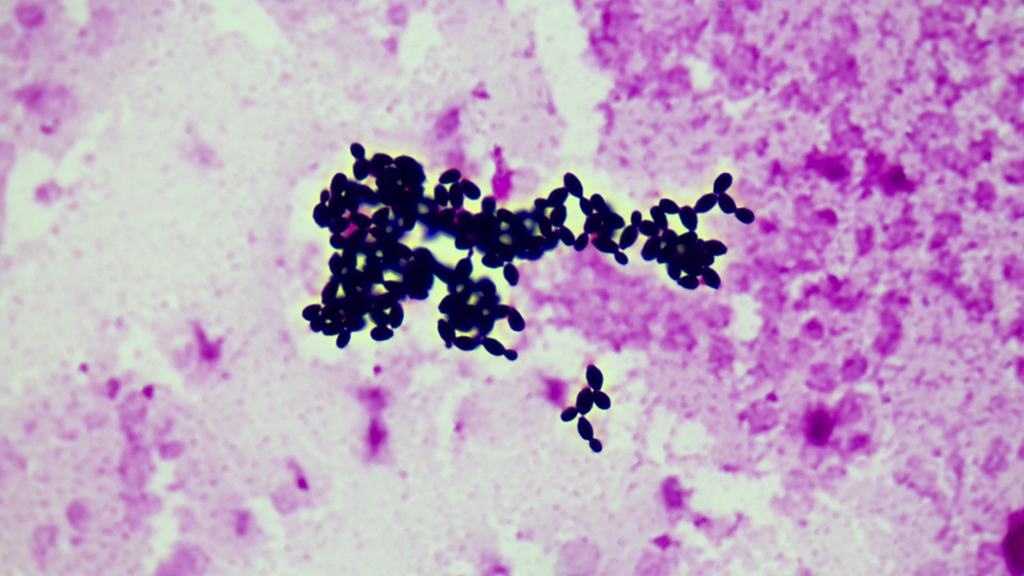
Meyerozyma guilliermondii
Meyerozyma guilliermondii (formerly known as Pichia guilliermondii until its rename in 2010) is a species of yeast of the genus Meyerozyma whose asexual or anamorphic form is known as Candida guilliermondii.
Candida guilliermondii has been isolated from numerous human infections, mostly of cutaneous origin, if only from immunosuppressed patients. C. guilliermondii has also been isolated from normal skin and in seawater, feces of animals, fig wasps, buttermilk, leather, fish, and beer.
From the article Meyerozyma guilliermondii on Wikipedia (CC BY-SA), quoted section by section
Description
Candida guilliermondii colonies are flat, moist, smooth, and cream to yellow in color on Sabouraud dextrose agar. It does not grow on the surface when inoculated into Sabouraud broth. When grown on cornmeal-Tween 80 agar at 25 °C for 72 hours, C. guillermondii produces clusters of small blastospores along its pseudohyphae, especially at septal points. Pseudohyphae are short and few in number.
Wikipedia: “Morphology”
Where it lives
Recorded sightings
—
geo-referenced records in GBIF, from museums, herbaria and field observers.
Drag the globe to turn it. Dots are where records exist, not a range map; darker means more records.
In the stacks
Searching the stacks…
Every page naming Meyerozyma guilliermondii in the Biodiversity Heritage Library →
This page is assembled live from iNaturalist, GBIF, Wikipedia, the Source Library and the Internet Archive. It is not yet part of the hand-edited codex. iNaturalist taxon 1237453.