- Fungi Including Lichens
- ›Basidiomycete Fungi
- ›Higher Basidiomycetes
- ›Mushrooms, Bracket Fungi, Puffballs, and Allies
- ›Shelf Fungi
- ›Bracket Fungi
- ›Daedaleopsis
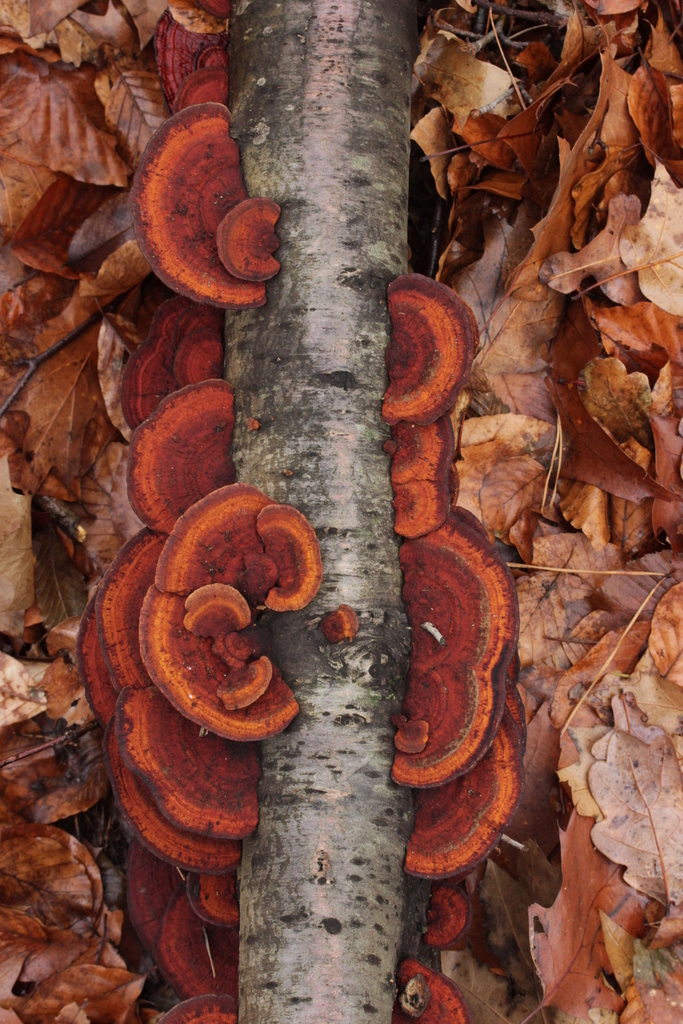
Thin-walled Maze Polypore
Daedaleopsis confragosa
Daedaleopsis confragosa, commonly known as the thin-walled maze polypore or the blushing bracket, is a species of polypore fungus in the family Polyporaceae. The species was first described from Europe in 1791 as a form of Boletus, and has undergone several changes of genus in its taxonomic history. It acquired its current name when Joseph Schröter transferred it to Daedaleopsis in 1888.
A plant pathogen, it causes a white rot of injured hardwoods, especially willows. The fruit bodies are semicircular and tough, have a concentrically zoned brownish upper surface, and measure up to 20 cm (8 in) in diameter. The whitish underside turns gray-brown as the fruit body ages, but bruises pink or red. It is found all year and is common in northern temperate woodlands of Eurasia and eastern North America.
From the article Daedaleopsis confragosa on Wikipedia (CC BY-SA), quoted section by section
Description
The shelflike or bracketlike fruit body is fan-shaped to semicircular, and typically measures 5–15 cm (2–6 in) in diameter, and up to 2 cm (0.8 in) thick. Its upper surface is broadly convex to flat, dry, smooth to somewhat hairy, and usually has concentric zone lines. Its color ranges from reddish brown to brown to grayish, sometimes becoming blackish in maturity. The cap surface may have an umbo at the point of attachment to the substrate. Fruit bodies are leathery to corky when moist, but become hard and rigid when dry. The flesh is white to pinkish to brownish and tough. The underside of the fruit bodies features tiny pores measuring about 0.5–1.5 mm in diameter. They are white to tan to brown, but will develop pinkish or reddish tones if bruised. Pore shape is highly variable, ranging from circular to elongated, to mazelike, to gill-like. The tubes are up to 1.5 cm (0.6 in) long. The fruit body lacks a stalk, as the shelf attaches directly to the substrate. The fruit bodies have no distinctive odor and a slightly bitter taste. The spore print is white; spores are cylindrical, smooth, and measure 7–11 by 2–3 μm. The basidia (spore-bearing cells) have a shape ranging from cylindrical to club-shaped, and dimensions of 20–40 by 3–5 μm. The hymenium features numerous hyphidia (modified terminal hyphae), which measure 2–3 μm. …
Range & habitat
Daedaleopsis confragosa is a lignicolous fungus that produces a decay of sapwood. It causes white rot, a type of wood decay in which lignin is degraded and cellulose remains as a light-colored residue. The fruit bodies grow singly or in groups, sometimes in tiers, in the wounds of living trees. Its preferred host is willow, but it has also been found on birch and other hardwoods. Fruiting usually occurs from June to December, but the hard shelves can persist year-round. In North America, the species is most common in eastern locales, but rare in western regions. It is common in Europe, and is one of the 100 most common fungi in the United Kingdom. Its European range extends east to the Urals. In Asia it is widely distributed, having been recorded from China, western Maharashtra (India), Iran, and Japan. The fruit bodies are popular among fungus-loving beetles. In a Russian study, 54 species from 16 families in the Coleoptera complex were recorded using the fungus; the most common were Cis comptus, Sillcacis affinis (Ciidae), Tritoma subbasalis, Dacne bipustulata (Erotylidae), Mycetophagus multipunctatus, M. piceus (Mycetophagidae), and Thymalus oblongus (Trogossitidae).
Wikipedia: “Ecology and distribution”
At the table
The polypore is used in ornamental paper making, whereby the fruit bodies are pulped, pressed, and dried to produce sheets with unusual textures and colors. It is inedible.
== References ==
Wikipedia: “Uses”
Where it lives
Recorded sightings
—
geo-referenced records in GBIF, from museums, herbaria and field observers.
Drag the globe to turn it. Dots are where records exist, not a range map; darker means more records.
In the stacks
Searching the stacks…
Every page naming Daedaleopsis confragosa in the Biodiversity Heritage Library →
This page is assembled live from iNaturalist, GBIF, Wikipedia, the Source Library and the Internet Archive. It is not yet part of the hand-edited codex. iNaturalist taxon 124102.