- Plants
- ›Vascular Plants
- ›flowering plants
- ›Dicots
- ›Sunflowers, Bellflowers, Fanflowers, and Allies
- ›fanflower family
- ›Scaevola
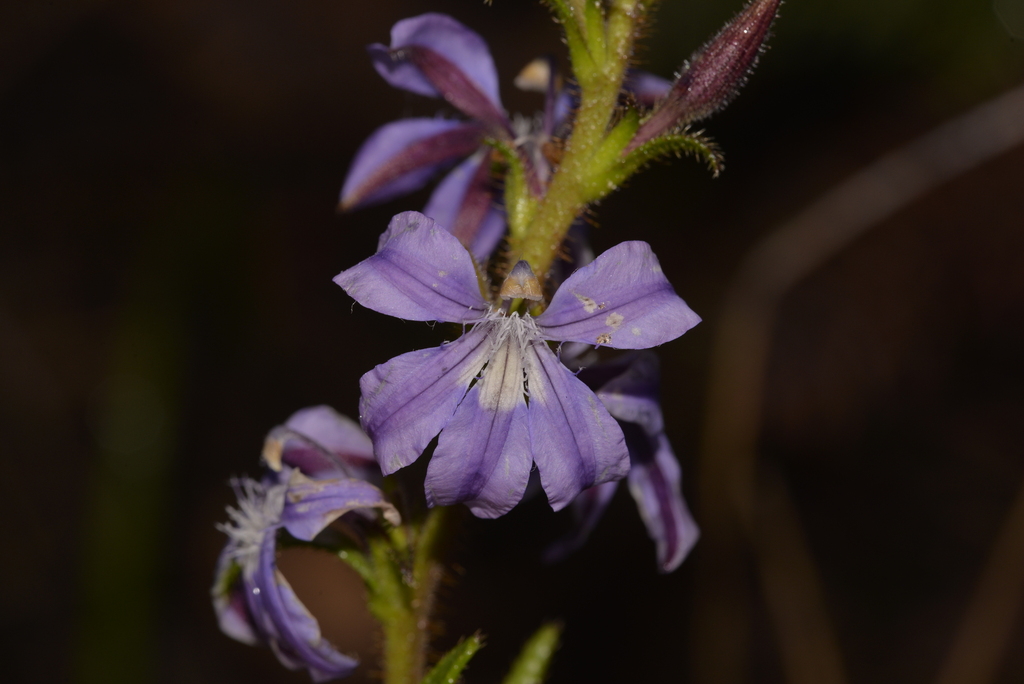
viscid hand-flower
Scaevola glandulifera
Scaevola glandulifera, the viscid hand-flower, is a shrub in the family Goodeniaceae, endemic to Western Australia.
From the article Scaevola glandulifera on Wikipedia (CC BY-SA), quoted section by section
Description
Scaevola glandulifera is an erect shrub which grows to a height of 50 cm. The stems are not ribbed. The leaves are stalkless, sometimes smooth edged, sometimes toothed, with a leaf blade which is 2-9 cm long and 1-10 mm wide. The flowers occur in terminal spikes. The corolla is 10-30 mm long, and has short hairs both simple and glandular with occasionally longer, stiff, yellow hairs on the outside. It is bearded inside and a deep blue-purple colour. The ovary has two locules. The cup which holds the style (indusium) is 1.5-3 mm wide, and hairy on both the inner and outer surfaces. The fruit is obovoid and up to 4 mm long and can be with or without a hairy surface. It flowers from August to December, January.
Range & habitat
In Western AustraliaScaevola glandulifera is found in the IBRA bioregions of Geraldton Sandplains, Swan Coastal Plain, Avon Wheatbelt, Jarrah Forest, Warren and Esperance Plains (or in the South West Botanical Province.
Wikipedia: “Distribution & habitat”
In human culture
The genus name, Scaevola, is Latin, a diminutive of scaeva, the left-handed, referring to the left-handed Roman, Gaius Mucius Scaevola, made famous by Livy, the flower being so like a hand. The specific epithet, glandulifera, comes from the Latin, glandula (gland) and ferre (carry/bear), giving "gland-bearing".
Wikipedia: “Etymology”
Where it lives
Recorded sightings
—
geo-referenced records in GBIF, from museums, herbaria and field observers.
Drag the globe to turn it. Dots are where records exist, not a range map; darker means more records.
In the stacks
Searching the stacks…
Every page naming Scaevola glandulifera in the Biodiversity Heritage Library →
This page is assembled live from iNaturalist, GBIF, Wikipedia, the Source Library and the Internet Archive. It is not yet part of the hand-edited codex. iNaturalist taxon 1242476.