- Plants
- ›Vascular Plants
- ›flowering plants
- ›Dicots
- ›Legumes, Milkworts, and Allies
- ›Legumes
- ›Faboideae
- ›Mirbelieae
- ›Pultenaea
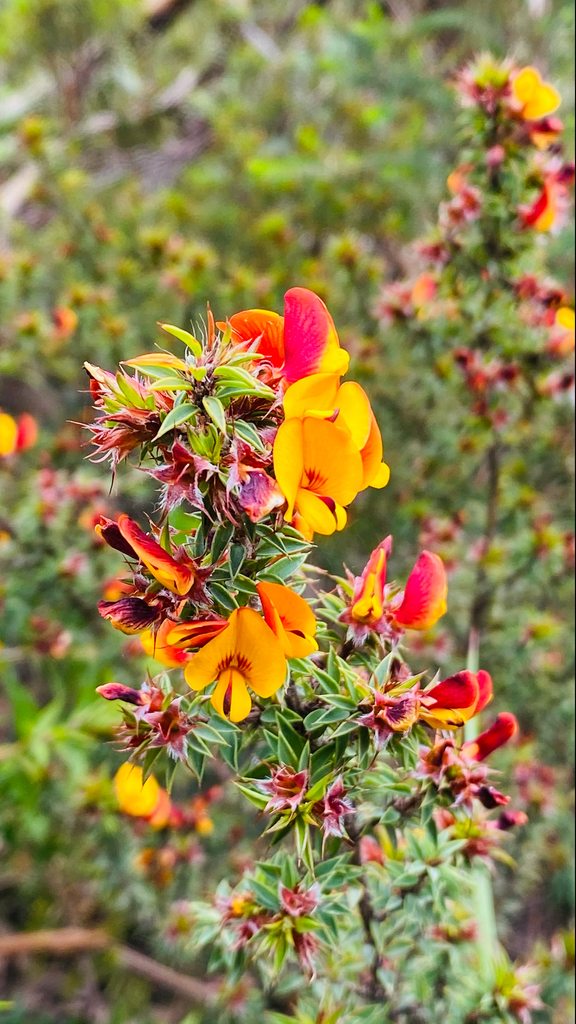
ribbed bush-pea
Pultenaea costata
Pultenaea costata, commonly known as ribbed bush-pea, is a species of flowering plant in the family Fabaceae and is endemic to the Grampians National Park in Victoria. It is a spreading shrub with egg-shaped to lance-shaped leaves, and dense clusters of pea-like flowers.
From the article Pultenaea costata on Wikipedia (CC BY-SA), quoted section by section
Description
Pultenaea costata is a spreading shrub that typically grows to a height of up to 1 m (3 ft 3 in) and has stems that are hairy when young. The leaves are egg-shaped to lance-shaped, 7–15 mm (0.28–0.59 in) long and 2–5 mm (0.079–0.197 in) wide tapering to a sharp, down-curved point and with dark brown stipules about 7 mm (0.28 in) long at the base. The flowers are arranged in dense clusters of five to eight surrounded by bracts about 8 mm (0.31 in) long with two points on the tip. Bracteoles about 8 mm (0.31 in) long are attached to the base of the sepal tube. The sepals are about 9 mm (0.35 in) long and joined at the base, the lobes hairy. The standard petal is 13–15 mm (0.51–0.59 in) wide and the ovary is covered with long hairs. The fruit is a pod surrounded by the remains of the sepals.
Range & habitat
This pultenaea grows on the higher parts of the northern ranges of the Grampians in central western Victoria.
== References ==
Wikipedia: “Distribution and habitat”
Where it lives
Recorded sightings
—
geo-referenced records in GBIF, from museums, herbaria and field observers.
Drag the globe to turn it. Dots are where records exist, not a range map; darker means more records.
In the stacks
Searching the stacks…
Every page naming Pultenaea costata in the Biodiversity Heritage Library →
This page is assembled live from iNaturalist, GBIF, Wikipedia, the Source Library and the Internet Archive. It is not yet part of the hand-edited codex. iNaturalist taxon 1243917.