- Plants
- ›Vascular Plants
- ›flowering plants
- ›Dicots
- ›Legumes, Milkworts, and Allies
- ›Legumes
- ›Faboideae
- ›Mirbelieae
- ›Eutaxia
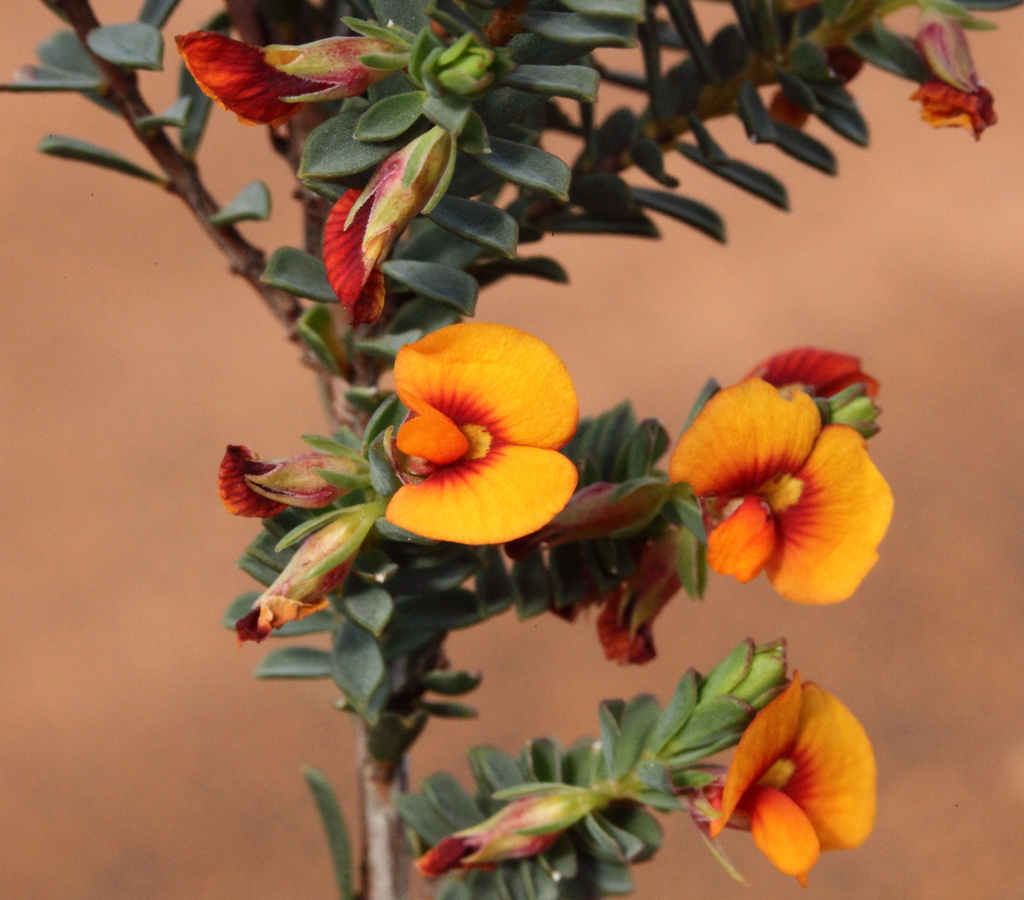
Eutaxia parvifolia
Eutaxia parvifolia is a species of flowering plant in the family Fabaceae and is endemic to southwestern Western Australia. It is a shrub with reddish brown stems, elliptic to egg-shaped leaves with the narrower end towards the base, and mostly yellow, red or orange flowers, with yellow red or orange markings.
From the article Eutaxia parvifolia on Wikipedia (CC BY-SA), quoted section by section
Description
Eutaxia parvifolia is an erect or prostrate, spindly, densely branched shrub that typically grows to a height of 0.2–2 m (7.9 in – 6 ft 6.7 in) and has reddish-brown, glabrous stems. The leaves are arranged in opposite pairs, elliptic to egg-shaped with the narrower end towards the base, 2.5–17 mm (0.098–0.669 in) long and 1–3 mm (0.039–0.118 in) wide on a petiole 1–3 mm (0.039–0.118 in) long. The flowers are arranged singly in leaf axils, often crowded near the ends of branchlets, each flower on a pedicel 1–2.4 mm (0.039–0.094 in) long. The sepals are ribbed and hairy, 4.5–7 mm (0.18–0.28 in) long and fused at the base. The petals are mostly yellow, red or orange with yellow, red or orange spots, streaks or blotches. The upright "standard" petal is 7.5–9 mm (0.30–0.35 in) long, the two "wing" petals 5.5–7.8 mm (0.22–0.31 in) long and the "keel" enclosing the stamens is 5–5.7 mm (0.20–0.22 in) long. Flowering occurs from August to December and the fruit is 4.5–7 mm (0.18–0.28 in) long and 2–3.5 mm (0.079–0.138 in) wide'
Range & habitat
This eutaxia grows in heath and woodland between Bolgart, Albany and the Cape Arid National Park.
Wikipedia: “Distribution and habitat”
Where it lives
Recorded sightings
—
geo-referenced records in GBIF, from museums, herbaria and field observers.
Drag the globe to turn it. Dots are where records exist, not a range map; darker means more records.
In the stacks
Searching the stacks…
Every page naming Eutaxia parvifolia in the Biodiversity Heritage Library →
This page is assembled live from iNaturalist, GBIF, Wikipedia, the Source Library and the Internet Archive. It is not yet part of the hand-edited codex. iNaturalist taxon 1244006.