- Plants
- ›Vascular Plants
- ›flowering plants
- ›Dicots
- ›Heathers, Balsams, Primroses, and Allies
- ›persimmon family
- ›Diospyros
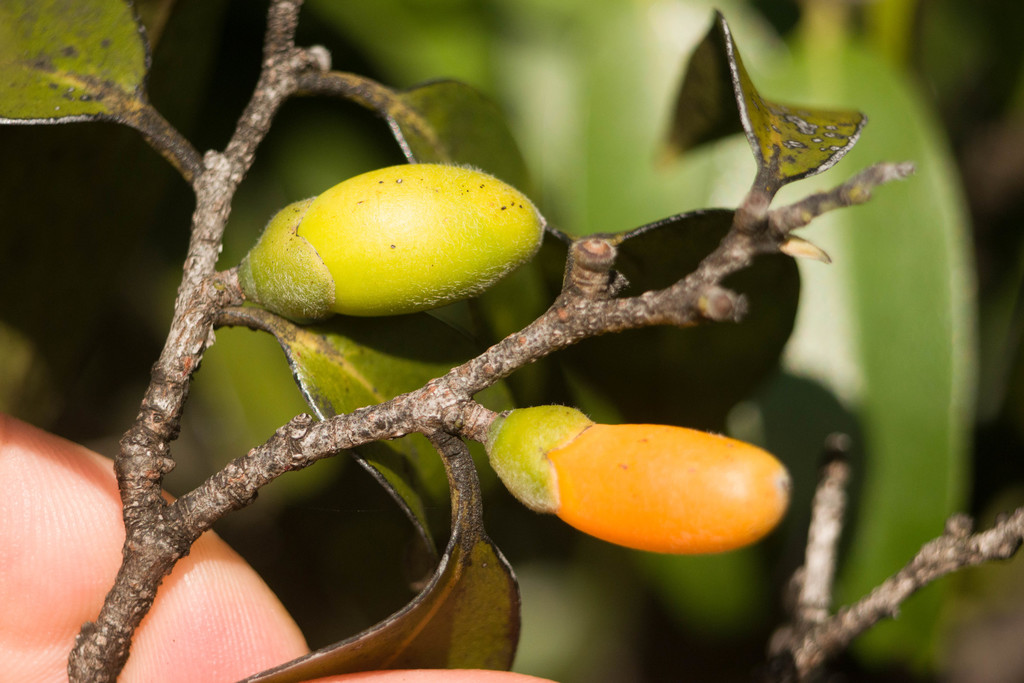
Lama
Diospyros sandwicensis
Diospyros sandwicensis is a species of flowering tree in the ebony family, Ebenaceae, that is endemic to Hawaii. It belongs to the same genus as both persimmons and ebony. Its common name, lama, also means enlightenment in Hawaiian. Lama is a small to medium-sized tree, with a height of 6–12 m (20–39 ft) and a trunk diameter of 0.3 m (0.98 ft). It can be found in dry, coastal mesic, mixed mesic, and wet forests at elevations of 5–1,220 m (16–4,003 ft) on all major islands. Lama and olopua (Nestegis sandwicensis) are dominant species in lowland dry forests on the islands of Maui, Molokaʻi, Kahoʻolawe, and Lānaʻi.
From the article Diospyros sandwicensis on Wikipedia (CC BY-SA), quoted section by section
At the table
The sapwood of lama is very white and forms a wide band inside the trunk. The heartwood is reddish-brown, fine-textured, straight-grained, and extremely hard. Native Hawaiians made aukā (upright supports) out of lama wood, which were used in hīnaʻi (basket fish trap) construction. The white sapwood represented enlightenment, and thus had many religious uses. The pou (posts), ʻaho (thatching sticks) and oʻa (rafters) of a special building called a hale lau lama were made of the sapwood. A pā lama is a fenced enclosure made from lama sapwood. A block of the sapwood, covered in a yellow kapa and scented with ʻōlena (Curcuma longa), was placed on the kuahu (altar) inside of a hālau hula (building in which hula was performed). This block represented Laka, goddess of hula. Lama wood was also used to carve kiʻi ('religious images'). The piʻoi (berries) are edible.
Wikipedia: “Uses”
Where it lives
Recorded sightings
—
geo-referenced records in GBIF, from museums, herbaria and field observers.
Drag the globe to turn it. Dots are where records exist, not a range map; darker means more records.
In the old herbals & bestiaries

François Le Vaillant — Histoire naturelle des promerops et des guêpiers (1807)
François Le Vaillant · 1807 · p.383

Wonders of Creatures
Anonymous · 1500 · p.172

Margarita philosophica
Reisch, Gregorius · 1504 · p.433

Commentaries on the Six Books of Pedanius Dioscorides on Medical Matter
Pietro Andrea Mattioli · 1565 · p.531

Compendium of Materia Medica: Illustrated Volume, Middle of the Lower Part
李時珍 · 1596 · p.91

The Tudor Pattern Book (Herbal-Bestiary)
Anonymous · 1525 · p.85

History of Animals, Book I: On Viviparous Quadrupeds
Conrad Gessner · 1554 · p.151

Garden of Health
Jacob Meydenbach · 1491 · p.584

Garden of Health
Jacob Meydenbach · 1491 · p.583

Garden of Health (Hortus Sanitatis)
Jacob Meydenbach · 1491 · p.536

Ortus sanitatis
1491 · p.586

Commentaries on the Six Books of Dioscorides on Medical Matter
Pietro Andrea Mattioli · 1563 · p.325
In the stacks
Searching the stacks…
Every page naming Diospyros sandwicensis in the Biodiversity Heritage Library →
This page is assembled live from iNaturalist, GBIF, Wikipedia, the Source Library and the Internet Archive. It is not yet part of the hand-edited codex. iNaturalist taxon 124448.