- Fungi Including Lichens
- ›Basidiomycete Fungi
- ›Higher Basidiomycetes
- ›Mushrooms, Bracket Fungi, Puffballs, and Allies
- ›Lepidostromatales
- ›Club Lichens
- ›Sulzbacheromyces
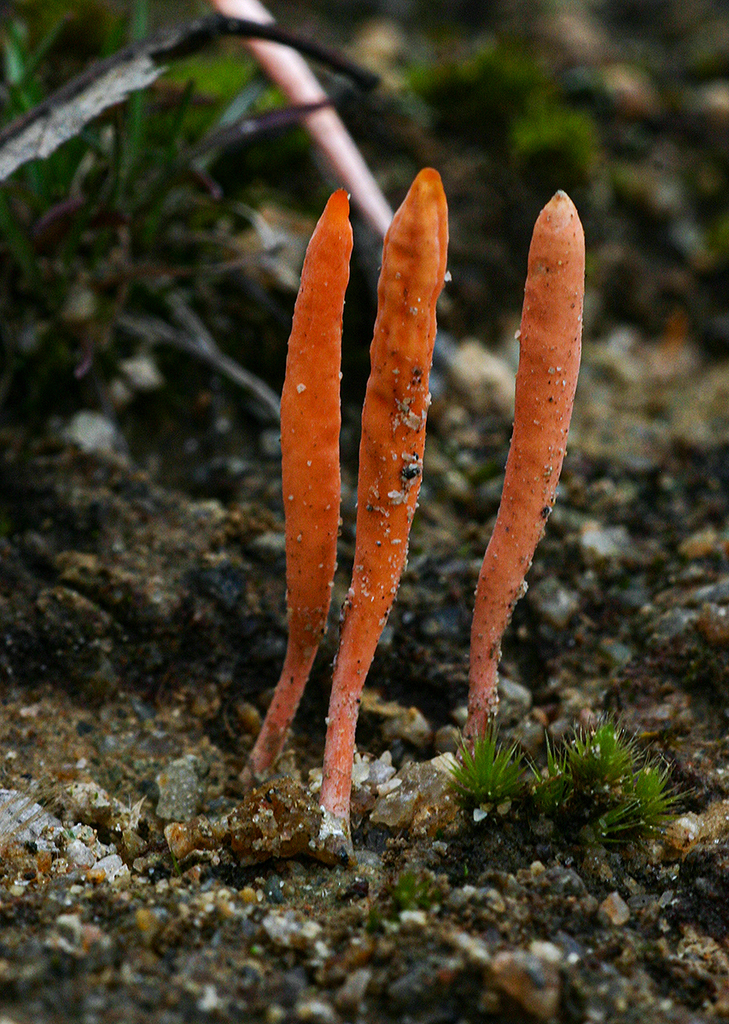
Spicular Clublichen
Sulzbacheromyces miomboensis
Sulzbacheromyces miomboensis is a species of basidiolichen in the family Lepidostromataceae. Found in the Democratic Republic of the Congo, as was described as new to science in 2017.
From the article Sulzbacheromyces miomboensis on Wikipedia (CC BY-SA), quoted section by section
Description
The organism forms a thin, barely noticeable crust containing single-celled green algae that have multiple chloroplasts and a large oil-containing body. Its most distinctive features are the upright fruiting bodies, which are club-shaped—narrow at the base and widening towards the tip. These structures reach 2–4.2 cm in height and are deep orange to reddish-orange in colour, except for their whitish-orange base. When dried, they become pale orange or orange-white, often with a pinkish tinge. The fruiting bodies have shallow lengthwise grooves and are hollow when mature. Under the microscope, they show a complex internal structure of fungal threads (hyphae) arranged in distinct layers, producing transparent, elongated spores.
Range & habitat
Sulzbacheromyces miomboensis is currently known only from the Haut-Katanga Province of the DRC, where it is common in its preferred habitat. The species appears in areas with a strongly seasonal climate, characterised by a dry season from May to September/October and a rainy season from November to April, during which rainfall averages 1,240 mm per year. The fruiting bodies emerge halfway through the rainy season, growing on compacted, iron-rich soil, often along dirt roads. These sites are typically very exposed to sun, hot, and have little other vegetation. When conditions are suitable, hundreds of fruiting bodies can appear together, covering several square metres.
== References ==
Wikipedia: “Habitat and distribution”
Where it lives
Recorded sightings
—
geo-referenced records in GBIF, from museums, herbaria and field observers.
Drag the globe to turn it. Dots are where records exist, not a range map; darker means more records.
In the stacks
This page is assembled live from iNaturalist, GBIF, Wikipedia, the Source Library and the Internet Archive. It is not yet part of the hand-edited codex. iNaturalist taxon 1245658.