- Plants
- ›Vascular Plants
- ›flowering plants
- ›Dicots
- ›saxifrages, stonecrops, and allies
- ›peony family
- ›Paeonia
- ›Moutan
- ›Moutan
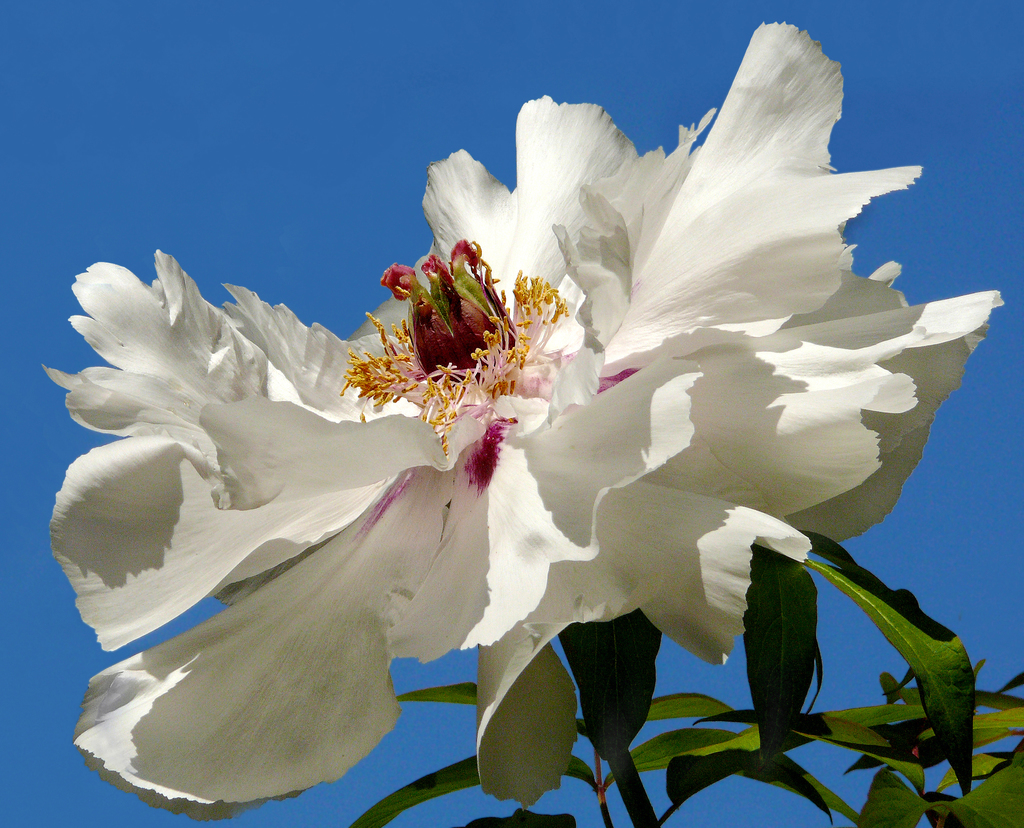
tree peony
Paeonia × suffruticosa
Paeonia × suffruticosa is a group of tree peony cultivars that are the result of hybridization with peony species exclusively belonging to the subsection Vaginatae. The common name used in China is mǔdān (Chinese: 牡丹) or Moutan peony. Cultivars of this group have been cultivated in Chinese floriculture for millennia, initially only as a source of traditional Chinese medicine, particularly for the skin of their roots (牡丹皮; mǔdān pí). Already early on, the plant was also cultivated for its ornamental value, and it is highly revered in Chinese culture.
Paeonia × suffruticosa is a perennial deciduous shrub with stems up to 2 m (6 ft 7 in); the branches are short and thick. leaves are usually green, pale green, sometimes white, about 5–11 cm (2.0–4.3 in) long. Flowers have petals of reddish purple, pink to white. Flowering occurs in May; fruiting in June.
From the article Paeonia × suffruticosa on Wikipedia (CC BY-SA), quoted section by section
In medicine
Paeonia × suffruticosa has a long history of being used in Chinese medicine. There are more than 1000 Chinese tree peony cultivars with various flower colors and flower forms that have been selected artificially for medicinal uses for more than 2000 years. The root bark, often referred to as Mu Dan Pi or Cortex Moutan, is the main part that is used in Chinese medicine. Mu Dan Pi's main functions include reducing heat, cooling the blood, improving liver function, and mildly invigorating the blood. Mu Dan Pi of the best quality should be very fragrant, thick, white and starchy. The flower is now mostly cultivated for medicinal uses. Due to over-harvesting, the wild plant is threatened with extinction.
Wikipedia: “As medicine”
How it is grown
In order to propagate the bush, the seeds are collected in June when the seed pods split. They are air-dried for a few days and then stored in moist soil before planting out during autumn. If the pods are fully dried out, it is more difficult for the seeds to sprout. Seeds that are harvested late or allowed to dry completely will not produce roots until the following spring, and then do not send up shoots for another year. Ideally, the plant should be planted in fertile, humus-rich soil with plenty of organic matter (in USDA zones 3 to 8). Paeonia × suffruticosa grows in both full sun to dappled shade. However, the plant blooms best in dappled shade with 3 to 4 hours of sunlight. When grown in full sun, it is essential to provide adequate moisture to the plant. Generally, the tree requires very little pruning, but it is necessary to cut off dead branches, and to cut off any sprouts that are suckers from the herbaceous root stock. Potential cultivating diseases include Ca. Phytoplasma solani, the causal agent of the Black wood disease of grapevine. This is associated with tree peony yellowing disease in China.
Wikipedia: “Cultivation”
In human culture
The name Paeonia × suffruticosa is derived from two different sources. The genus name Paeonia derives from the name Paeon. In Greek mythology, Paeon was a disciple of the god of medicine, Asclepius. The species name "suffruticosa" is composed of two parts. The first part "suf-" is only a prefix; the second part "fruticosa", means shrub-like.
Wikipedia: “Etymology of scientific name”
Where it lives
Recorded sightings
—
geo-referenced records in GBIF, from museums, herbaria and field observers.
Drag the globe to turn it. Dots are where records exist, not a range map; darker means more records.
In the stacks
Searching the stacks…
Every page naming Paeonia × suffruticosa in the Biodiversity Heritage Library →
This page is assembled live from iNaturalist, GBIF, Wikipedia, the Source Library and the Internet Archive. It is not yet part of the hand-edited codex. iNaturalist taxon 125432.